HealthFreePrintable

Teen Mental Health Strategies

A free health worksheet ready for your classroom. Open in Kuraplan to grab the print-ready PDF, customize it for your students, or generate a fresh version in seconds.
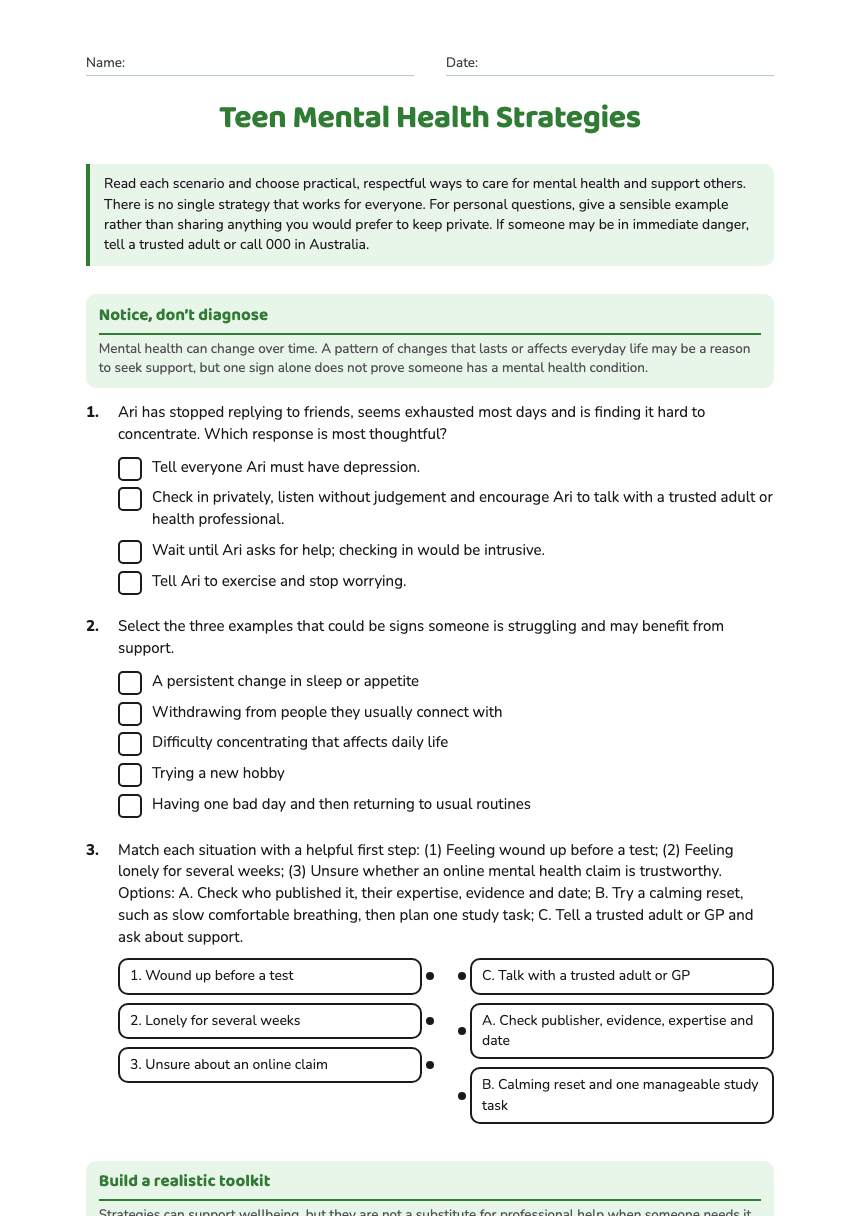
Teen Mental Health Strategies worksheet preview
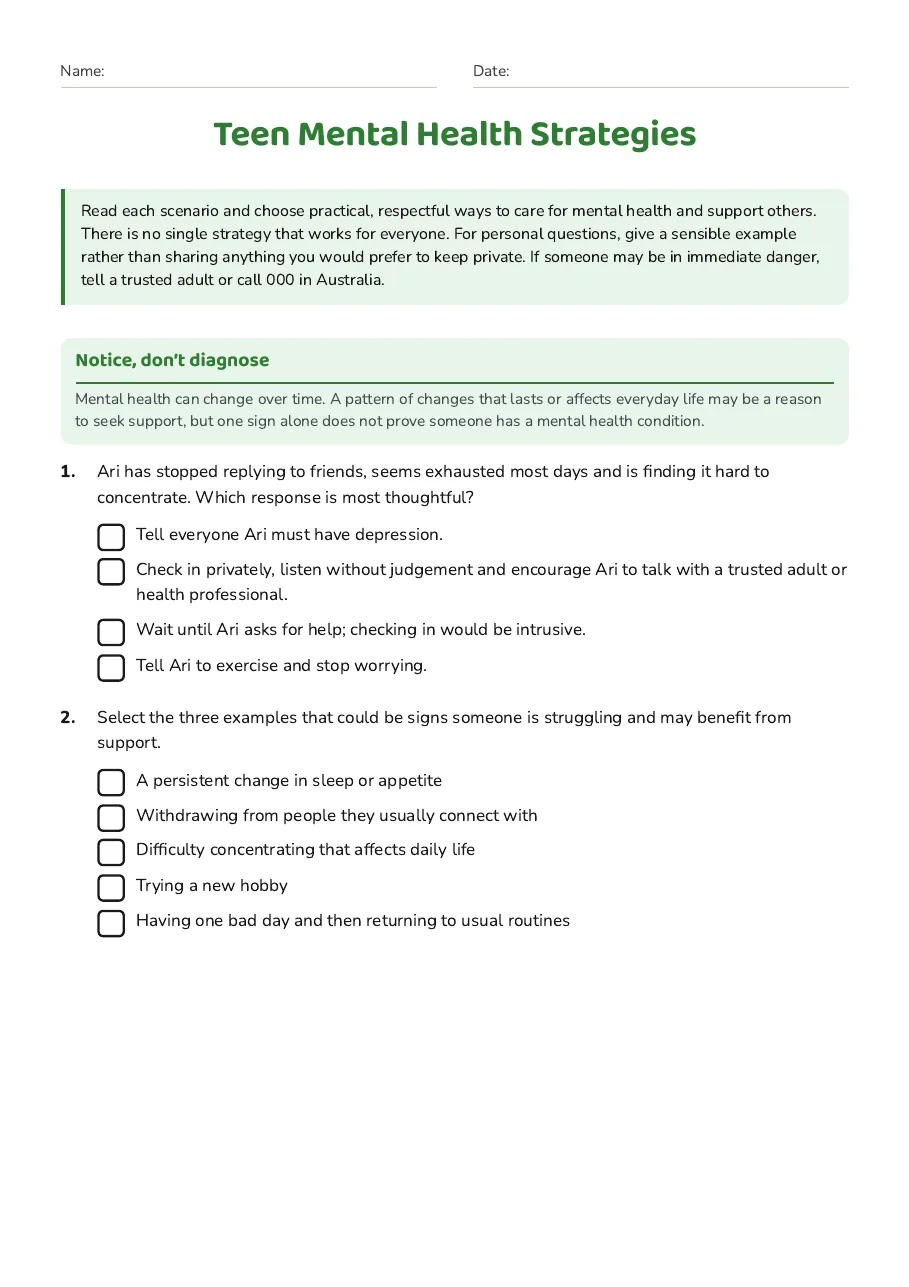
Name:Date:

Teen Mental Health Strategies

Read each scenario and choose practical, respectful ways to care for mental health and support others. There is no single strategy that works for everyone. For personal questions, give a sensible example rather than sharing anything you would prefer to keep private. If someone may be in immediate danger, tell a trusted adult or call 000 in Australia.

Notice, don’t diagnose

Mental health can change over time. A pattern of changes that lasts or affects everyday life may be a reason to seek support, but one sign alone does not prove someone has a mental health condition.

1.Ari has stopped replying to friends, seems exhausted most days and is finding it hard to concentrate. Which response is most thoughtful?
  • Tell everyone Ari must have depression.
  • Check in privately, listen without judgement and encourage Ari to talk with a trusted adult or health professional.
  • Wait until Ari asks for help; checking in would be intrusive.
  • Tell Ari to exercise and stop worrying.
2.Select the three examples that could be signs someone is struggling and may benefit from support.
  • A persistent change in sleep or appetite
  • Withdrawing from people they usually connect with
  • Difficulty concentrating that affects daily life
  • Trying a new hobby
  • Having one bad day and then returning to usual routines
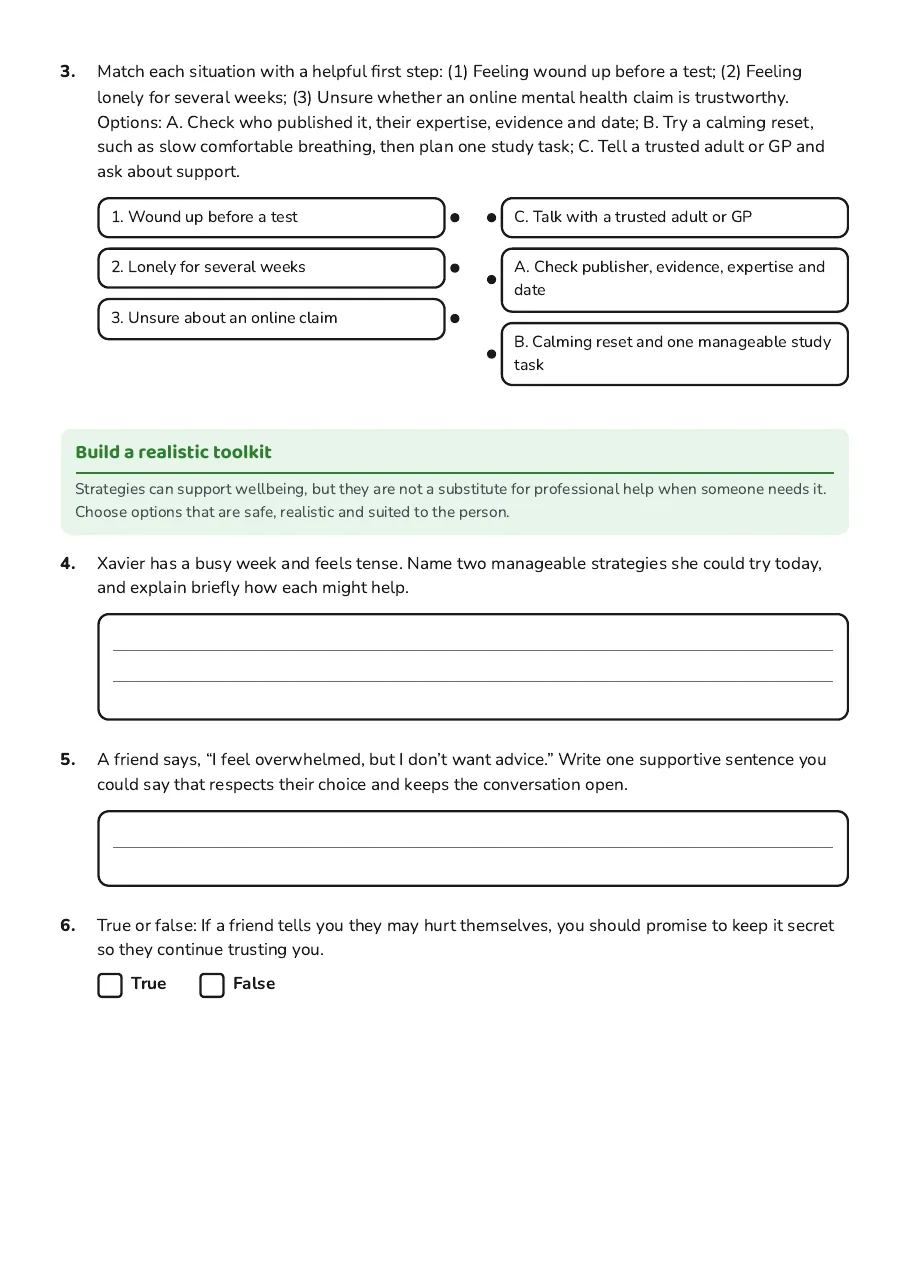
3.Match each situation with a helpful first step: (1) Feeling wound up before a test; (2) Feeling lonely for several weeks; (3) Unsure whether an online mental health claim is trustworthy. Options: A. Check who published it, their expertise, evidence and date; B. Try a calming reset, such as slow comfortable breathing, then plan one study task; C. Tell a trusted adult or GP and ask about support.
  • 1. Wound up before a test
  • 2. Lonely for several weeks
  • 3. Unsure about an online claim
  • C. Talk with a trusted adult or GP
  • A. Check publisher, evidence, expertise and date
  • B. Calming reset and one manageable study task

Build a realistic toolkit

Strategies can support wellbeing, but they are not a substitute for professional help when someone needs it. Choose options that are safe, realistic and suited to the person.

4.Xavier has a busy week and feels tense. Name two manageable strategies she could try today, and explain briefly how each might help.
5.A friend says, “I feel overwhelmed, but I don’t want advice.” Write one supportive sentence you could say that respects their choice and keeps the conversation open.
6.True or false: If a friend tells you they may hurt themselves, you should promise to keep it secret so they continue trusting you.
TrueFalse

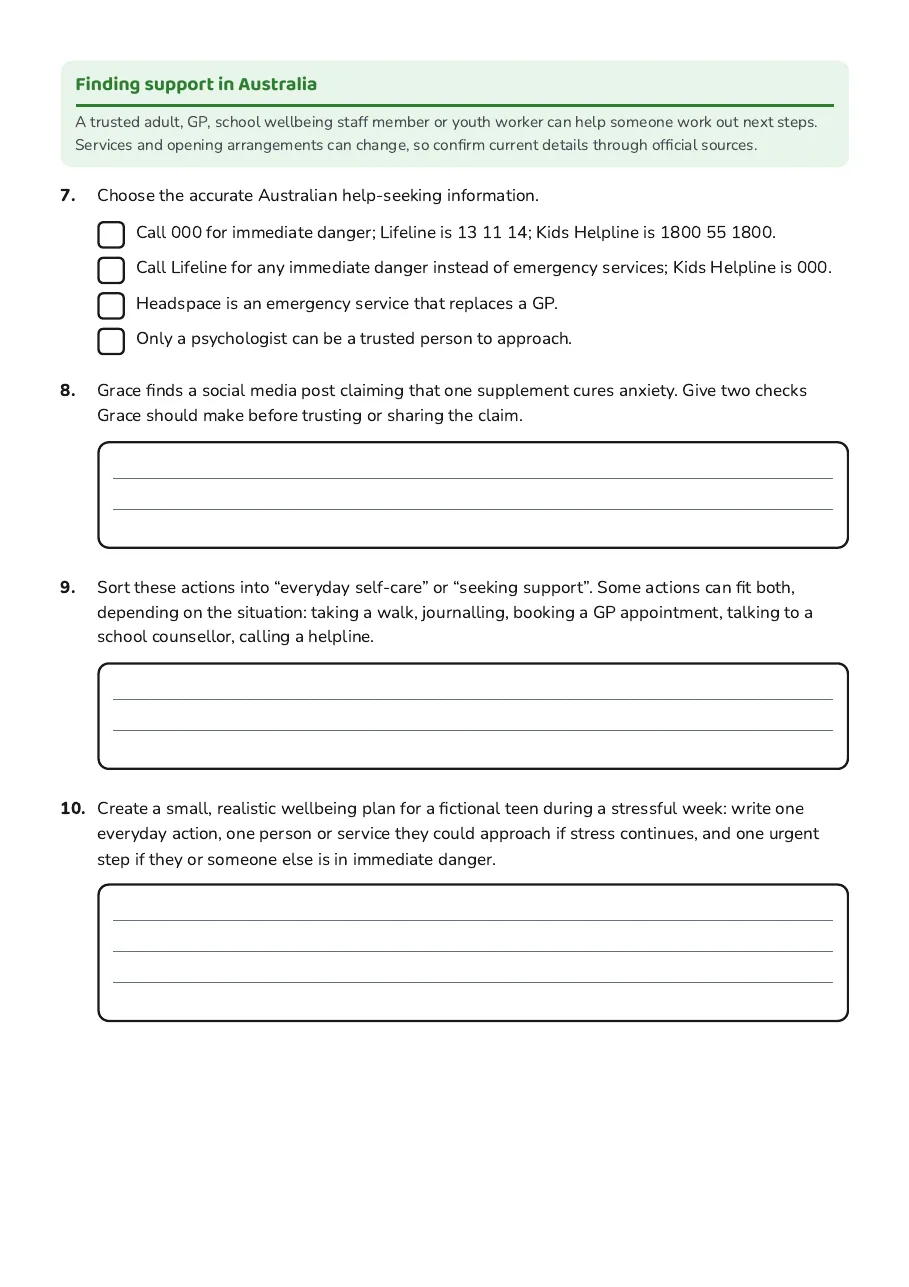
Finding support in Australia

A trusted adult, GP, school wellbeing staff member or youth worker can help someone work out next steps. Services and opening arrangements can change, so confirm current details through official sources.

7.Choose the accurate Australian help-seeking information.
  • Call 000 for immediate danger; Lifeline is 13 11 14; Kids Helpline is 1800 55 1800.
  • Call Lifeline for any immediate danger instead of emergency services; Kids Helpline is 000.
  • Headspace is an emergency service that replaces a GP.
  • Only a psychologist can be a trusted person to approach.
8.Grace finds a social media post claiming that one supplement cures anxiety. Give two checks Grace should make before trusting or sharing the claim.
9.Sort these actions into “everyday self-care” or “seeking support”. Some actions can fit both, depending on the situation: taking a walk, journalling, booking a GP appointment, talking to a school counsellor, calling a helpline.
10.Create a small, realistic wellbeing plan for a fictional teen during a stressful week: write one everyday action, one person or service they could approach if stress continues, and one urgent step if they or someone else is in immediate danger.

3 printable pages

  • Teen Mental Health Strategies, page 1 of 3: Notice, don’t diagnose

    Page 1

  • Teen Mental Health Strategies, page 2 of 3: Build a realistic toolkit

    Page 2

  • Teen Mental Health Strategies, page 3 of 3: Finding support in Australia

    Page 3

About This Worksheet

Free in Kuraplan

Sign up free, grab the PDF, and customize it for your class.

Print-Ready

Formatted for standard paper. Clean layout, easy to read.

AI-Generated

Created with Kuraplan's AI, designed for real classroom use.

For Teachers & Parents

Use in classrooms, for homework, tutoring, or homeschool.

Need a custom version of this worksheet?

Kuraplan's AI generates custom worksheets in seconds — differentiated for every learner, aligned to your curriculum.

Generate Custom Worksheets — Free
No credit card Curriculum-aligned Under 60 seconds