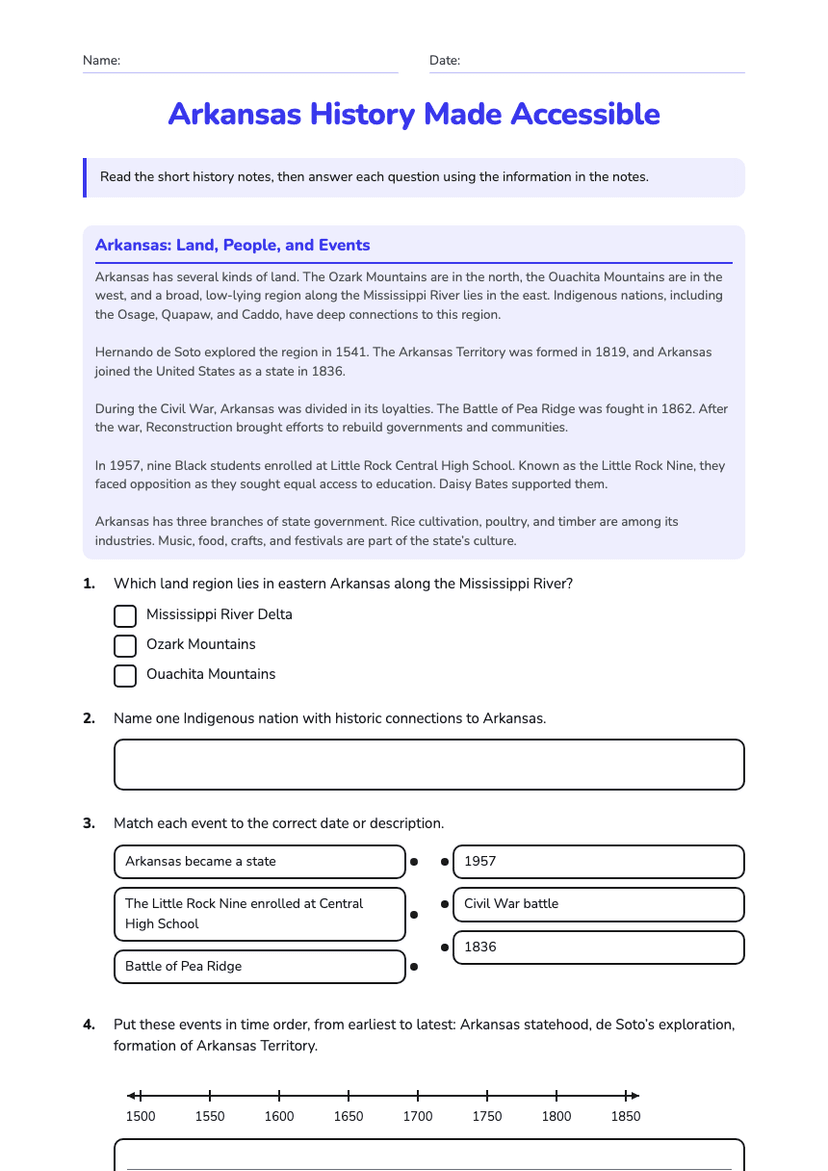
Arkansas History Learning Packet
A free us history worksheet ready for your classroom. Open in Kuraplan to grab the print-ready PDF, customize it for your students, or generate a fresh version in seconds.

Arkansas History Learning Packet
Part 1: Place, People, and Early Arkansas
Lesson 1: Arkansas Geography and Indigenous Peoples
I can: describe how Arkansas’s land and waterways influenced people and communities.
Vocabulary: region, river, Indigenous, culture, resource
Directions: Read each question carefully. Use what you know about Arkansas geography and Indigenous peoples.
Source: “The Quapaw lived near the lower Arkansas River and used the river for travel, fishing, and trade.”
Exit ticket: Name one Arkansas landform or waterway and explain why it mattered.
Success criteria: I correctly identify an Arkansas waterway, use the word “Indigenous” accurately, and explain one geography connection.
Support: Read directions aloud, provide a word bank, and allow students to follow along with a dyslexia-friendly large-print or audio version.
Extension: Research one Arkansas Indigenous nation and record one fact about its history or culture.
Lesson 2: Exploration, Settlement, and Statehood
I can: explain how exploration and settlement changed Arkansas and identify when Arkansas became a state.
Vocabulary: exploration, settlement, territory, statehood, frontier
Directions: Use the timeline information and your history knowledge to answer.
Timeline: 1541—Hernando de Soto explored the region; 1803—The Louisiana Purchase included the area; 1819—Arkansas Territory was created; 1836—Arkansas became a state.
Exit ticket: In one sentence, explain the difference between a territory and a state.
Success criteria: I place events in order, identify 1836 as the year of statehood, and explain one effect of rivers.
Support: Offer a picture timeline, read the source in short sections, and permit speech-to-text or oral answers.
Extension: Compare Arkansas statehood with the statehood date of another state.
Part 2: Arkansas, Conflict, and Change
Lesson 3: Civil War and Reconstruction
I can: describe how the Civil War and Reconstruction affected Arkansas.
Vocabulary: Union, Confederacy, emancipation, Reconstruction, amendment
Directions: Remember that historical events can affect different groups in different ways.
Source: “After the war, Arkansas had to rebuild roads, schools, farms, and government. Newly freed people worked to create families, churches, schools, and communities.”
Exit ticket: Why is Reconstruction an important part of Arkansas history?
Success criteria: I use Civil War vocabulary, identify two effects of the war, and explain why rebuilding mattered.
Support: Provide a simplified text, vocabulary cards, audio reading, and a timeline with pictures.
Extension: Investigate how one Arkansas town or school changed during Reconstruction.
Lesson 4: Civil Rights and the Little Rock Nine
I can: explain how the Little Rock Nine showed courage and helped advance equal rights.
Vocabulary: civil rights, segregation, integration, justice, federal
Directions: Use the source and your knowledge of the Little Rock Nine. Support your ideas with evidence.
Source: “The Little Rock Nine faced angry crowds and threats while trying to attend Central High School. Federal troops helped protect them. Their actions became an important event in the struggle for civil rights.”
Exit ticket: What is one lesson people can learn from the Little Rock Nine?
Success criteria: I define segregation or integration, cite evidence from a source, and explain why the Little Rock Nine mattered.
Support: Use a read-aloud, highlighted evidence, sentence starters, and a dyslexia-friendly font with extra spacing.
Extension: Compare the Little Rock Nine with another civil rights event and identify one similarity.
Part 3: Arkansas Today and Cumulative Review
Lesson 5: Government, Economy, and Culture
I can: describe how Arkansas government, businesses, workers, and traditions shape the state.
Vocabulary: legislature, governor, economy, agriculture, culture
Directions: Answer using complete thoughts when asked.
Exit ticket: How can citizens participate in Arkansas government or improve their community?
Success criteria: I identify one government leader, one economic activity, and one cultural example.
Support: Use picture vocabulary, choice banks, partner discussion, and audio or enlarged reading materials.
Extension: Interview a family or community member about an Arkansas tradition and summarize the response.
Final Cumulative Assessment
Directions: Complete the questions independently. For Question 23, use at least two reliable sources and include facts in your own words.
Topic: Indigenous peoples, Arkansas statehood, the Civil War, Reconstruction, the Little Rock Nine, government, economy, or culture.
Answer Key
1. Mississippi River. 2. Rivers. 3. A–3, B–2, C–1. 6. 25th. 7. de Soto’s exploration, Louisiana Purchase, Arkansas Territory, Arkansas statehood. 9. Confederacy. 10. A–3, B–2, C–1. 13. Nine Black students integrated Central High School. 15. The first and second choices. 16. Governor. 17. Agriculture. 19. Mississippi River. 20. 1836.
Questions 4, 5, 8, 11, 12, 14, 18, 21, and 22 should include accurate facts and clear explanations. Accept reasonable map labels and well-supported responses.
Research Response Rubric
4—Excellent: Uses two reliable sources, includes accurate details about what happened and when, explains why the topic matters, and organizes ideas clearly in the student’s own words.
3—Proficient: Uses two sources, includes mostly accurate details, explains the topic’s importance, and is generally organized.
2—Developing: Uses one source or includes limited details. The explanation of importance is incomplete or partly unclear.
1—Beginning: Gives very few facts, does not identify sources clearly, or does not explain the topic’s importance.
About This Worksheet
Free in Kuraplan
Sign up free, grab the PDF, and customize it for your class.
Print-Ready
Formatted for standard paper. Clean layout, easy to read.
AI-Generated
Created with Kuraplan's AI, designed for real classroom use.
For Teachers & Parents
Use in classrooms, for homework, tutoring, or homeschool.
Need a custom version of this worksheet?
Kuraplan's AI generates custom worksheets in seconds — differentiated for every learner, aligned to your curriculum.
Generate Custom Worksheets — FreeMore US History Worksheets
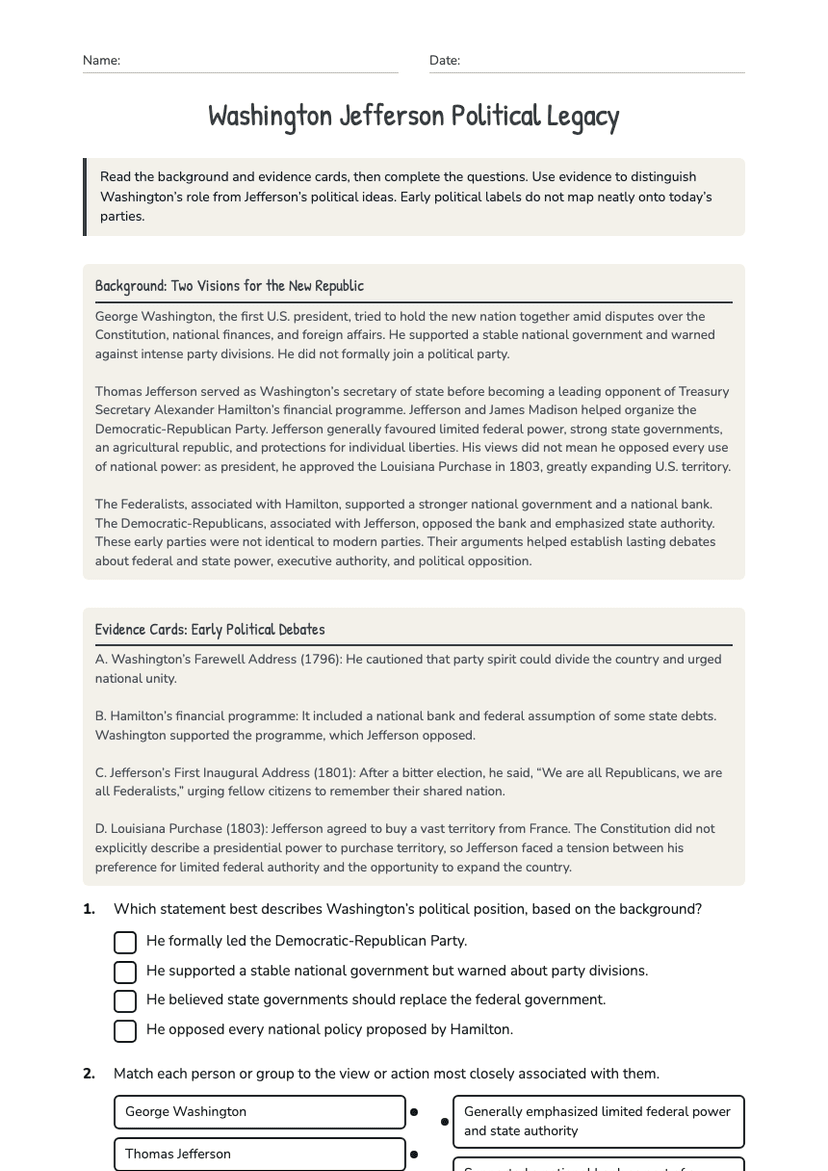
Washington Jefferson Political Legacy
Free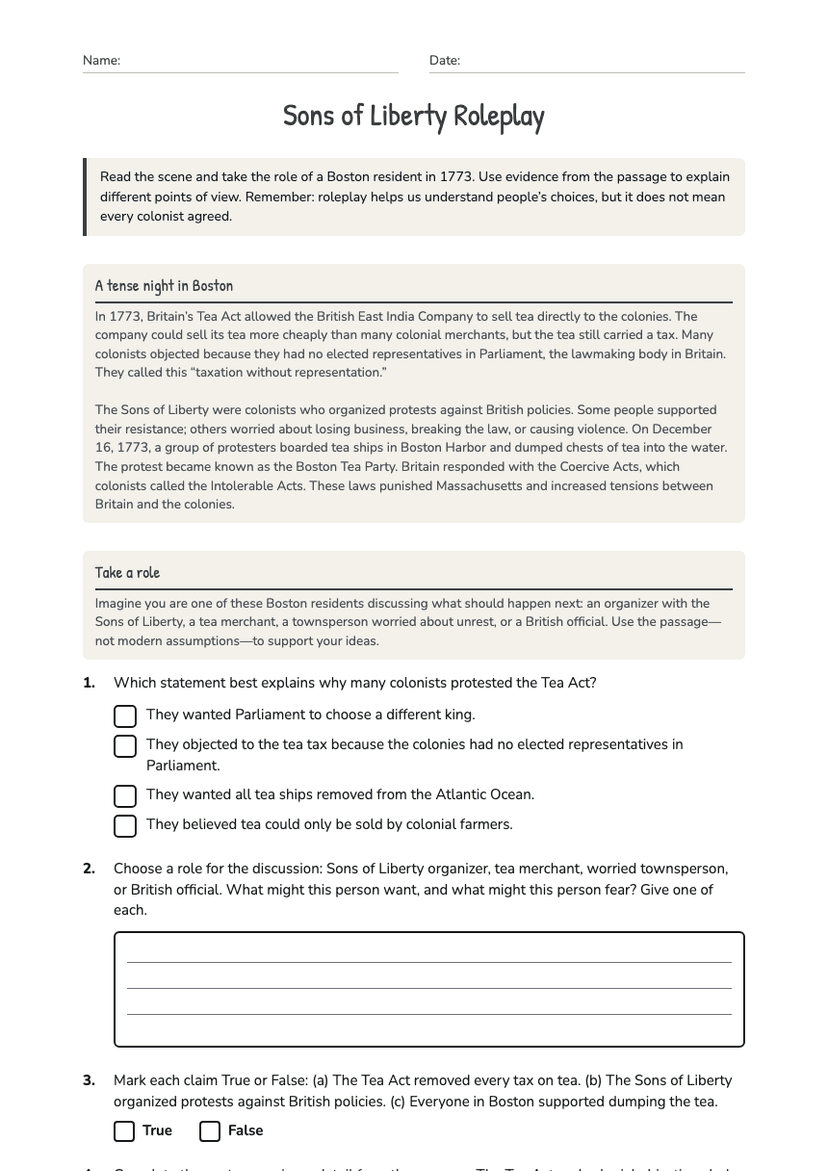
Sons of Liberty Roleplay
Free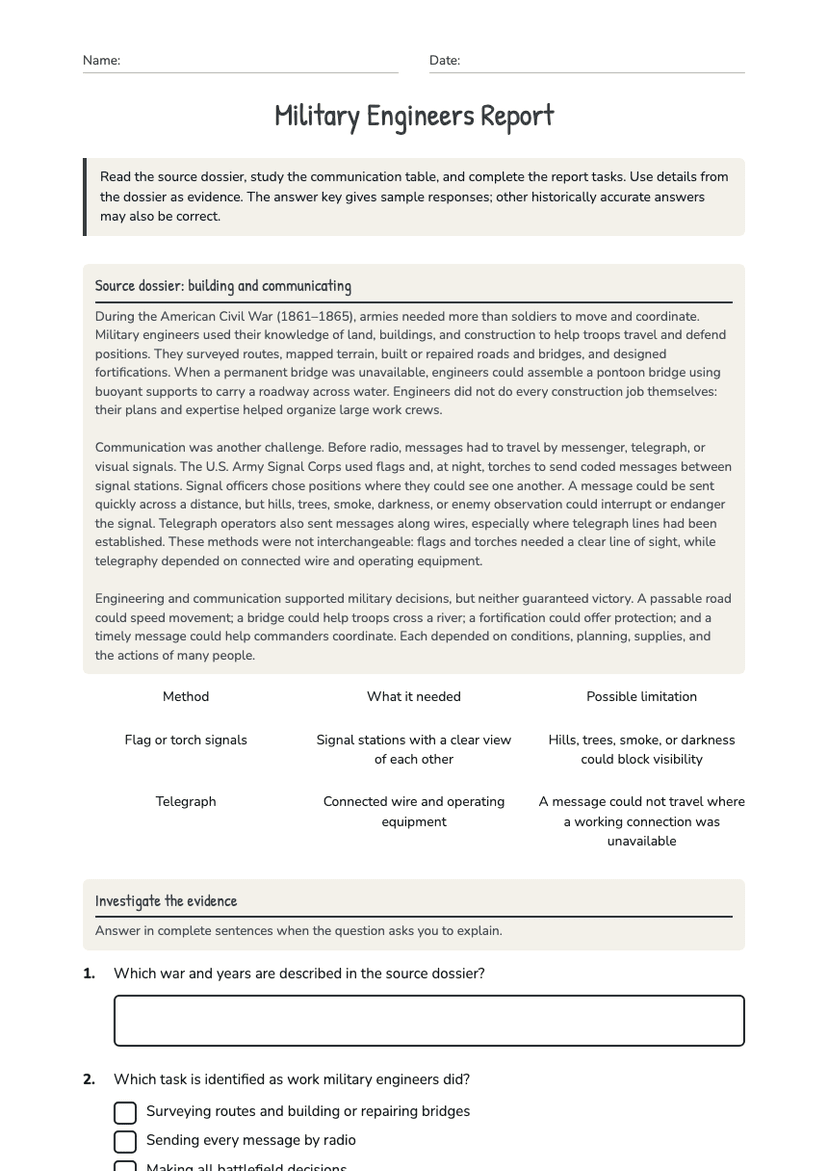
Military Engineers Report
Free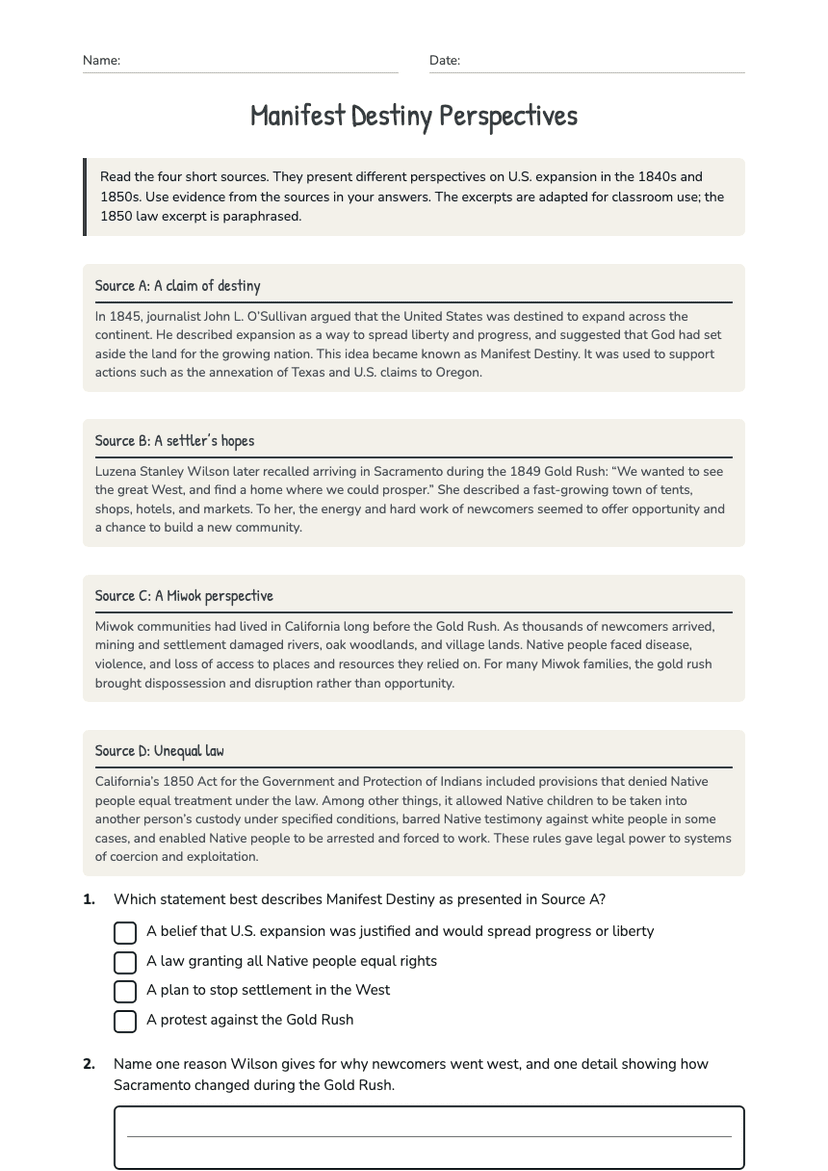
Manifest Destiny Perspectives
Free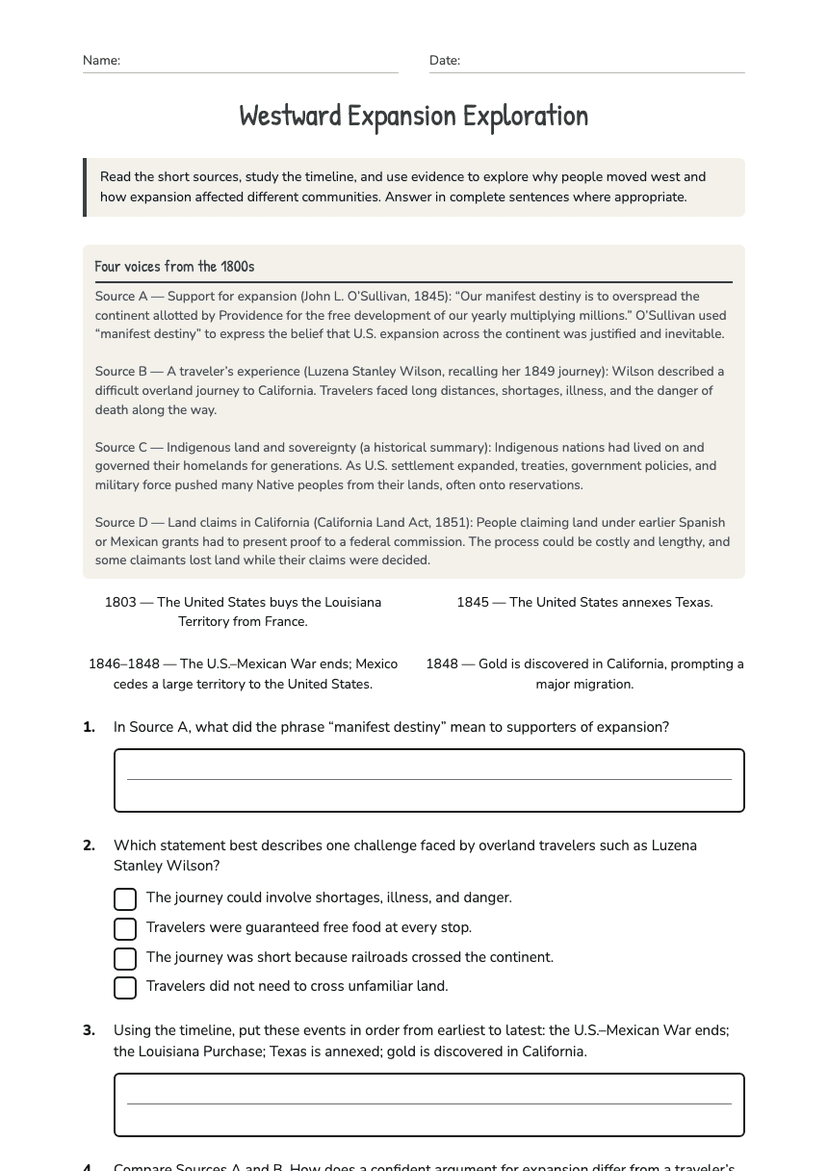
Westward Expansion Exploration
Free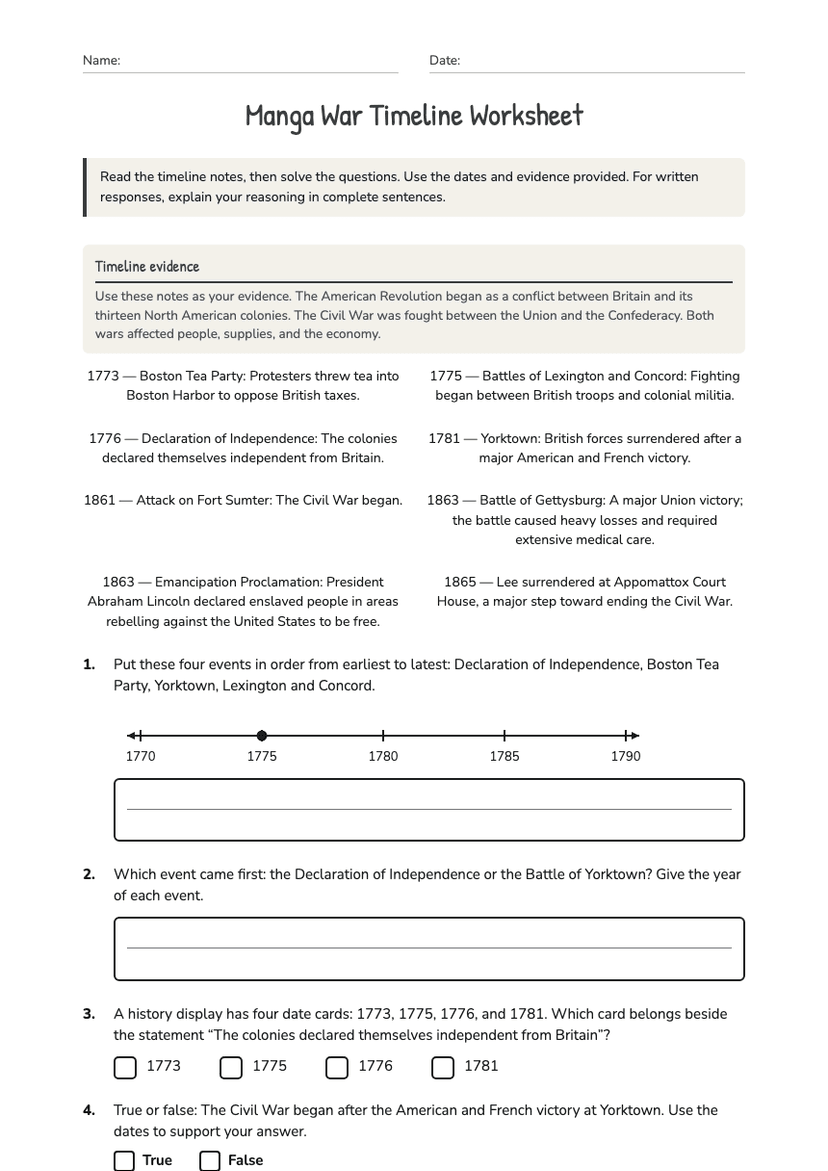
Manga War Timeline Worksheet
Free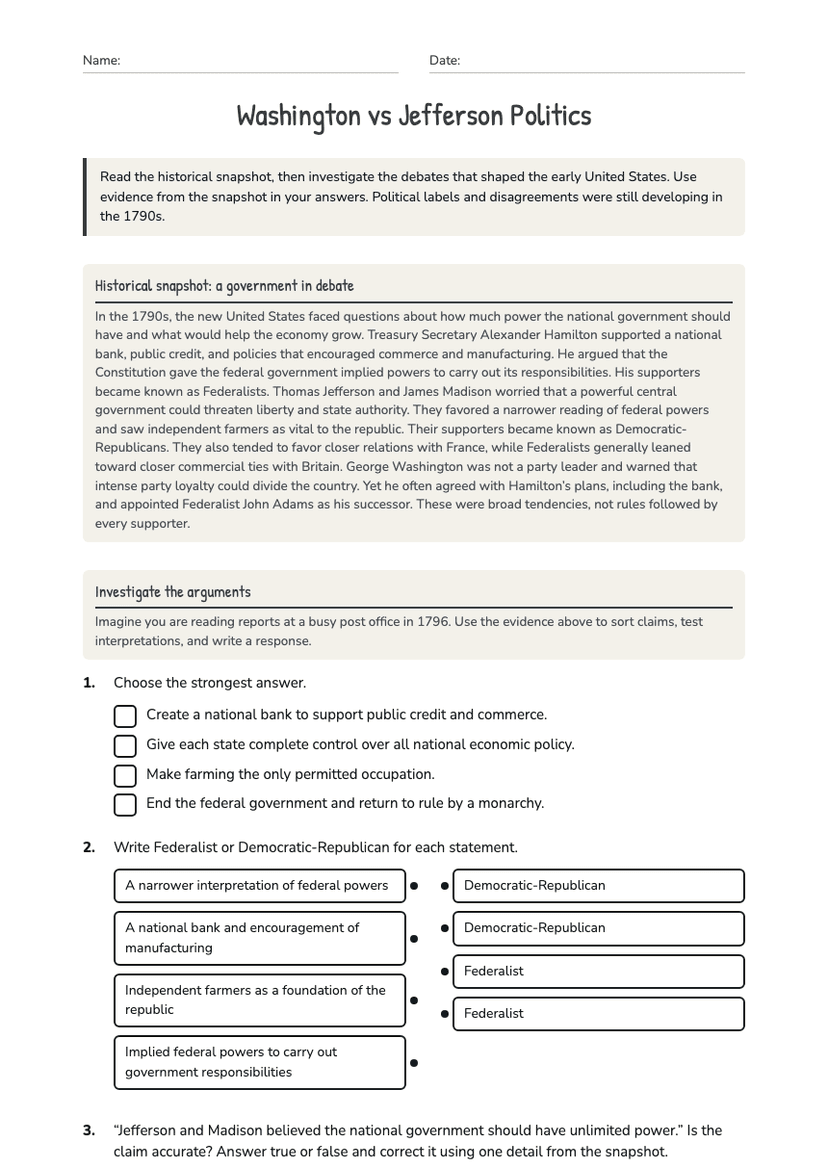
Washington vs Jefferson Politics
Free