ScienceFreePrintable

Atomic Structure Basics

A free science worksheet ready for your classroom. Open in Kuraplan to grab the print-ready PDF, customize it for your students, or generate a fresh version in seconds.
Atomic Structure Basics worksheet preview
Name:Date:

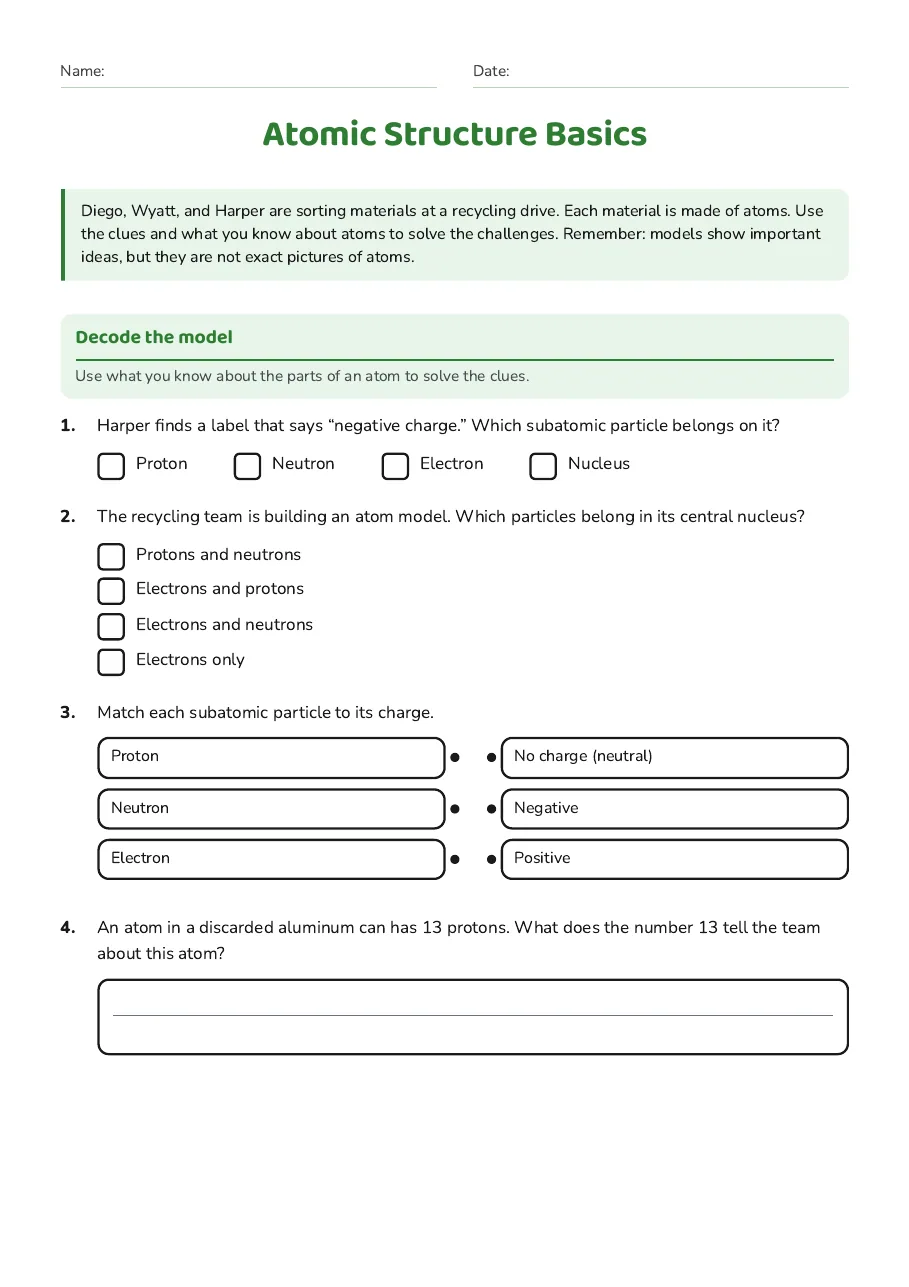
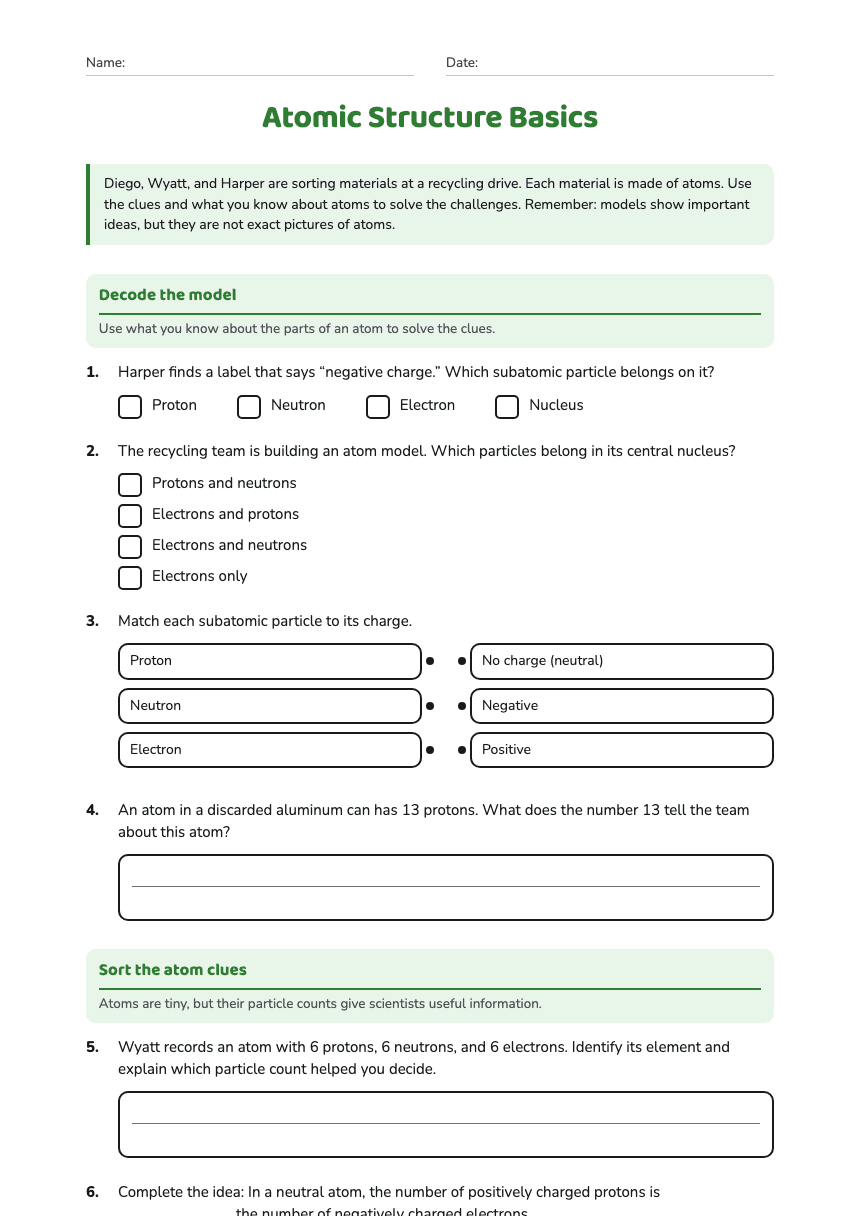
Atomic Structure Basics

Diego, Wyatt, and Harper are sorting materials at a recycling drive. Each material is made of atoms. Use the clues and what you know about atoms to solve the challenges. Remember: models show important ideas, but they are not exact pictures of atoms.

Decode the model

Use what you know about the parts of an atom to solve the clues.

1.Harper finds a label that says “negative charge.” Which subatomic particle belongs on it?
  • Proton
  • Neutron
  • Electron
  • Nucleus
2.The recycling team is building an atom model. Which particles belong in its central nucleus?
  • Protons and neutrons
  • Electrons and protons
  • Electrons and neutrons
  • Electrons only
3.Match each subatomic particle to its charge.
  • Proton
  • Neutron
  • Electron
  • No charge (neutral)
  • Negative
  • Positive
4.An atom in a discarded aluminum can has 13 protons. What does the number 13 tell the team about this atom?

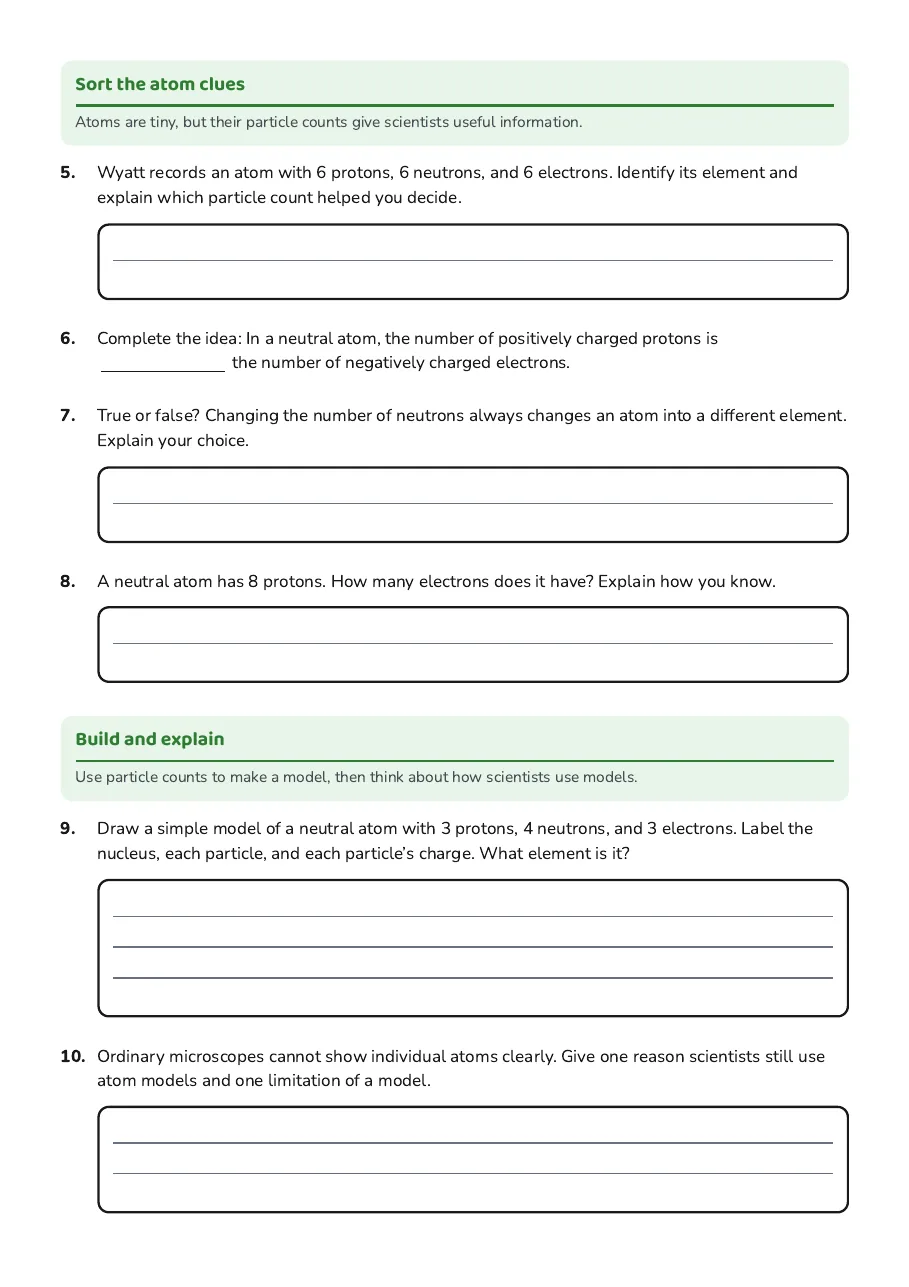
Sort the atom clues

Atoms are tiny, but their particle counts give scientists useful information.

5.Wyatt records an atom with 6 protons, 6 neutrons, and 6 electrons. Identify its element and explain which particle count helped you decide.
6.Complete the idea: In a neutral atom, the number of positively charged protons is the number of negatively charged electrons.
7.True or false? Changing the number of neutrons always changes an atom into a different element. Explain your choice.
8.A neutral atom has 8 protons. How many electrons does it have? Explain how you know.

Build and explain

Use particle counts to make a model, then think about how scientists use models.

9.Draw a simple model of a neutral atom with 3 protons, 4 neutrons, and 3 electrons. Label the nucleus, each particle, and each particle’s charge. What element is it?
10.Ordinary microscopes cannot show individual atoms clearly. Give one reason scientists still use atom models and one limitation of a model.
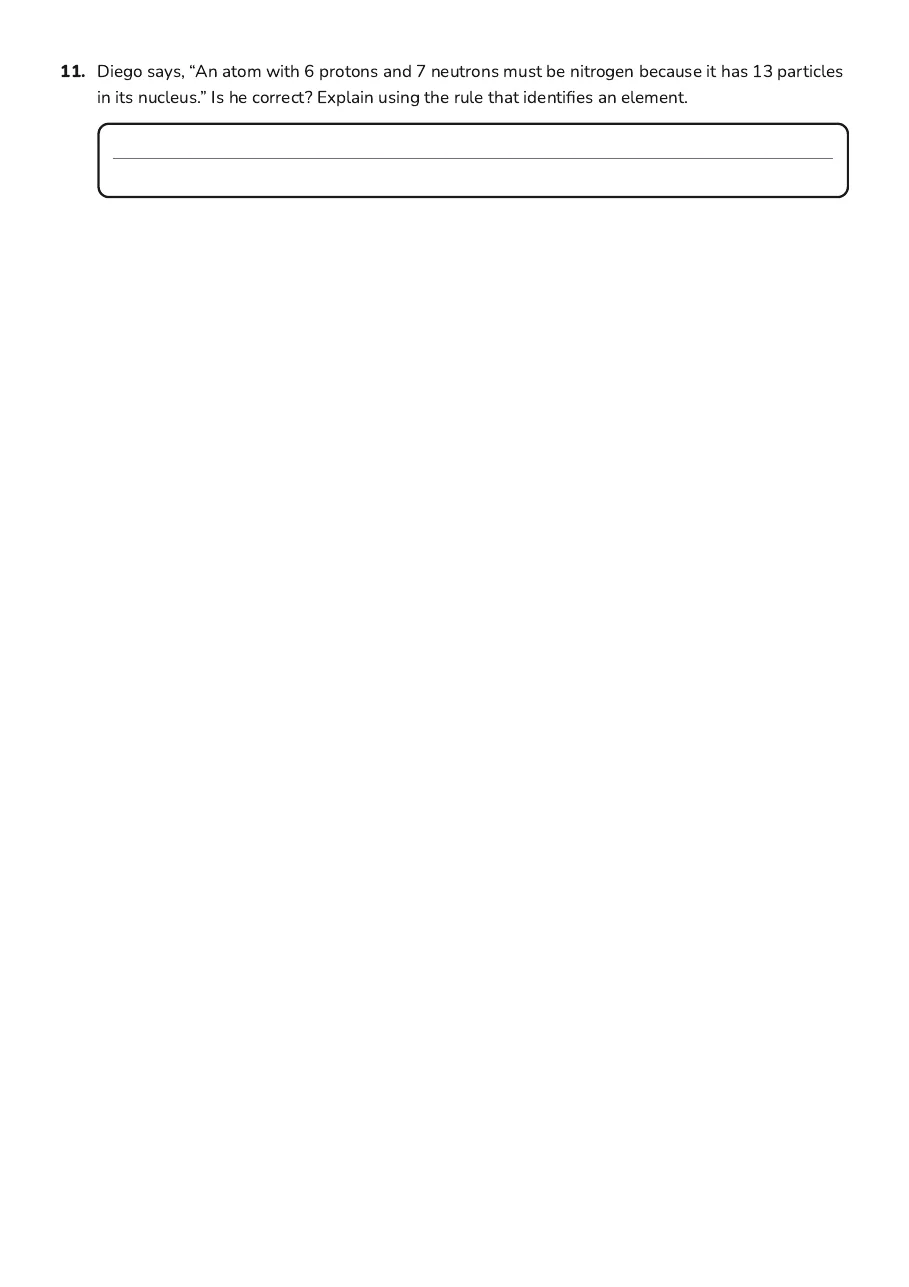
11.Diego says, “An atom with 6 protons and 7 neutrons must be nitrogen because it has 13 particles in its nucleus.” Is he correct? Explain using the rule that identifies an element.

3 printable pages

  • Atomic Structure Basics, page 1 of 3: Decode the model

    Page 1

  • Atomic Structure Basics, page 2 of 3: Sort the atom clues, Build and explain

    Page 2

  • Atomic Structure Basics, page 3 of 3: 11. Diego says, “An atom with 6 protons and 7 neutrons must be nitrogen because it has 13…

    Page 3

About This Worksheet

Free in Kuraplan

Sign up free, grab the PDF, and customize it for your class.

Print-Ready

Formatted for standard paper. Clean layout, easy to read.

AI-Generated

Created with Kuraplan's AI, designed for real classroom use.

For Teachers & Parents

Use in classrooms, for homework, tutoring, or homeschool.

Need a custom version of this worksheet?

Kuraplan's AI generates custom worksheets in seconds — differentiated for every learner, aligned to your curriculum.

Generate Custom Worksheets — Free
No credit card Curriculum-aligned Under 60 seconds