Atoms Adventure Reading Worksheet
A free science worksheet ready for your classroom. Open in Kuraplan to grab the print-ready PDF, customize it for your students, or generate a fresh version in seconds.
Atoms Adventure Reading Worksheet
📖 Reading Passage: The Incredible Shrinking Adventure
Maya and Alex couldn't believe their eyes when their science teacher, Ms. Rodriguez, pulled out a strange-looking device that resembled a camera crossed with a telescope.
"This is the Atomic Explorer 3000," she announced with a grin. "Today, we're going on a field trip like no other – we're shrinking down to explore the world of atoms!"
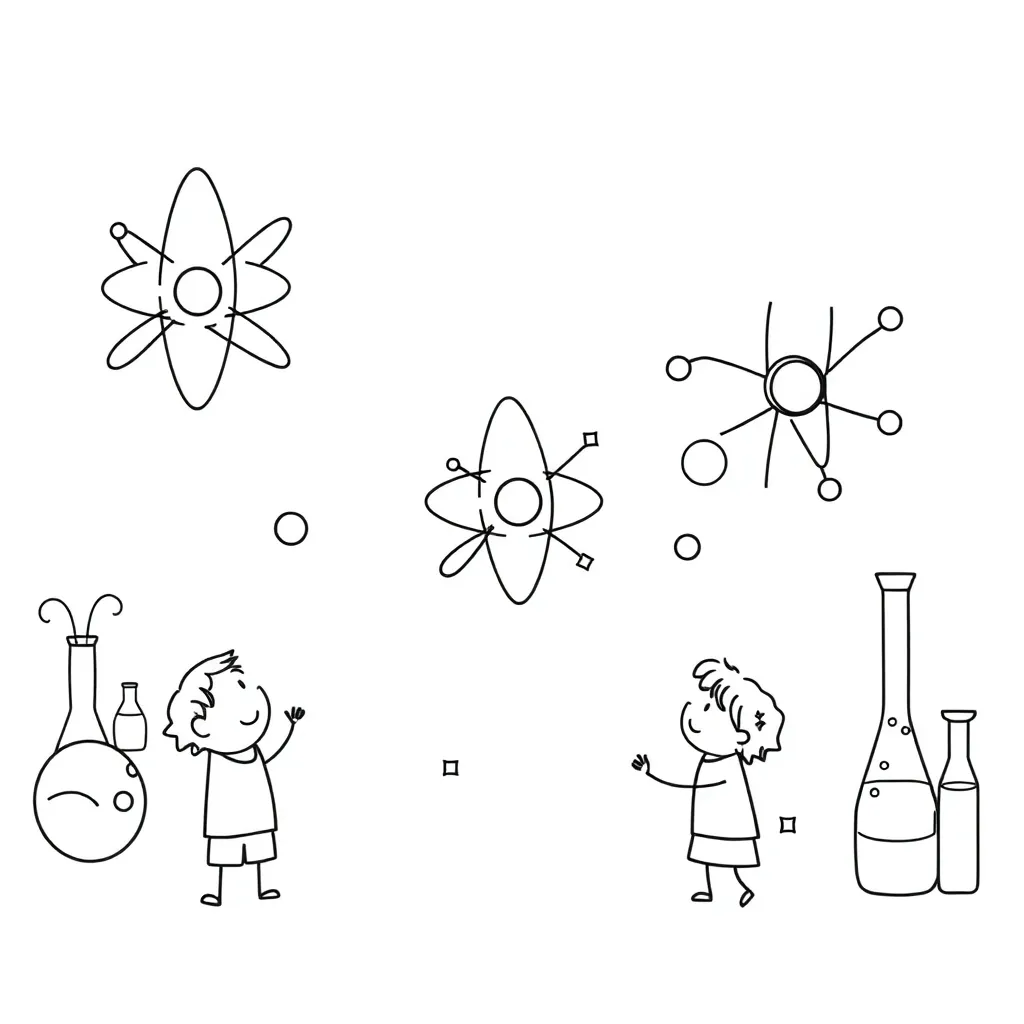
With a bright flash of light, Maya and Alex found themselves smaller than they ever imagined possible. They were now the size of subatomic particles, floating in what looked like a vast universe filled with tiny spheres.
"Welcome to the atomic world!" called Ms. Rodriguez's voice through their miniature headsets. "What you're seeing around you are atoms – the building blocks of everything in our universe. Every single thing you can touch, from your desk to your pencil to your own body, is made up of these incredibly tiny particles."
Maya reached out to touch a nearby sphere that glowed with a soft blue light. "It's so small, but it feels solid!" she exclaimed.
"That's because atoms are mostly empty space," explained Ms. Rodriguez. "What you're touching is the nucleus – the dense center of the atom that contains protons and neutrons. If an atom were the size of a football stadium, the nucleus would be like a marble sitting in the center!"
Alex noticed tiny particles zipping around the nucleus at incredible speeds. "What are those fast-moving things?" he asked.
"Those are electrons," Ms. Rodriguez replied. "They orbit around the nucleus in areas called electron shells. Think of them like planets orbiting the sun, but much, much faster and in a more unpredictable pattern."
As they floated deeper into this microscopic world, Maya and Alex began to see atoms joining together. "Look!" Maya pointed. "Those atoms are holding hands!"
"Excellent observation!" praised Ms. Rodriguez. "When atoms join together, they form molecules. The 'hands' you see are called chemical bonds. For example, two hydrogen atoms can bond with one oxygen atom to create a water molecule – H₂O. That's the water you drink every day!"
Alex watched in amazement as different atoms combined in various ways. "So everything around us is just different combinations of these tiny building blocks?"
"Exactly!" confirmed Ms. Rodriguez. "There are 118 different types of atoms, called elements, and they can combine in countless ways to create everything from the air we breathe to the food we eat. It's like having a cosmic LEGO set!"
As their adventure came to an end and they returned to normal size, Maya and Alex looked around their classroom with new eyes. They now understood that beneath the surface of everything they could see was an incredible, invisible world of atoms and molecules, constantly moving and interacting to create the amazing world around them.
🧠 Part 1: Reading Comprehension
Answer: _____________________
✏️ Part 2: Critical Thinking
About This Worksheet
Free in Kuraplan
Sign up free, grab the PDF, and customize it for your class.
Print-Ready
Formatted for standard paper. Clean layout, easy to read.
AI-Generated
Created with Kuraplan's AI, designed for real classroom use.
For Teachers & Parents
Use in classrooms, for homework, tutoring, or homeschool.
Need a custom version of this worksheet?
Kuraplan's AI generates custom worksheets in seconds — differentiated for every learner, aligned to your curriculum.
Generate Custom Worksheets — FreeMore Science Worksheets
Lithium Element Worksheet
Free
Atoms, Molecules, and Compounds
Free
Chemistry Concepts Quiz
Free
Balancing Chemical Equations
Free
Balancing Chemical Equations Worksheet
Free
Balancing Chemical Equations Worksheet
Free
Periodic Table Properties Patterns
Free