ScienceFreePrintable

Periodic Table Properties Patterns

A free science worksheet ready for your classroom. Open in Kuraplan to grab the print-ready PDF, customize it for your students, or generate a fresh version in seconds.
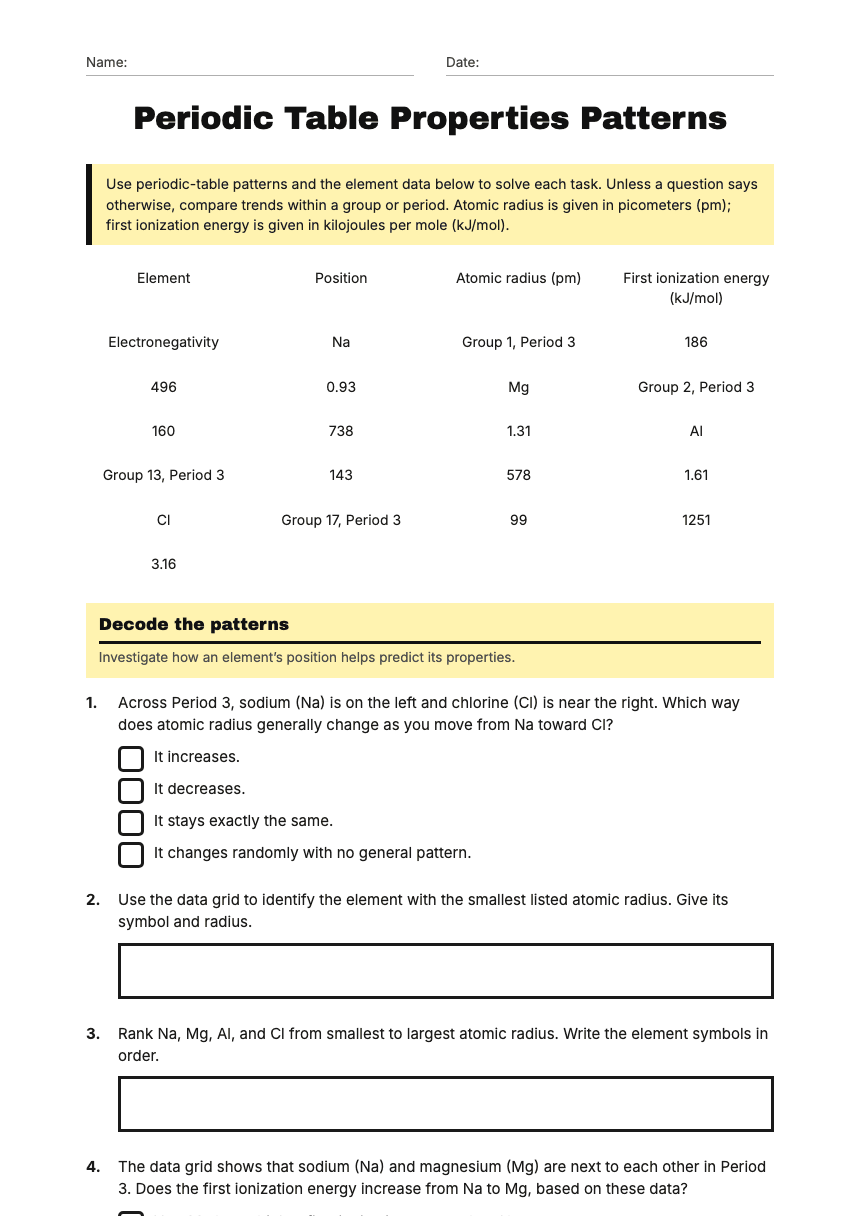
Periodic Table Properties Patterns worksheet preview
Name:Date:

Periodic Table Properties Patterns

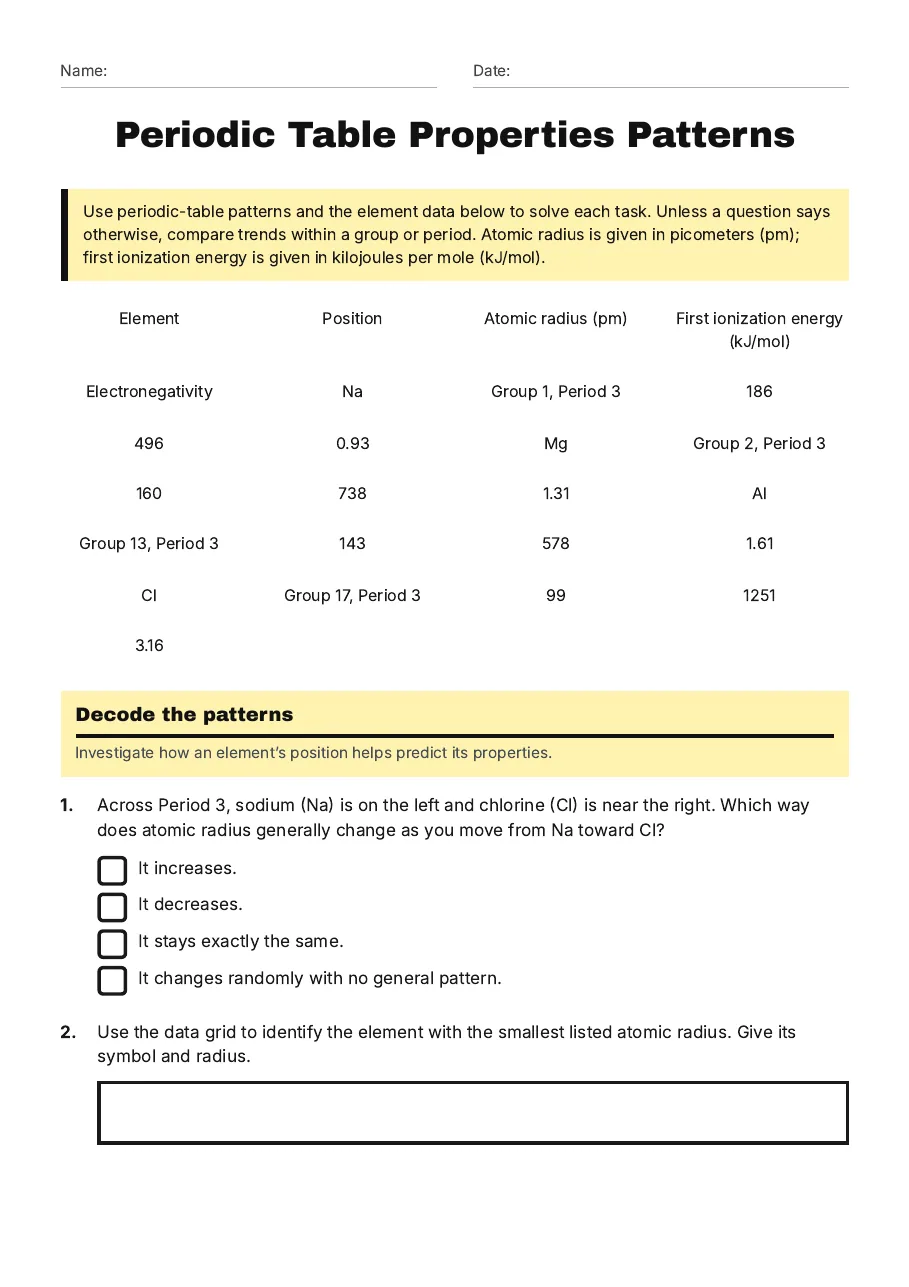
Use periodic-table patterns and the element data below to solve each task. Unless a question says otherwise, compare trends within a group or period. Atomic radius is given in picometers (pm); first ionization energy is given in kilojoules per mole (kJ/mol).

Element

Position

Atomic radius (pm)

First ionization energy (kJ/mol)

Electronegativity

Na

Group 1, Period 3

186

496

0.93

Mg

Group 2, Period 3

160

738

1.31

Al

Group 13, Period 3

143

578

1.61

Cl

Group 17, Period 3

99

1251

3.16

Decode the patterns

Investigate how an element’s position helps predict its properties.

1.Across Period 3, sodium (Na) is on the left and chlorine (Cl) is near the right. Which way does atomic radius generally change as you move from Na toward Cl?
  • It increases.
  • It decreases.
  • It stays exactly the same.
  • It changes randomly with no general pattern.
2.Use the data grid to identify the element with the smallest listed atomic radius. Give its symbol and radius.
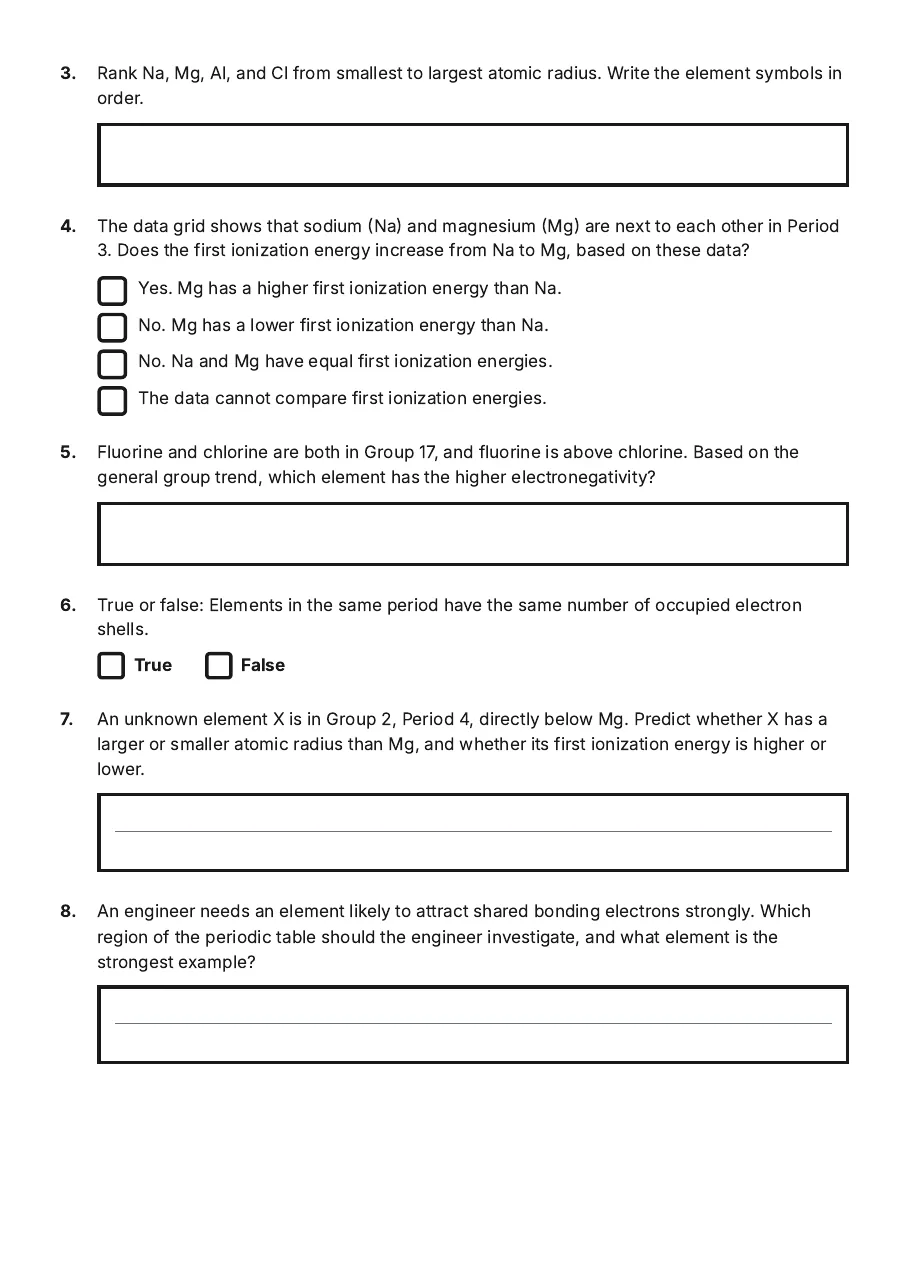
3.Rank Na, Mg, Al, and Cl from smallest to largest atomic radius. Write the element symbols in order.
4.The data grid shows that sodium (Na) and magnesium (Mg) are next to each other in Period 3. Does the first ionization energy increase from Na to Mg, based on these data?
  • Yes. Mg has a higher first ionization energy than Na.
  • No. Mg has a lower first ionization energy than Na.
  • No. Na and Mg have equal first ionization energies.
  • The data cannot compare first ionization energies.
5.Fluorine and chlorine are both in Group 17, and fluorine is above chlorine. Based on the general group trend, which element has the higher electronegativity?
6.True or false: Elements in the same period have the same number of occupied electron shells.
TrueFalse
7.An unknown element X is in Group 2, Period 4, directly below Mg. Predict whether X has a larger or smaller atomic radius than Mg, and whether its first ionization energy is higher or lower.
8.An engineer needs an element likely to attract shared bonding electrons strongly. Which region of the periodic table should the engineer investigate, and what element is the strongest example?
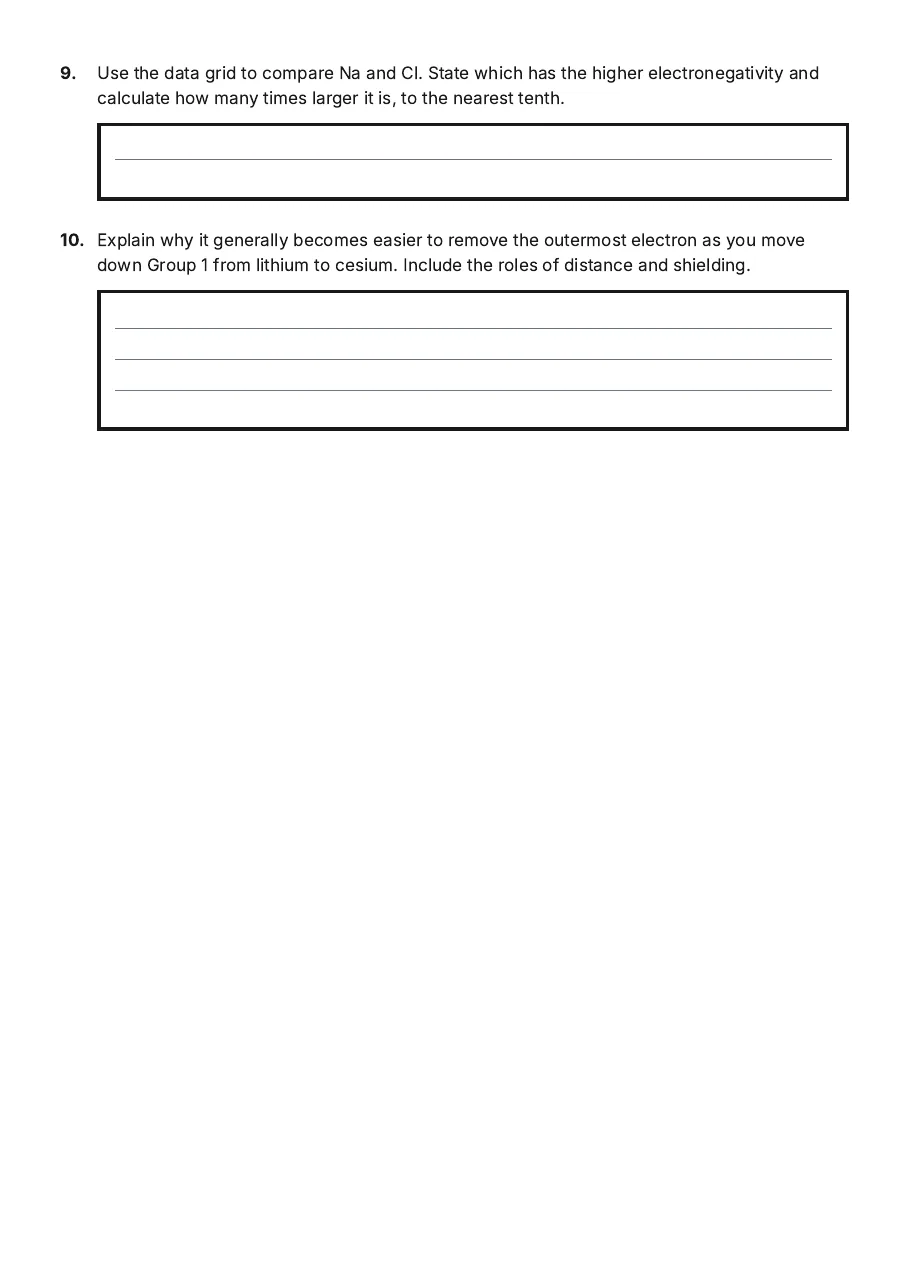
9.Use the data grid to compare Na and Cl. State which has the higher electronegativity and calculate how many times larger it is, to the nearest tenth.
10.Explain why it generally becomes easier to remove the outermost electron as you move down Group 1 from lithium to cesium. Include the roles of distance and shielding.

3 printable pages

  • Periodic Table Properties Patterns, page 1 of 3: Decode the patterns

    Page 1

  • Periodic Table Properties Patterns, page 2 of 3: 3. Rank Na, Mg, Al, and Cl from smallest to largest atomic radius. Write the element…

    Page 2

  • Periodic Table Properties Patterns, page 3 of 3: 9. Use the data grid to compare Na and Cl. State which has the higher electronegativity…

    Page 3

About This Worksheet

Free in Kuraplan

Sign up free, grab the PDF, and customize it for your class.

Print-Ready

Formatted for standard paper. Clean layout, easy to read.

AI-Generated

Created with Kuraplan's AI, designed for real classroom use.

For Teachers & Parents

Use in classrooms, for homework, tutoring, or homeschool.

Need a custom version of this worksheet?

Kuraplan's AI generates custom worksheets in seconds — differentiated for every learner, aligned to your curriculum.

Generate Custom Worksheets — Free
No credit card Curriculum-aligned Under 60 seconds