ScienceFreePrintable
Understanding Vector Diagrams
A free science worksheet ready for your classroom. Open in Kuraplan to grab the print-ready PDF, customize it for your students, or generate a fresh version in seconds.
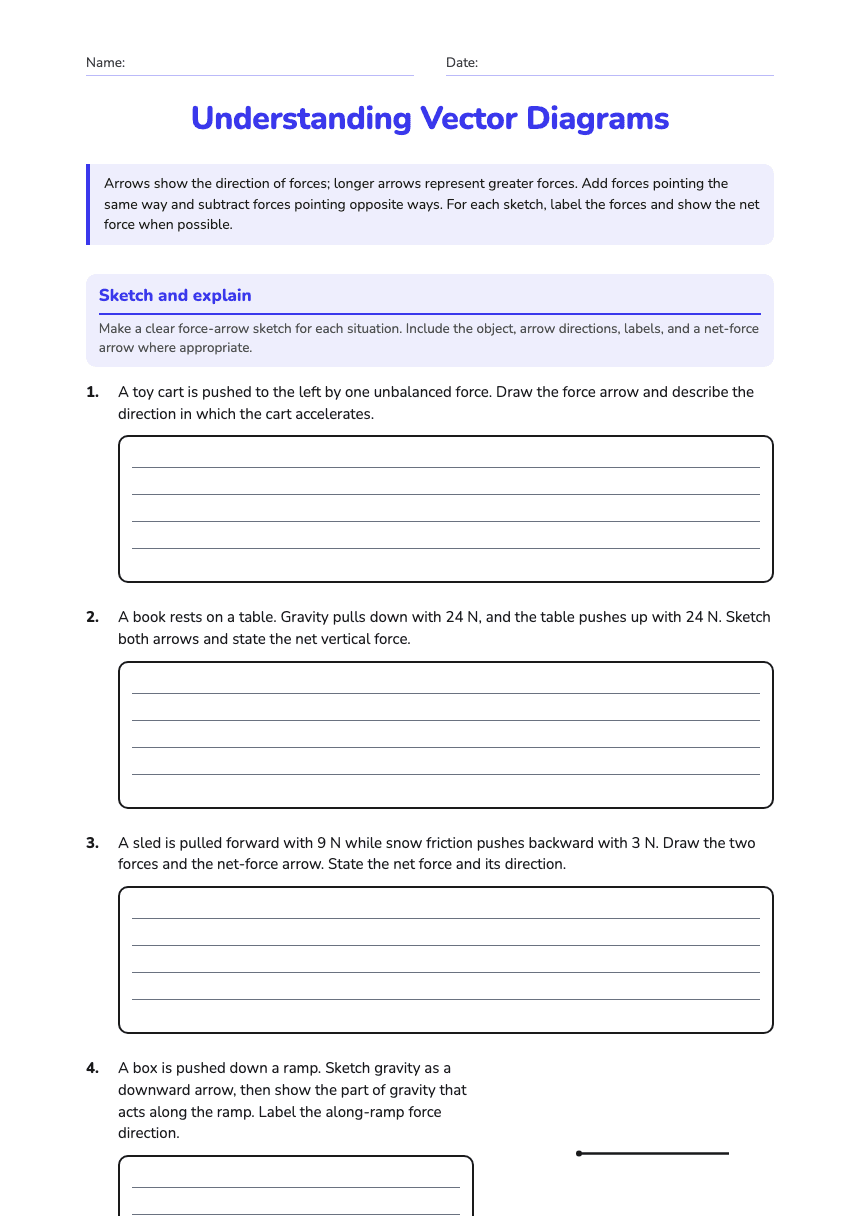
Name:Date:
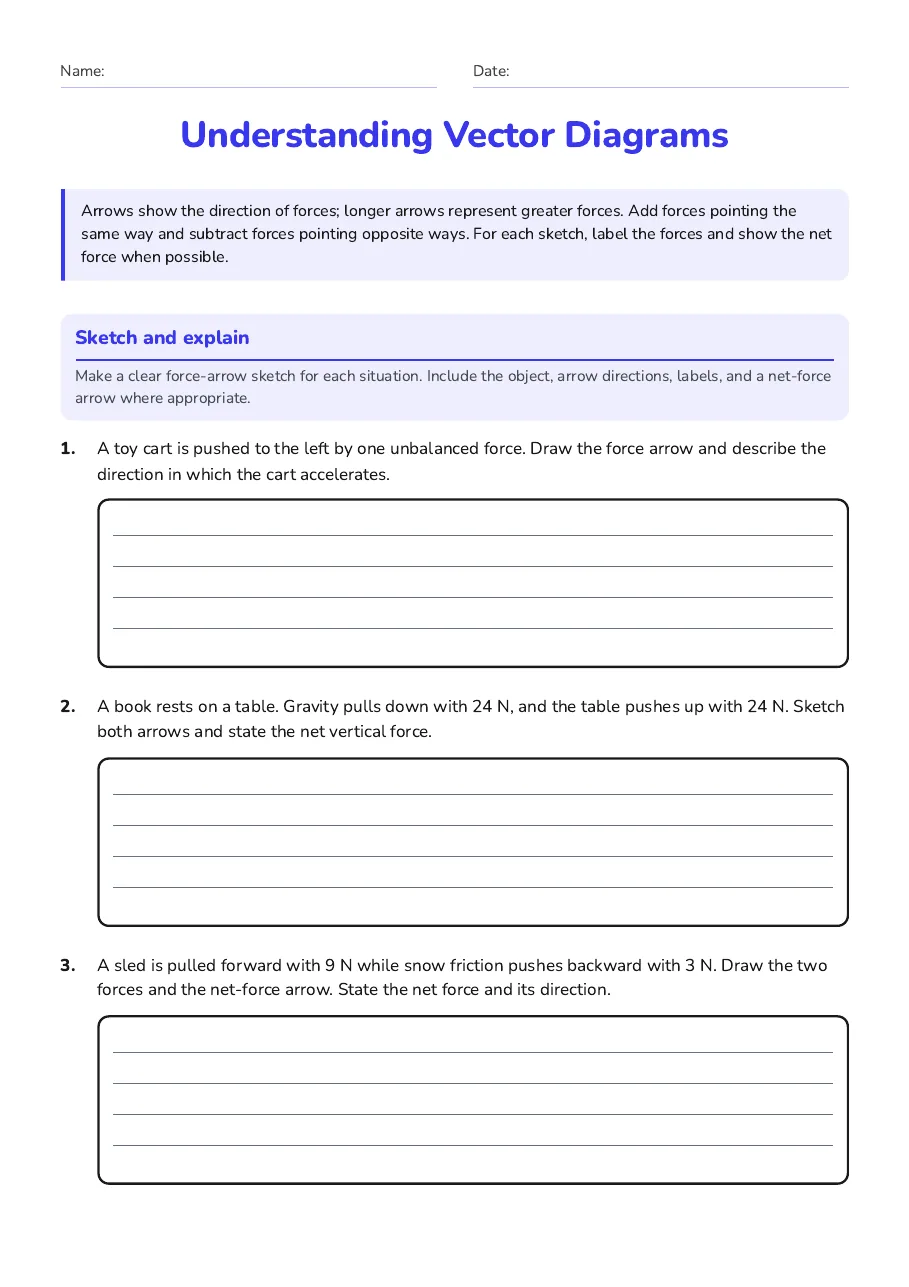
Understanding Vector Diagrams
Arrows show the direction of forces; longer arrows represent greater forces. Add forces pointing the same way and subtract forces pointing opposite ways. For each sketch, label the forces and show the net force when possible.
Sketch and explain
Make a clear force-arrow sketch for each situation. Include the object, arrow directions, labels, and a net-force arrow where appropriate.
1.A toy cart is pushed to the left by one unbalanced force. Draw the force arrow and describe the direction in which the cart accelerates.
2.A book rests on a table. Gravity pulls down with 24 N, and the table pushes up with 24 N. Sketch both arrows and state the net vertical force.
3.A sled is pulled forward with 9 N while snow friction pushes backward with 3 N. Draw the two forces and the net-force arrow. State the net force and its direction.
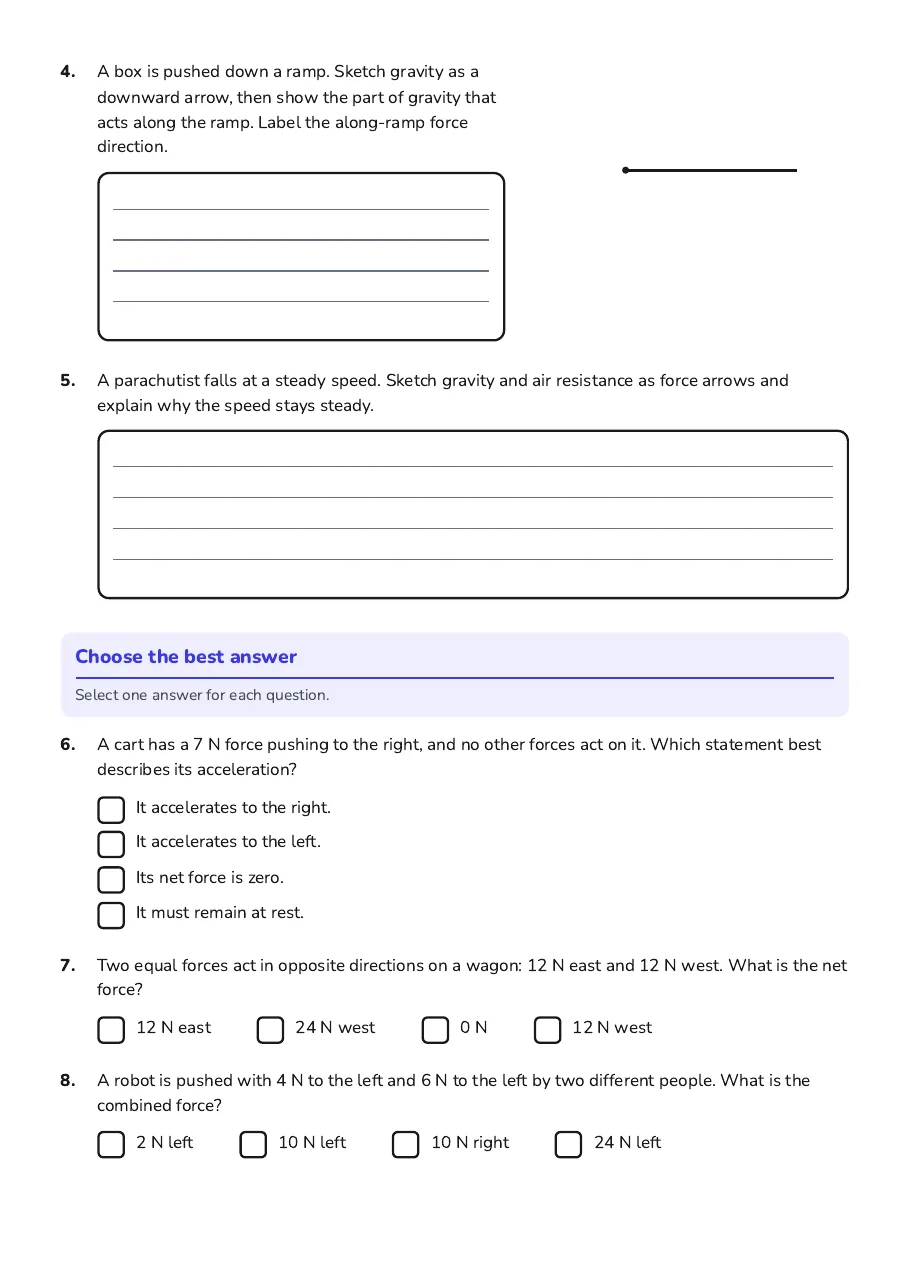
4.A box is pushed down a ramp. Sketch gravity as a downward arrow, then show the part of gravity that acts along the ramp. Label the along-ramp force direction.
5.A parachutist falls at a steady speed. Sketch gravity and air resistance as force arrows and explain why the speed stays steady.
Choose the best answer
Select one answer for each question.
6.A cart has a 7 N force pushing to the right, and no other forces act on it. Which statement best describes its acceleration?
- It accelerates to the right.
- It accelerates to the left.
- Its net force is zero.
- It must remain at rest.
7.Two equal forces act in opposite directions on a wagon: 12 N east and 12 N west. What is the net force?
- 12 N east
- 24 N west
- 0 N
- 12 N west
8.A robot is pushed with 4 N to the left and 6 N to the left by two different people. What is the combined force?
- 2 N left
- 10 N left
- 10 N right
- 24 N left
9.A crate is pulled right with 11 N while friction acts left with 7 N. Which way does the crate accelerate?
- Left, because friction always causes motion left.
- Right, because the net force points right.
- Up, because the crate is on the floor.
- It does not accelerate because the forces are equal.
10.A 36 N downward gravitational force and a 36 N upward support force act on a still box. What is the net vertical force?
- 36 N downward
- 72 N upward
- 0 N
- 36 N upward
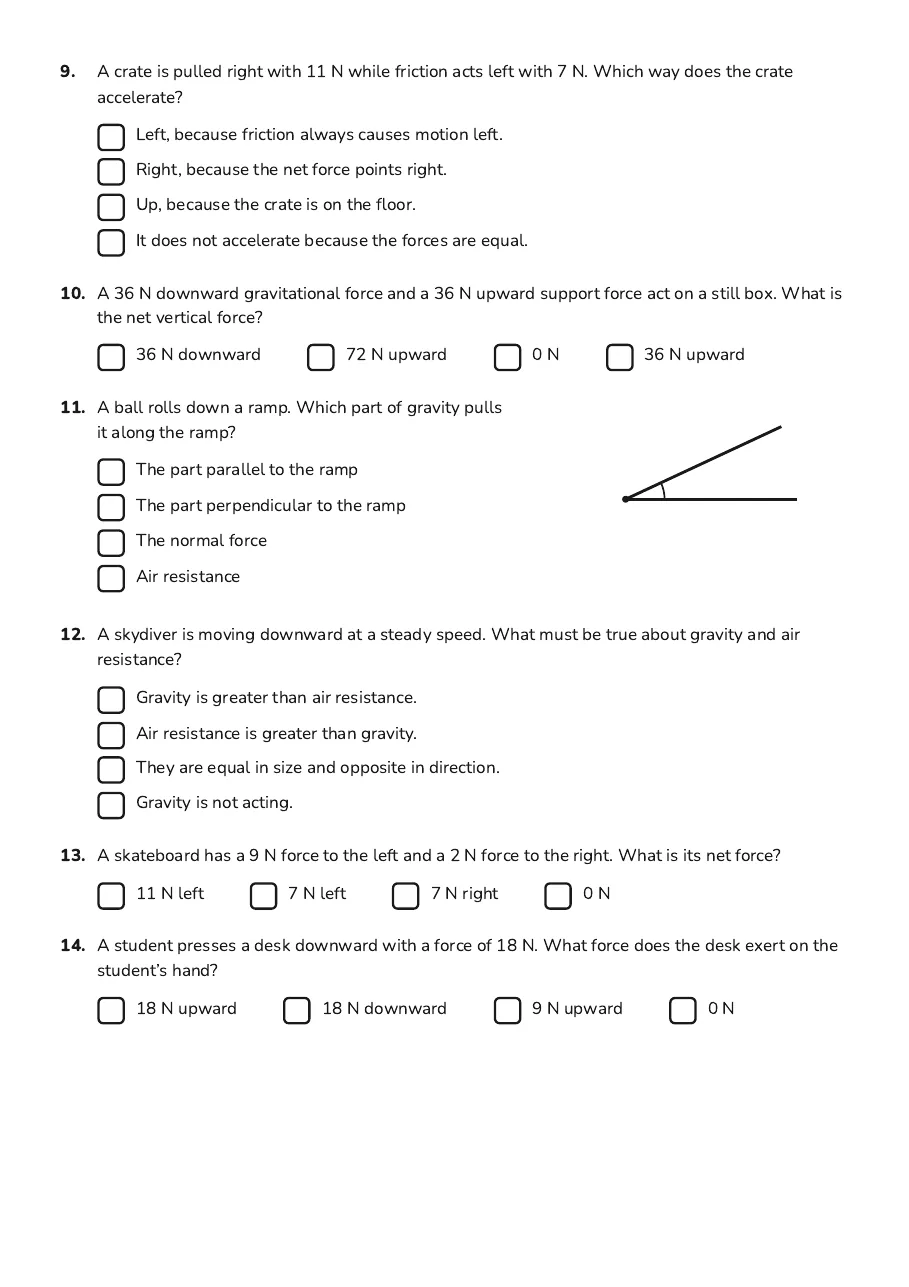
11.A ball rolls down a ramp. Which part of gravity pulls it along the ramp?
- The part parallel to the ramp
- The part perpendicular to the ramp
- The normal force
- Air resistance
12.A skydiver is moving downward at a steady speed. What must be true about gravity and air resistance?
- Gravity is greater than air resistance.
- Air resistance is greater than gravity.
- They are equal in size and opposite in direction.
- Gravity is not acting.
13.A skateboard has a 9 N force to the left and a 2 N force to the right. What is its net force?
- 11 N left
- 7 N left
- 7 N right
- 0 N
14.A student presses a desk downward with a force of 18 N. What force does the desk exert on the student’s hand?
- 18 N upward
- 18 N downward
- 9 N upward
- 0 N
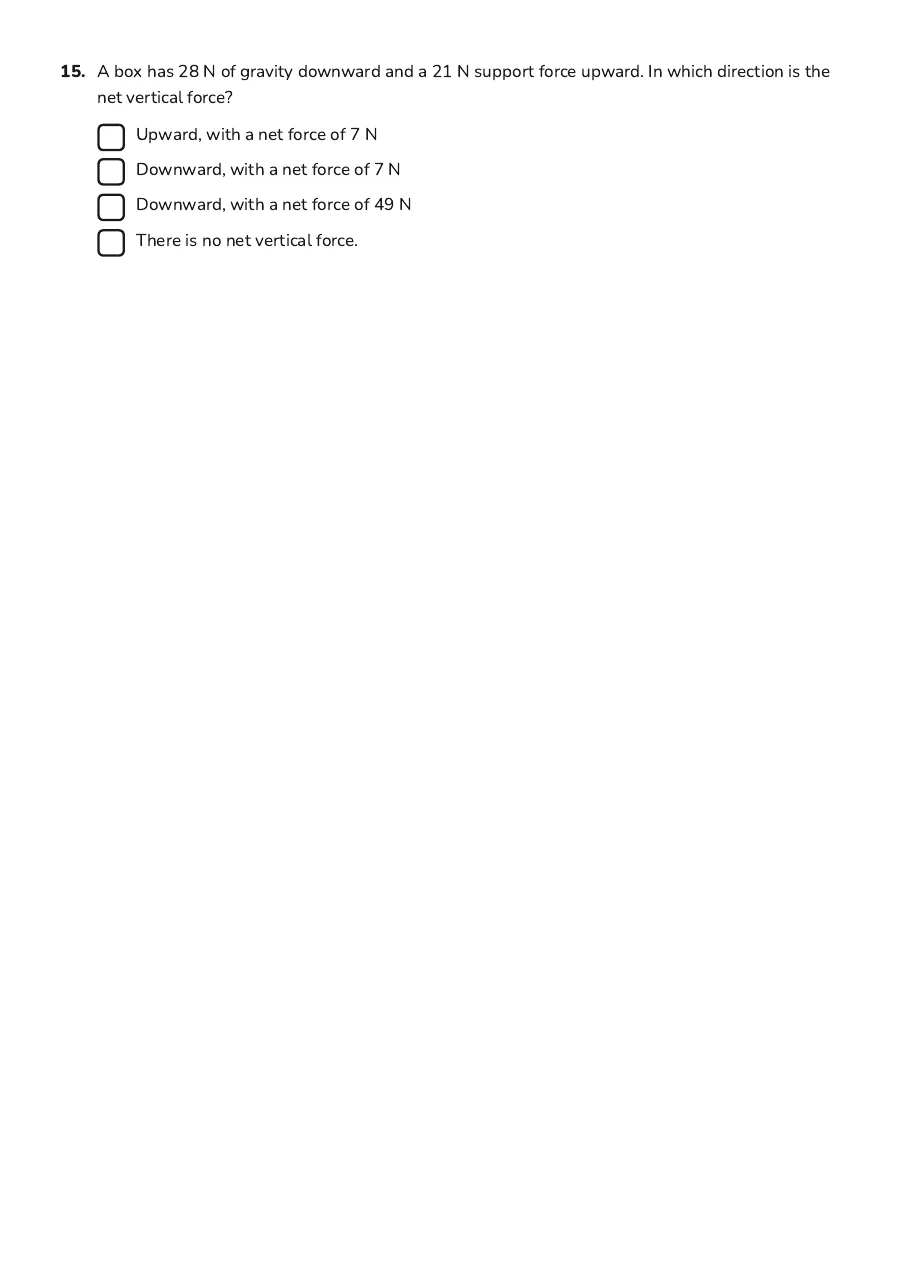
15.A box has 28 N of gravity downward and a 21 N support force upward. In which direction is the net vertical force?
- Upward, with a net force of 7 N
- Downward, with a net force of 7 N
- Downward, with a net force of 49 N
- There is no net vertical force.
4 printable pages
Page 1
Page 2
Page 3
Page 4
About This Worksheet
Free in Kuraplan
Sign up free, grab the PDF, and customize it for your class.
Print-Ready
Formatted for standard paper. Clean layout, easy to read.
AI-Generated
Created with Kuraplan's AI, designed for real classroom use.
For Teachers & Parents
Use in classrooms, for homework, tutoring, or homeschool.
Need a custom version of this worksheet?
Kuraplan's AI generates custom worksheets in seconds — differentiated for every learner, aligned to your curriculum.
Generate Custom Worksheets — Free No credit card Curriculum-aligned Under 60 seconds