Washington Jefferson Political Legacy
A free us history worksheet ready for your classroom. Open in Kuraplan to grab the print-ready PDF, customize it for your students, or generate a fresh version in seconds.
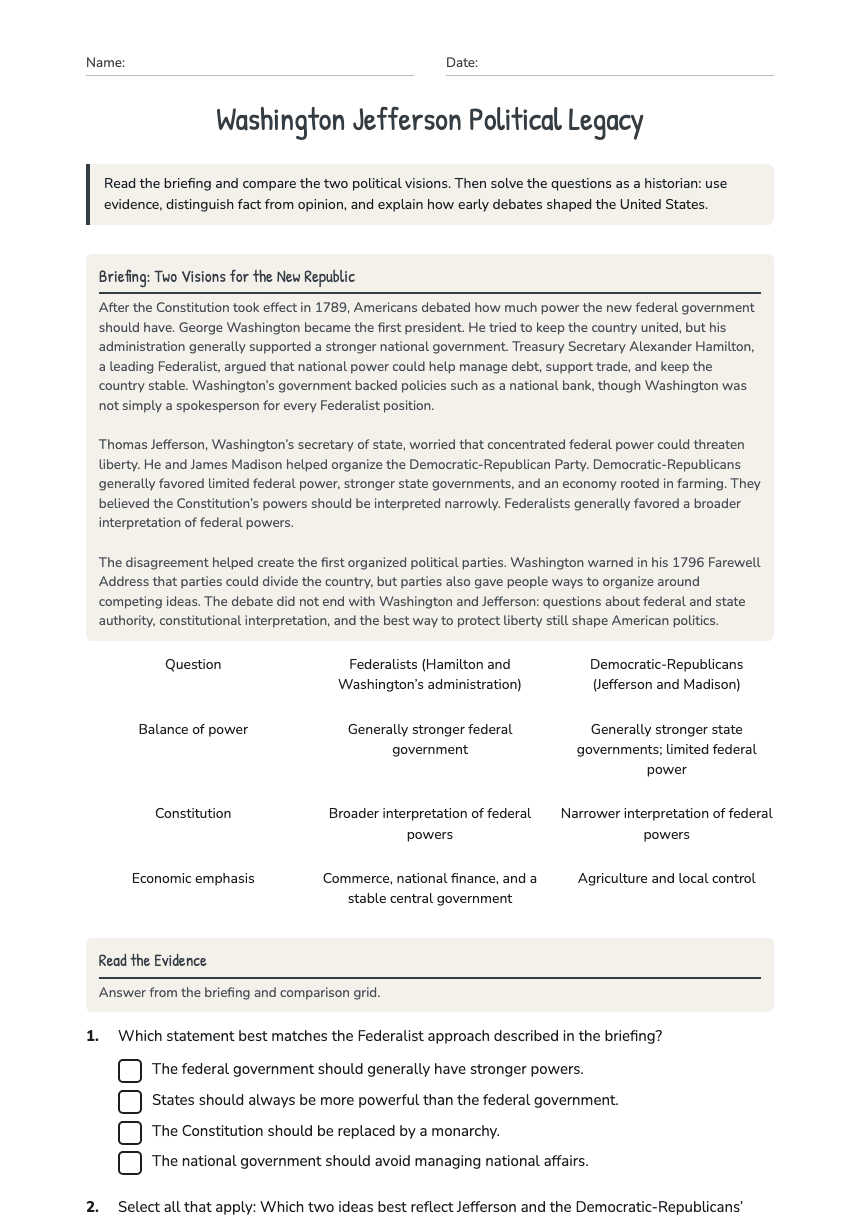
Washington Jefferson Political Legacy
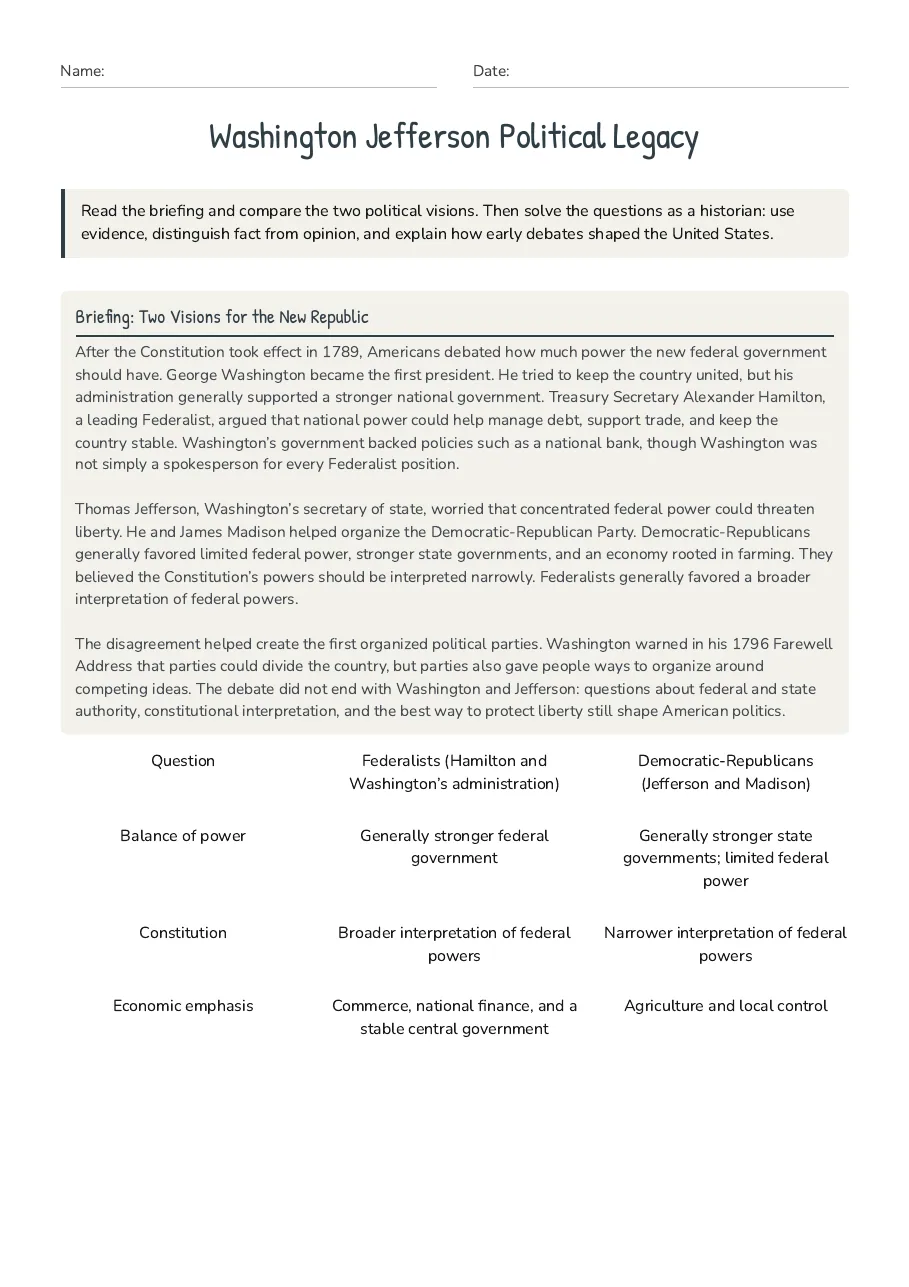
Briefing: Two Visions for the New Republic
After the Constitution took effect in 1789, Americans debated how much power the new federal government should have. George Washington became the first president. He tried to keep the country united, but his administration generally supported a stronger national government. Treasury Secretary Alexander Hamilton, a leading Federalist, argued that national power could help manage debt, support trade, and keep the country stable. Washington’s government backed policies such as a national bank, though Washington was not simply a spokesperson for every Federalist position. Thomas Jefferson, Washington’s secretary of state, worried that concentrated federal power could threaten liberty. He and James Madison helped organize the Democratic-Republican Party. Democratic-Republicans generally favored limited federal power, stronger state governments, and an economy rooted in farming. They believed the Constitution’s powers should be interpreted narrowly. Federalists generally favored a broader interpretation of federal powers. The disagreement helped create the first organized political parties. Washington warned in his 1796 Farewell Address that parties could divide the country, but parties also gave people ways to organize around competing ideas. The debate did not end with Washington and Jefferson: questions about federal and state authority, constitutional interpretation, and the best way to protect liberty still shape American politics.
Question
Federalists (Hamilton and Washington’s administration)
Democratic-Republicans (Jefferson and Madison)
Balance of power
Generally stronger federal government
Generally stronger state governments; limited federal power
Constitution
Broader interpretation of federal powers
Narrower interpretation of federal powers
Economic emphasis
Commerce, national finance, and a stable central government
Agriculture and local control
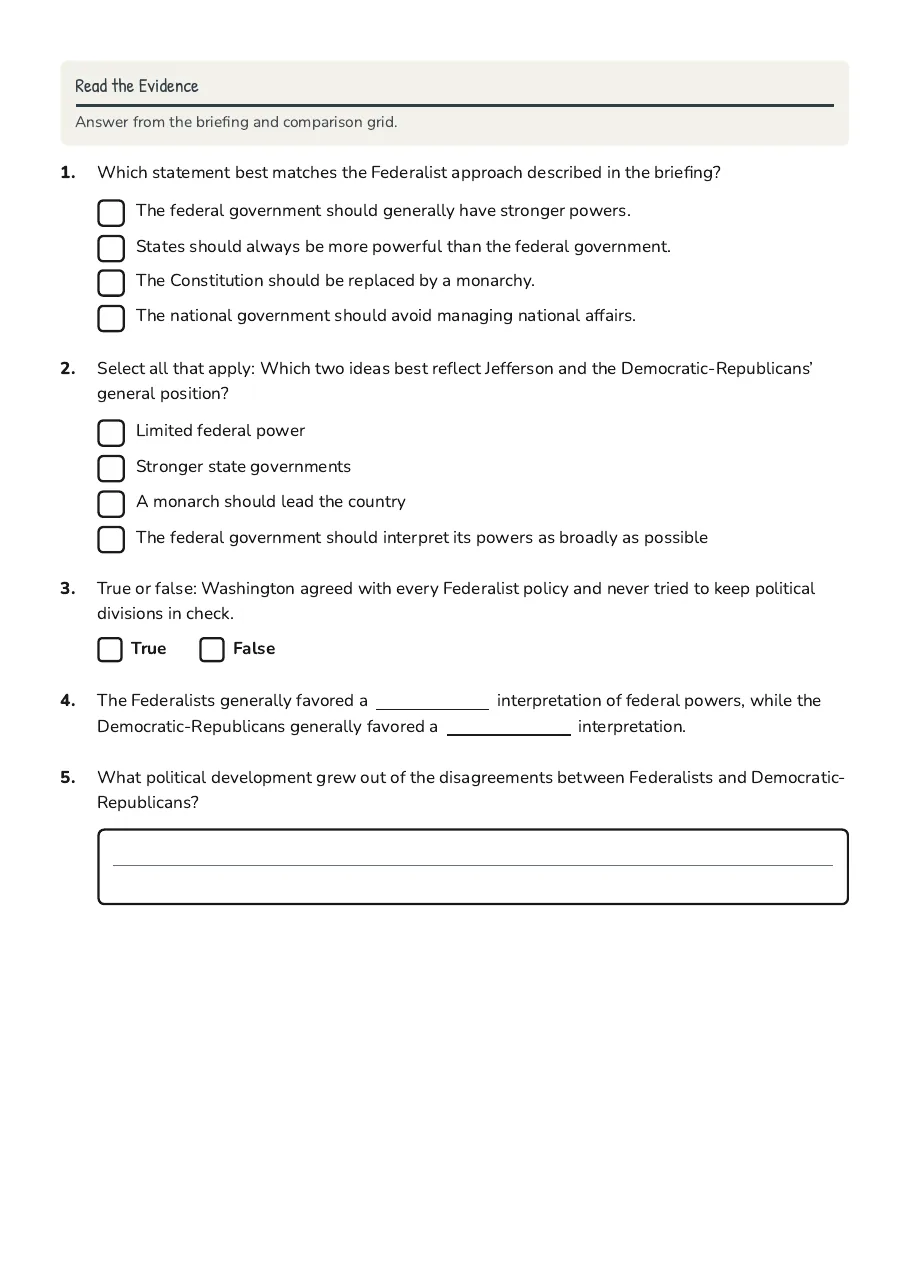
Read the Evidence
Answer from the briefing and comparison grid.
- The federal government should generally have stronger powers.
- States should always be more powerful than the federal government.
- The Constitution should be replaced by a monarchy.
- The national government should avoid managing national affairs.
- Limited federal power
- Stronger state governments
- A monarch should lead the country
- The federal government should interpret its powers as broadly as possible
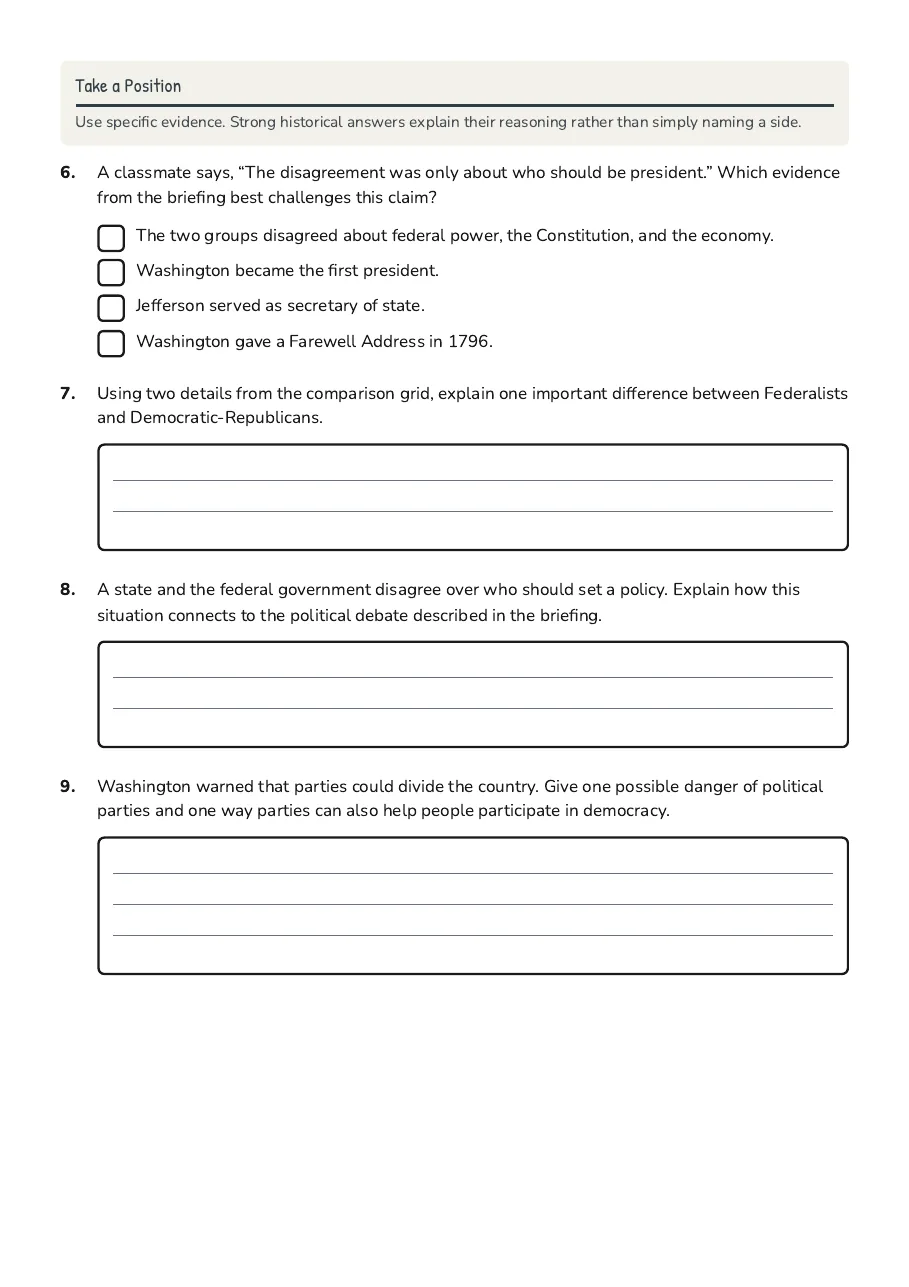
Take a Position
Use specific evidence. Strong historical answers explain their reasoning rather than simply naming a side.
- The two groups disagreed about federal power, the Constitution, and the economy.
- Washington became the first president.
- Jefferson served as secretary of state.
- Washington gave a Farewell Address in 1796.
4 printable pages
Page 1
Page 2
Page 3

Page 4
About This Worksheet
Free in Kuraplan
Sign up free, grab the PDF, and customize it for your class.
Print-Ready
Formatted for standard paper. Clean layout, easy to read.
AI-Generated
Created with Kuraplan's AI, designed for real classroom use.
For Teachers & Parents
Use in classrooms, for homework, tutoring, or homeschool.
Need a custom version of this worksheet?
Kuraplan's AI generates custom worksheets in seconds — differentiated for every learner, aligned to your curriculum.
Generate Custom Worksheets — FreeMore US History Worksheets
Washington Jefferson Political Legacy
Free
Sons of Liberty Roleplay
Free
Military Engineers Report
Free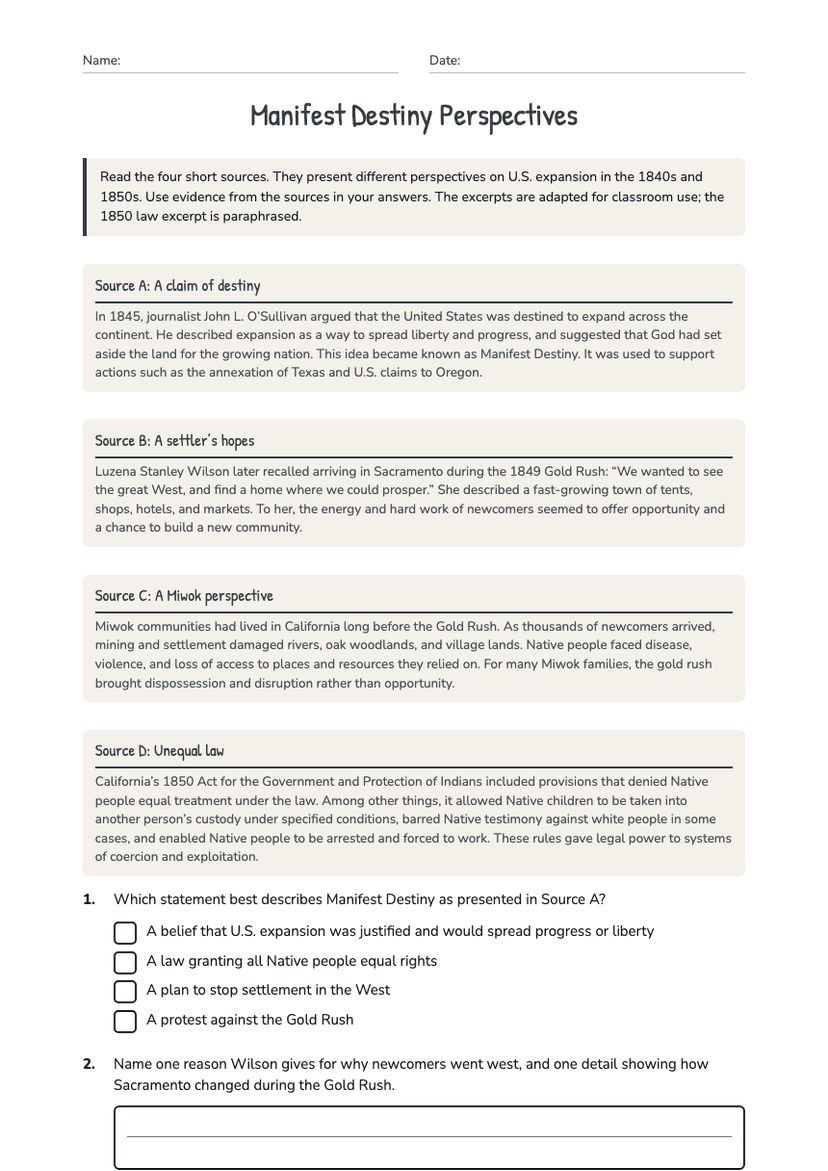
Manifest Destiny Perspectives
Free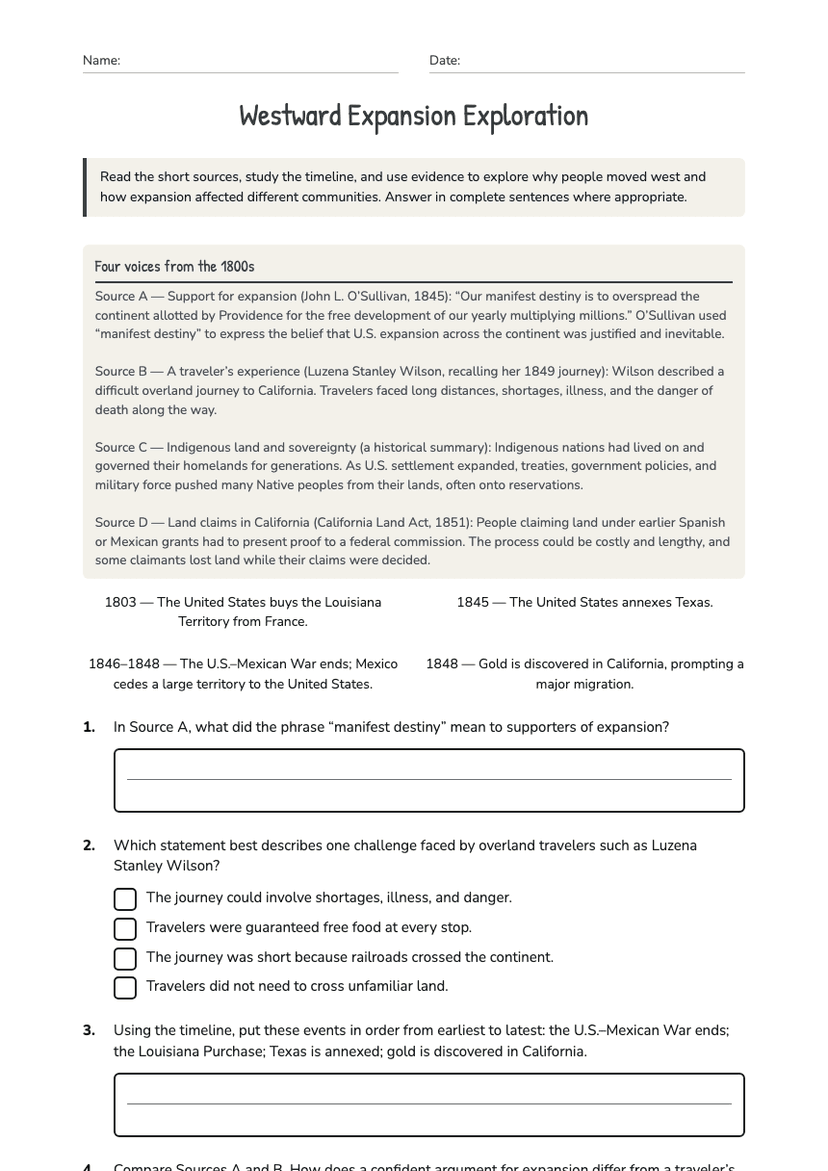
Westward Expansion Exploration
Free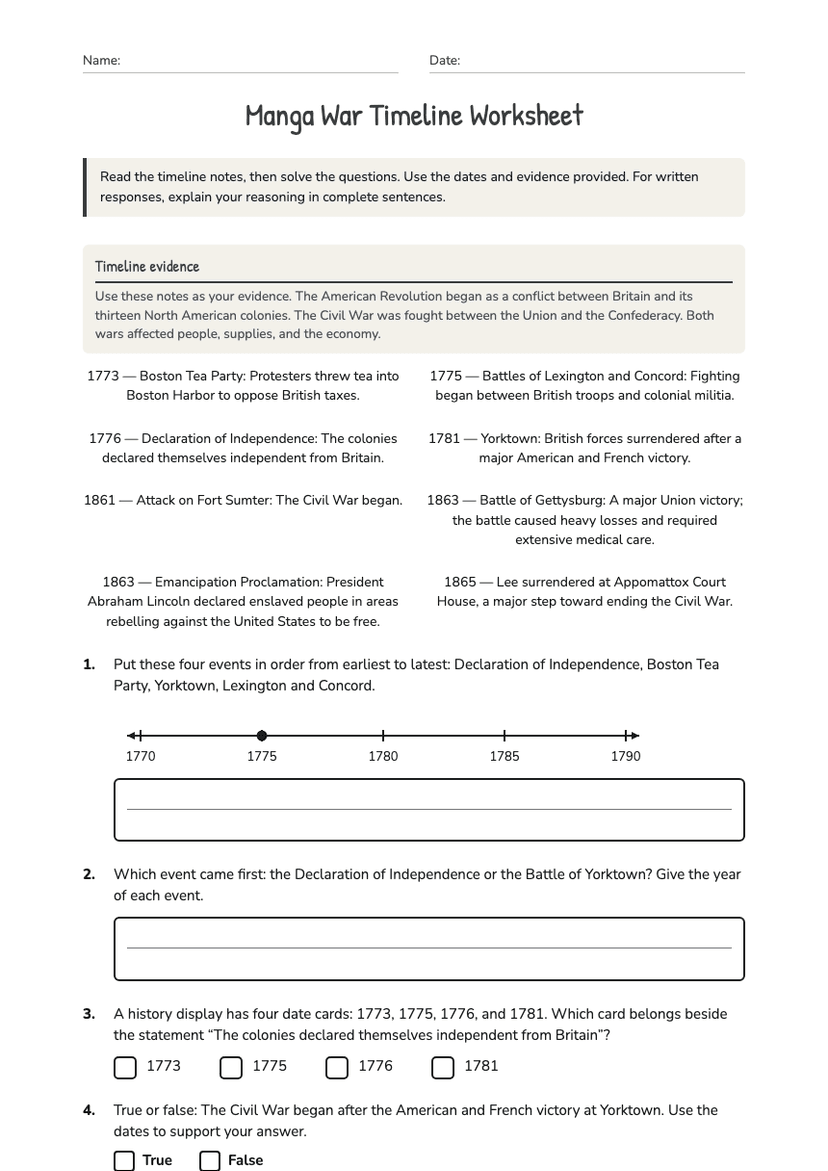
Manga War Timeline Worksheet
Free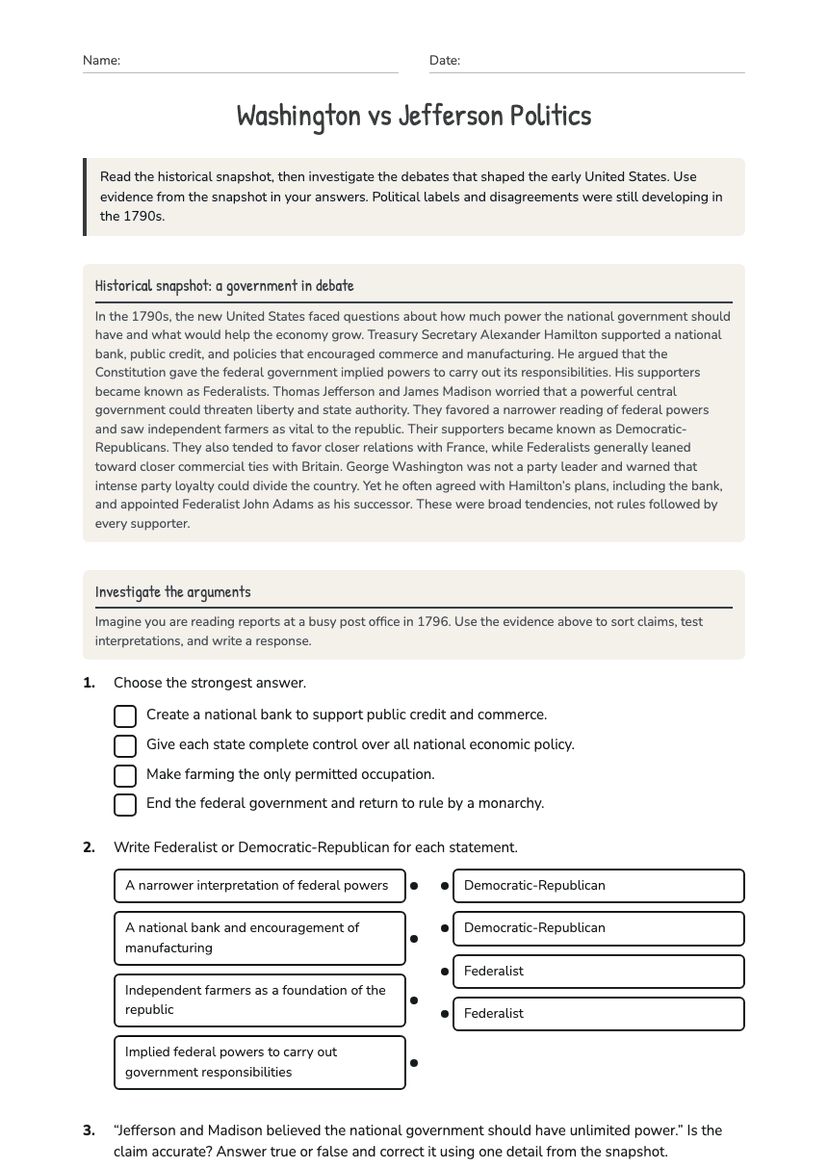
Washington vs Jefferson Politics
Free