Metallic Bonding: Electron Sea Model (detailed) — free printable diagram
Free science resource for teachers · CC BY-NC 4.0
About this illustration
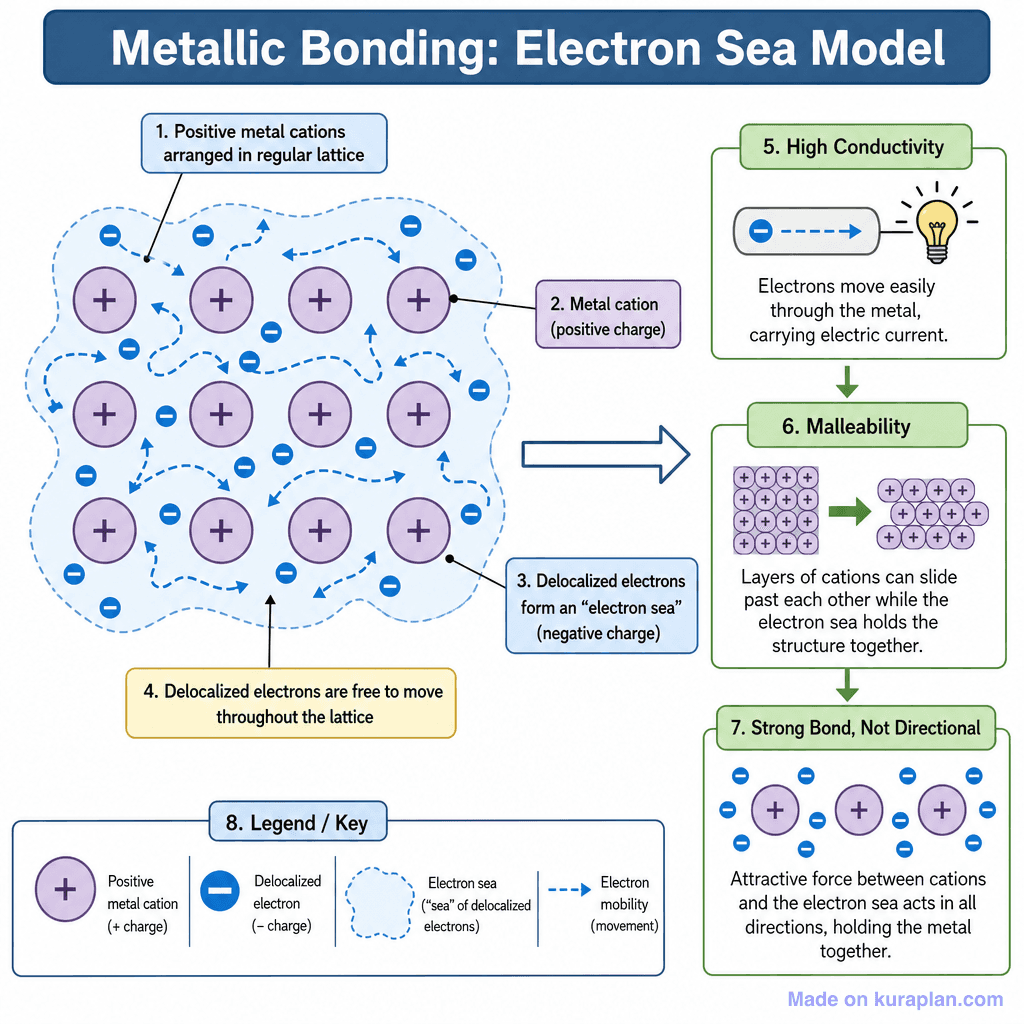
Metallic Bonding: Electron Sea Model (detailed)
What the electron sea model shows
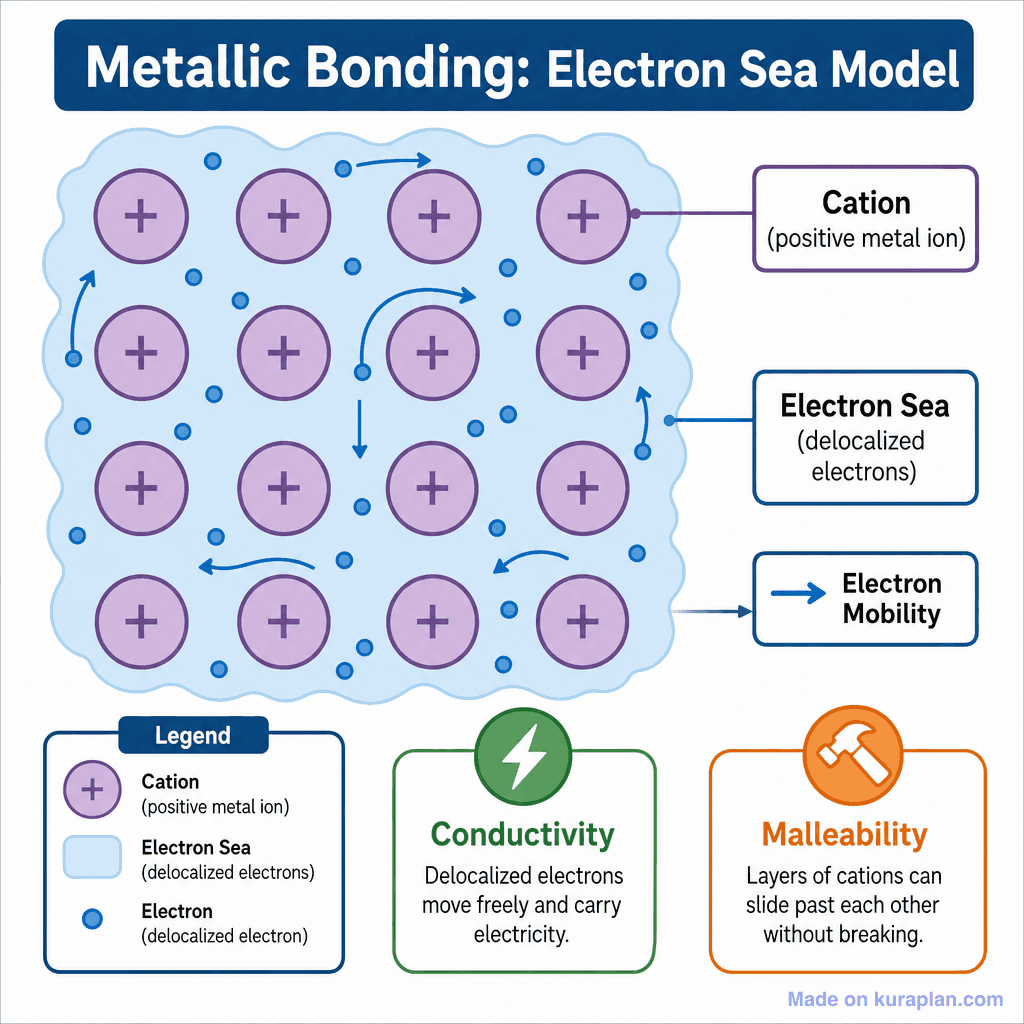
The electron sea model is the standard way of picturing metallic bonding. A metal is drawn as a regular lattice of positive metal ions sitting in a 'sea' of delocalised electrons — outer-shell electrons that have left their individual atoms and are free to move throughout the whole structure. The bond is the electrostatic attraction between those positive ions and the shared negative electrons.
- Positive ions
- Metal atoms that have lost their outer electrons
- The 'sea'
- Delocalised electrons, free to move through the structure
- The bond
- Attraction between positive ions and delocalised electrons
- Arrangement
- A regular, closely packed lattice
- Explains
- Electrical and thermal conductivity, malleability, high melting points
- 'Delocalised' is the key word: the electrons are not tied to any one atom and are shared across the entire lattice. That is what separates metallic bonding from covalent bonding, where a pair of electrons is shared between two specific atoms.
- Metals conduct electricity because the delocalised electrons are free to drift through the structure when a voltage is applied. The ions themselves stay where they are.
- The same free electrons carry energy quickly through the metal, which is why metals also conduct heat well.
- Metals are malleable and ductile because layers of ions can slide over one another without breaking the bonding — the electron sea simply flows with them and the attraction is maintained. In an ionic solid the same movement would push like charges together and shatter the crystal.
- Melting points are generally high because the attraction between the ions and the electron sea is strong and acts throughout the whole structure, so a large amount of energy is needed to break it down.
- The model is a simplification and is drawn in two dimensions, while a real metal lattice is three-dimensional and closely packed. It is a useful picture for explaining properties, not a literal photograph of the metal.
How to use
- 1Right-click the image and choose “Save image as”, or use the download button.
- 2Use it in your classroom worksheets, slides or printables — free under CC BY-NC 4.0.
- 3Attribute as “Image by Kuraplan” or link back to kuraplan.com. Not for commercial resale.
Turn this image into a worksheet
This illustration is already in Kuraplan's editor — describe the worksheet you need and the AI builds it around the image in seconds.
Related illustrations
More free science illustrations

Free worksheets on Metallic Bonding: Electron Sea Model (detailed)
All free worksheetsBrowse by subject
18 subjects · 4,850 free illustrations
Maths
1,894 free illustrations
Cross-Curricular
835 free illustrations
English
612 free illustrations
Geography
549 free illustrations
Health
200 free illustrations
Social Studies
177 free illustrations
Religious Education
139 free illustrations
Music
128 free illustrations
Art
66 free illustrations
Drama
56 free illustrations
Social Sciences
48 free illustrations
History
47 free illustrations
Arts
26 free illustrations
PE
25 free illustrations
Te Reo Māori
24 free illustrations
Technology
16 free illustrations
Culture
7 free illustrations
Languages
1 free illustrations