Anxiety Resilience Toolbox
A free health worksheet ready for your classroom. Open in Kuraplan to grab the print-ready PDF, customize it for your students, or generate a fresh version in seconds.
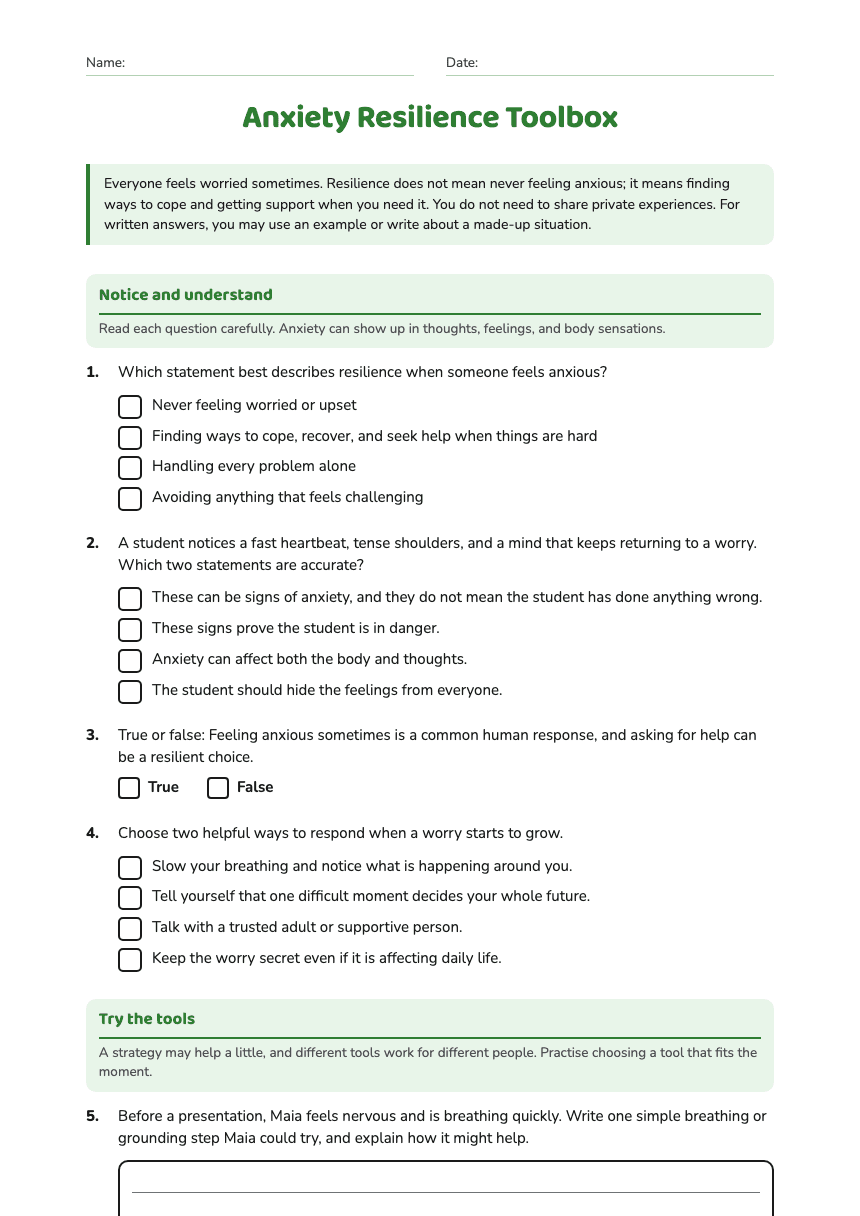
Anxiety Resilience Toolbox
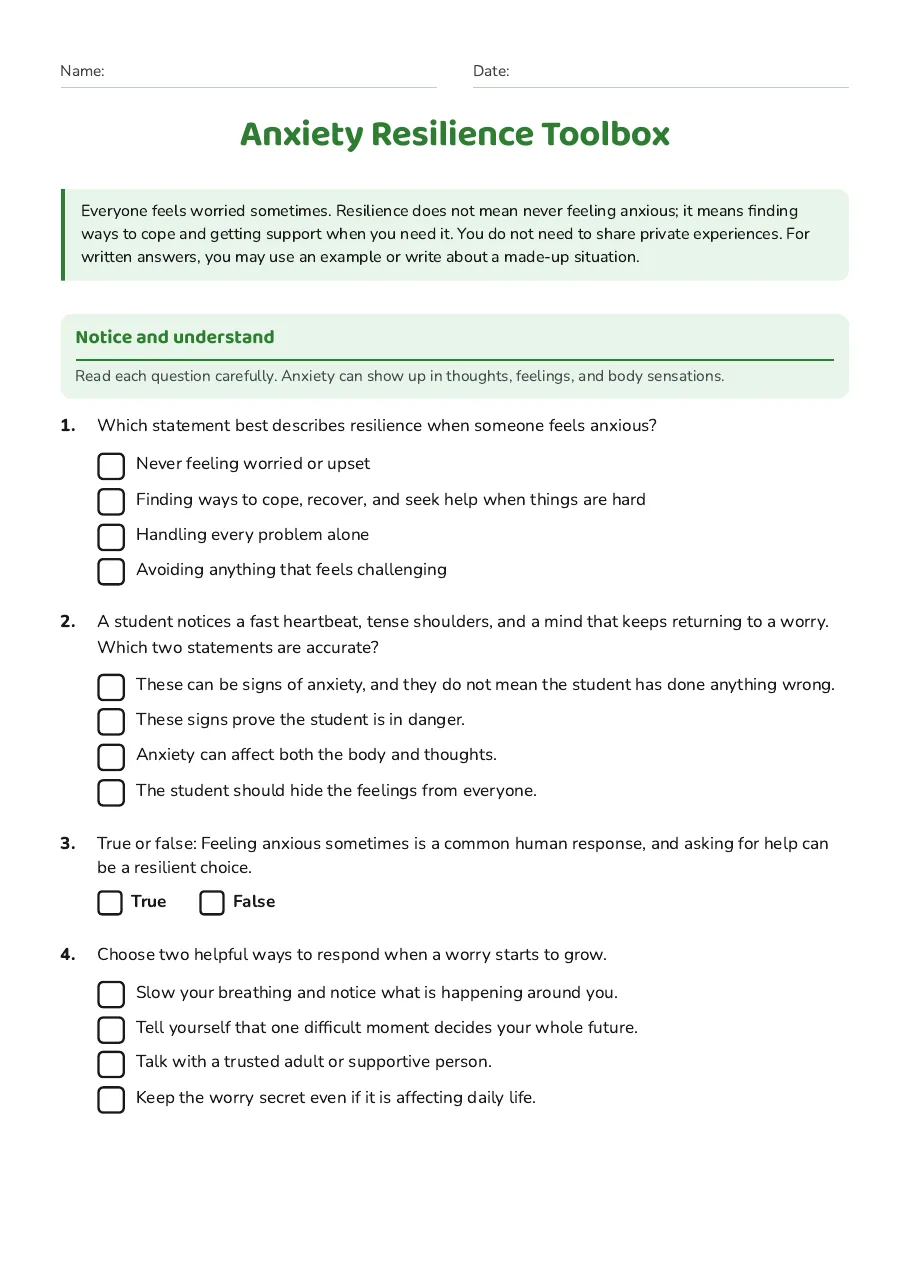
Notice and understand
Read each question carefully. Anxiety can show up in thoughts, feelings, and body sensations.
- Never feeling worried or upset
- Finding ways to cope, recover, and seek help when things are hard
- Handling every problem alone
- Avoiding anything that feels challenging
- These can be signs of anxiety, and they do not mean the student has done anything wrong.
- These signs prove the student is in danger.
- Anxiety can affect both the body and thoughts.
- The student should hide the feelings from everyone.
- Slow your breathing and notice what is happening around you.
- Tell yourself that one difficult moment decides your whole future.
- Talk with a trusted adult or supportive person.
- Keep the worry secret even if it is affecting daily life.
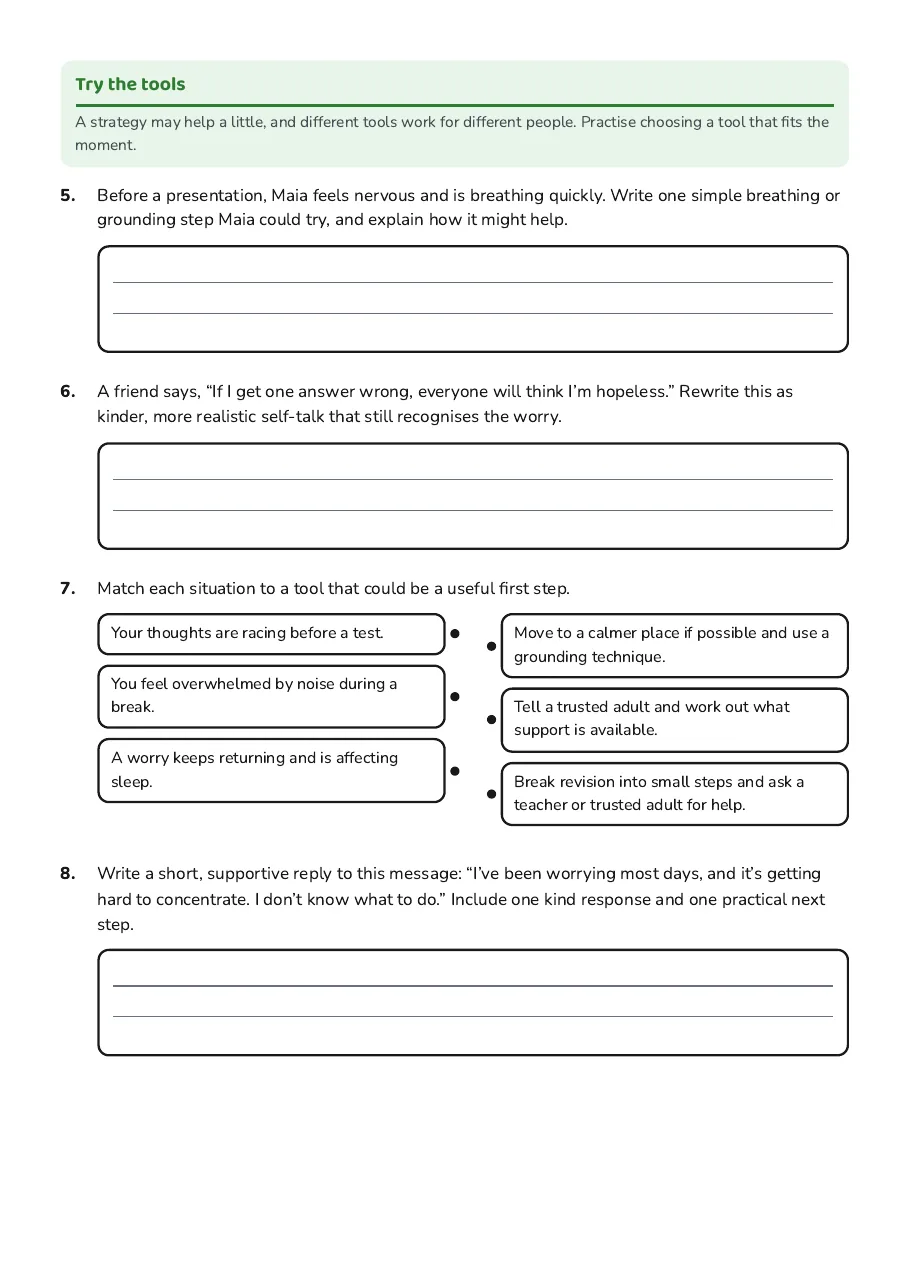
Try the tools
A strategy may help a little, and different tools work for different people. Practise choosing a tool that fits the moment.
- Your thoughts are racing before a test.
- You feel overwhelmed by noise during a break.
- A worry keeps returning and is affecting sleep.
- Move to a calmer place if possible and use a grounding technique.
- Tell a trusted adult and work out what support is available.
- Break revision into small steps and ask a teacher or trusted adult for help.
3 printable pages
Page 1
Page 2
Page 3
About This Worksheet
Free in Kuraplan
Sign up free, grab the PDF, and customize it for your class.
Print-Ready
Formatted for standard paper. Clean layout, easy to read.
AI-Generated
Created with Kuraplan's AI, designed for real classroom use.
For Teachers & Parents
Use in classrooms, for homework, tutoring, or homeschool.
Need a custom version of this worksheet?
Kuraplan's AI generates custom worksheets in seconds — differentiated for every learner, aligned to your curriculum.
Generate Custom Worksheets — Free