Atoms to Mixtures Exploration
A free science worksheet ready for your classroom. Open in Kuraplan to grab the print-ready PDF, customize it for your students, or generate a fresh version in seconds.
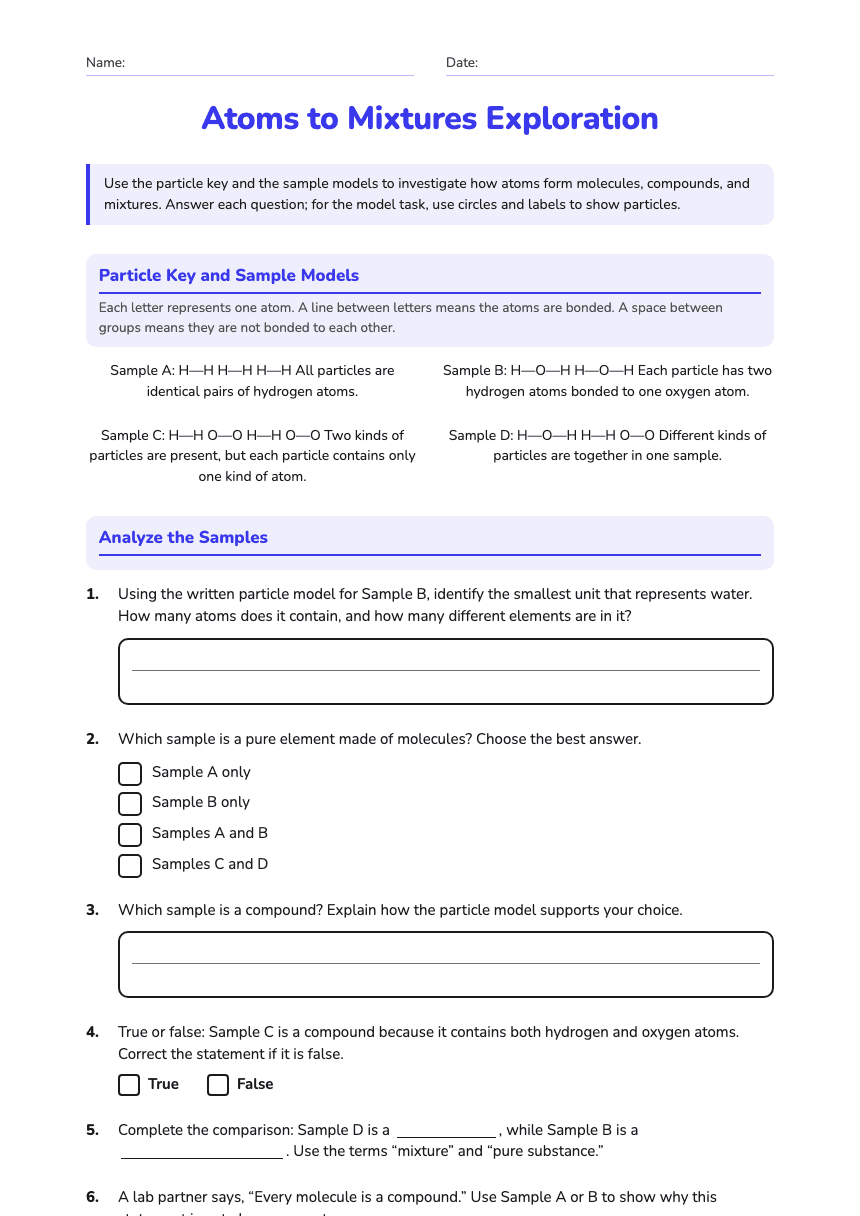
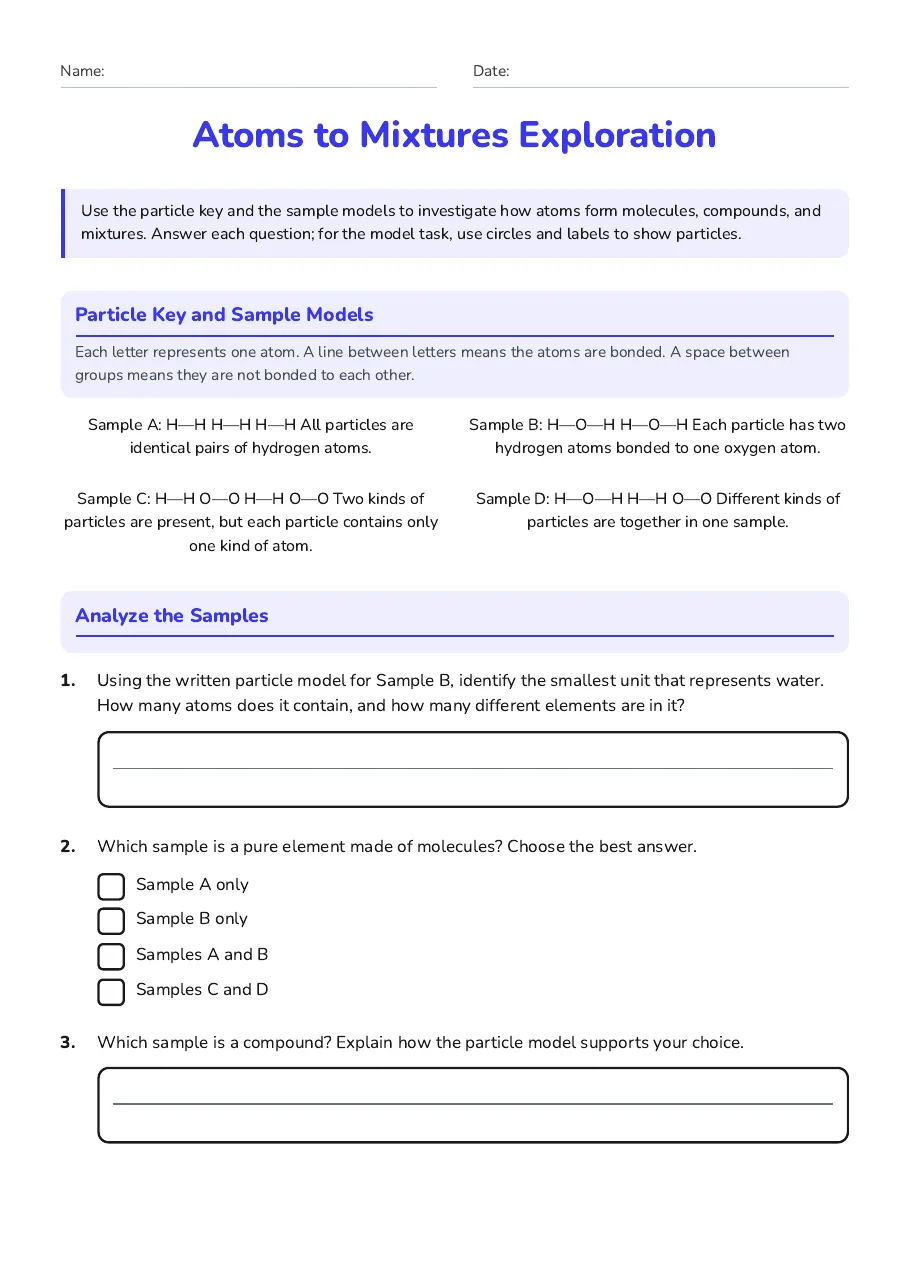
Atoms to Mixtures Exploration
Particle Key and Sample Models
Each letter represents one atom. A line between letters means the atoms are bonded. A space between groups means they are not bonded to each other.
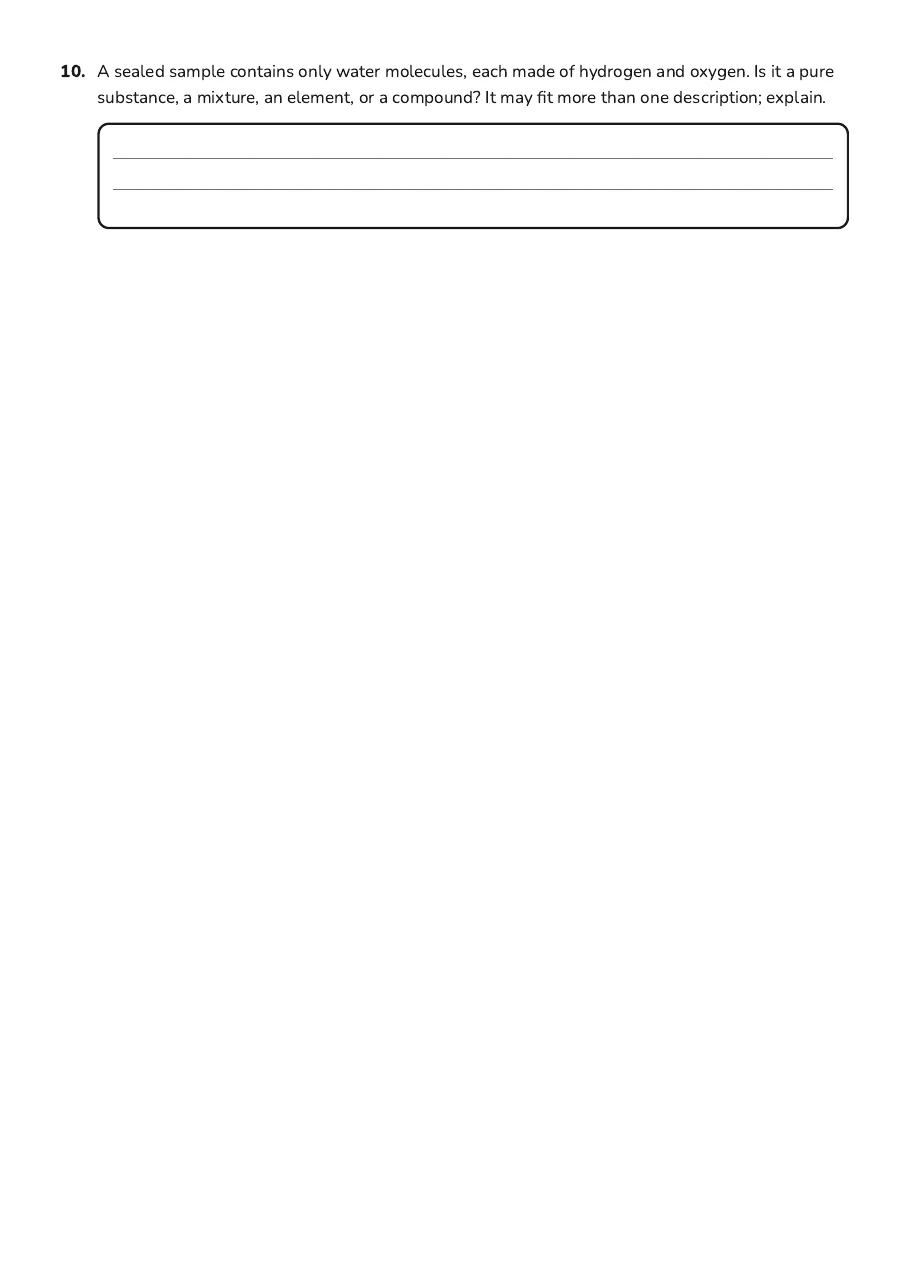
Sample A: H—H H—H H—H All particles are identical pairs of hydrogen atoms.
Sample B: H—O—H H—O—H Each particle has two hydrogen atoms bonded to one oxygen atom.
Sample C: H—H O—O H—H O—O Two kinds of particles are present, but each particle contains only one kind of atom.
Sample D: H—O—H H—H O—O Different kinds of particles are together in one sample.
Analyze the Samples
- Sample A only
- Sample B only
- Samples A and B
- Samples C and D
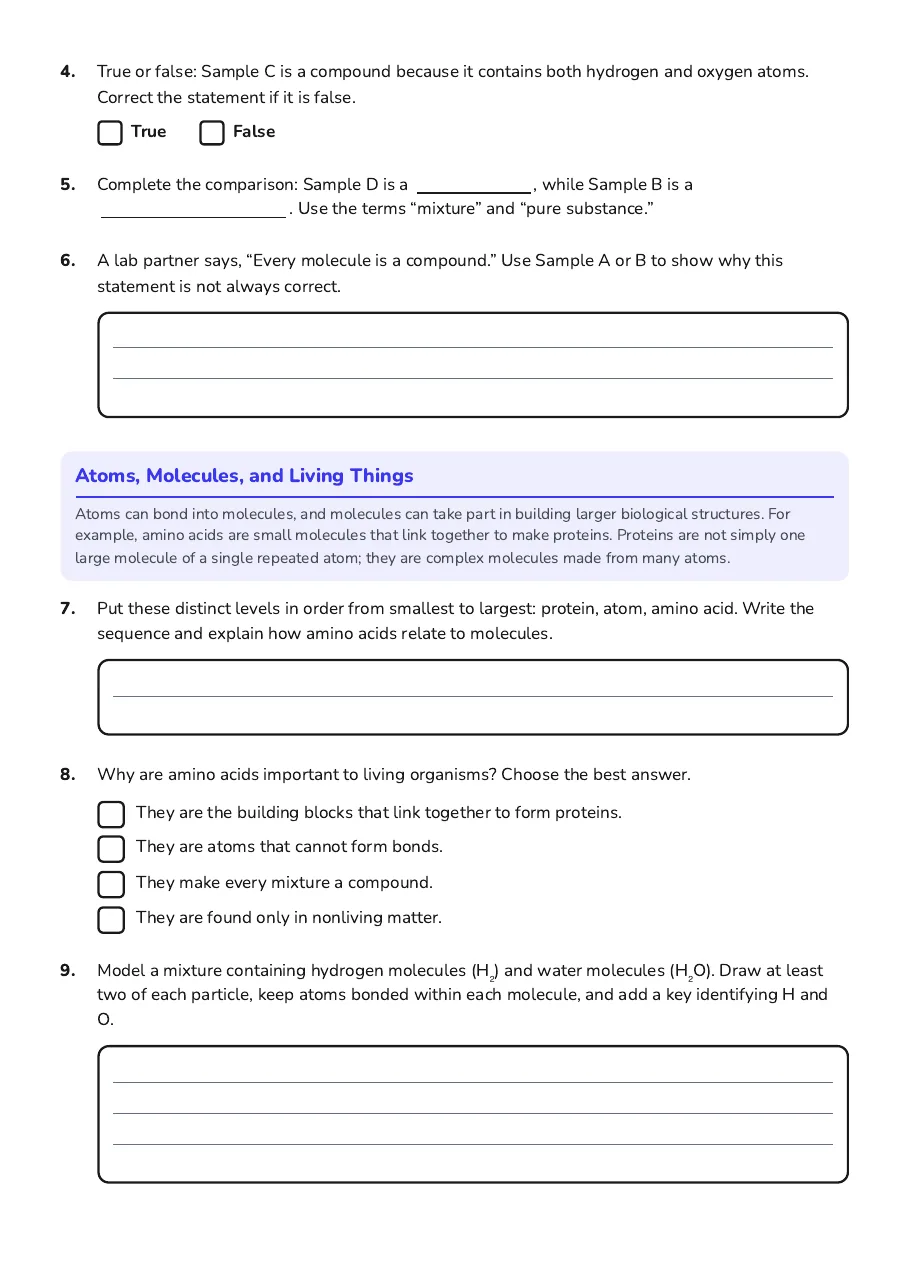
Atoms, Molecules, and Living Things
Atoms can bond into molecules, and molecules can take part in building larger biological structures. For example, amino acids are small molecules that link together to make proteins. Proteins are not simply one large molecule of a single repeated atom; they are complex molecules made from many atoms.
- They are the building blocks that link together to form proteins.
- They are atoms that cannot form bonds.
- They make every mixture a compound.
- They are found only in nonliving matter.
3 printable pages
Page 1
Page 2
Page 3
About This Worksheet
Free in Kuraplan
Sign up free, grab the PDF, and customize it for your class.
Print-Ready
Formatted for standard paper. Clean layout, easy to read.
AI-Generated
Created with Kuraplan's AI, designed for real classroom use.
For Teachers & Parents
Use in classrooms, for homework, tutoring, or homeschool.
Need a custom version of this worksheet?
Kuraplan's AI generates custom worksheets in seconds — differentiated for every learner, aligned to your curriculum.
Generate Custom Worksheets — FreeMore Science Worksheets
Atomic Structure Basics
Free
Controlling Chemical Reactions
Free
Periodic Table Properties Patterns
Free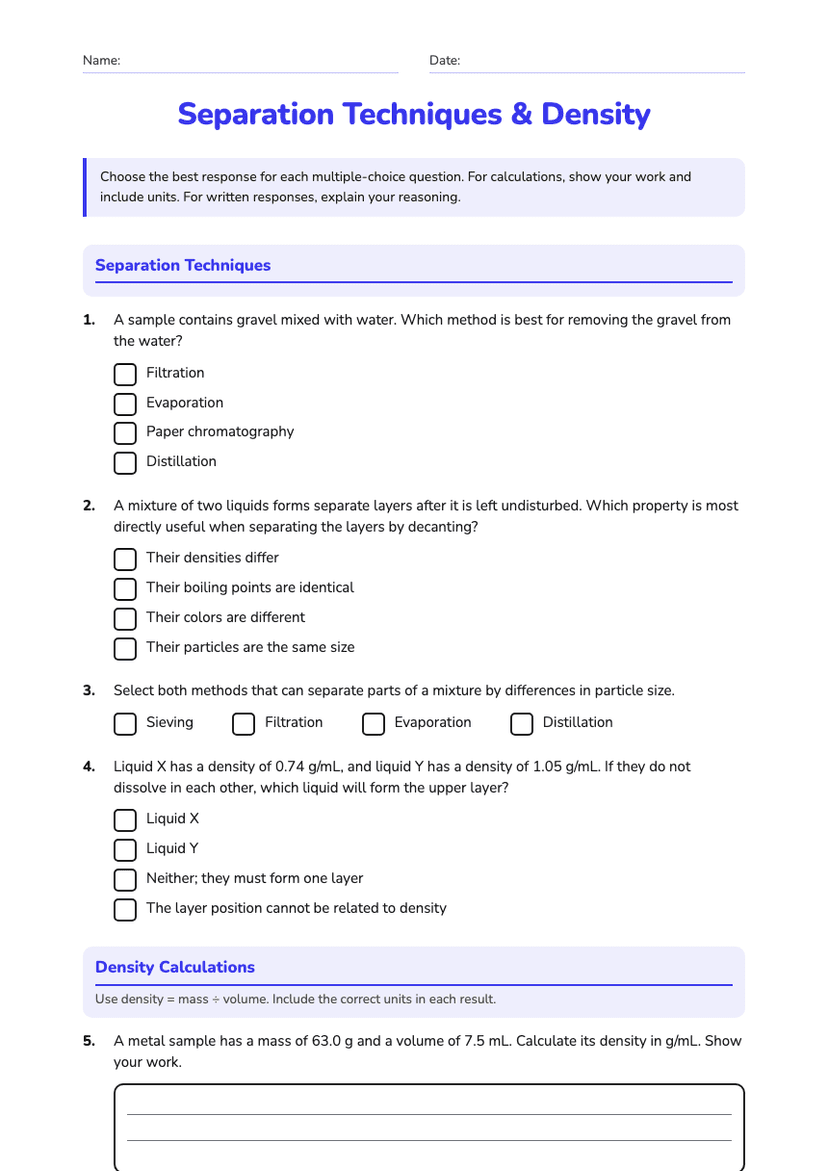
Separation Techniques & Density
Free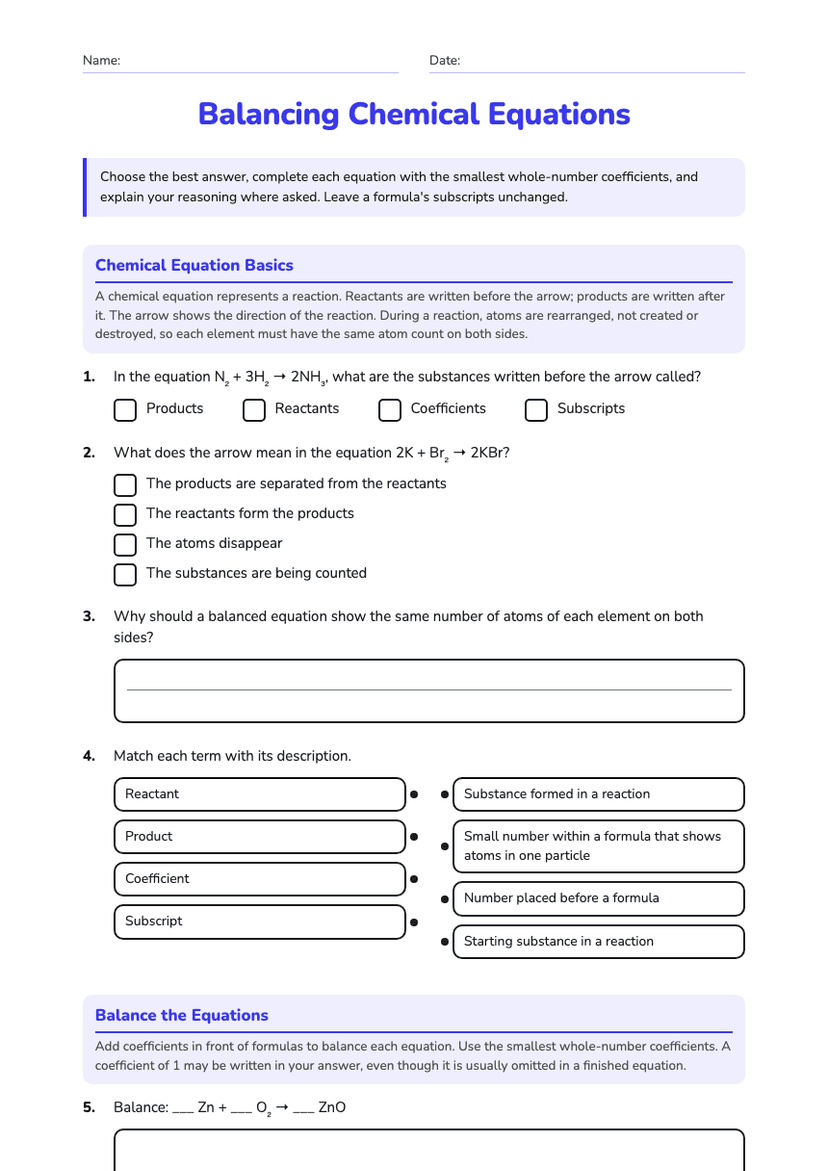
Balancing Chemical Equations
Free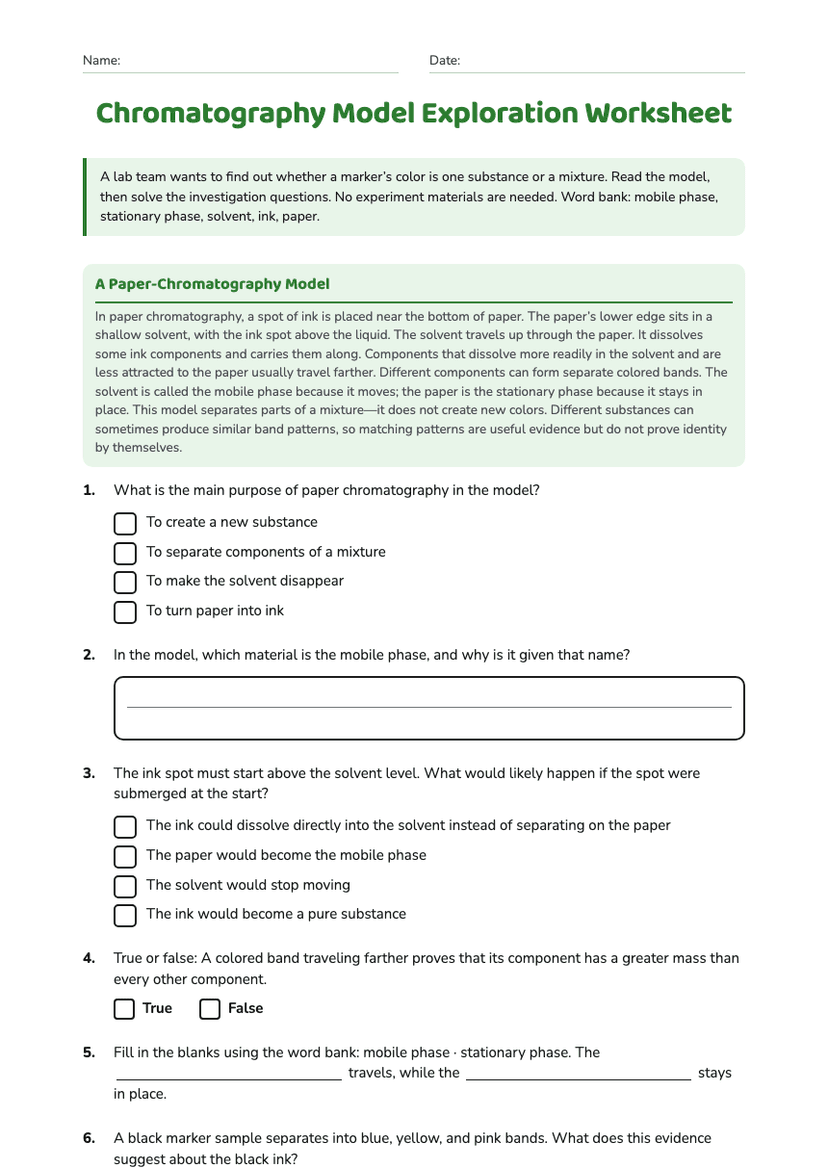
Chromatography Model Exploration Worksheet
Free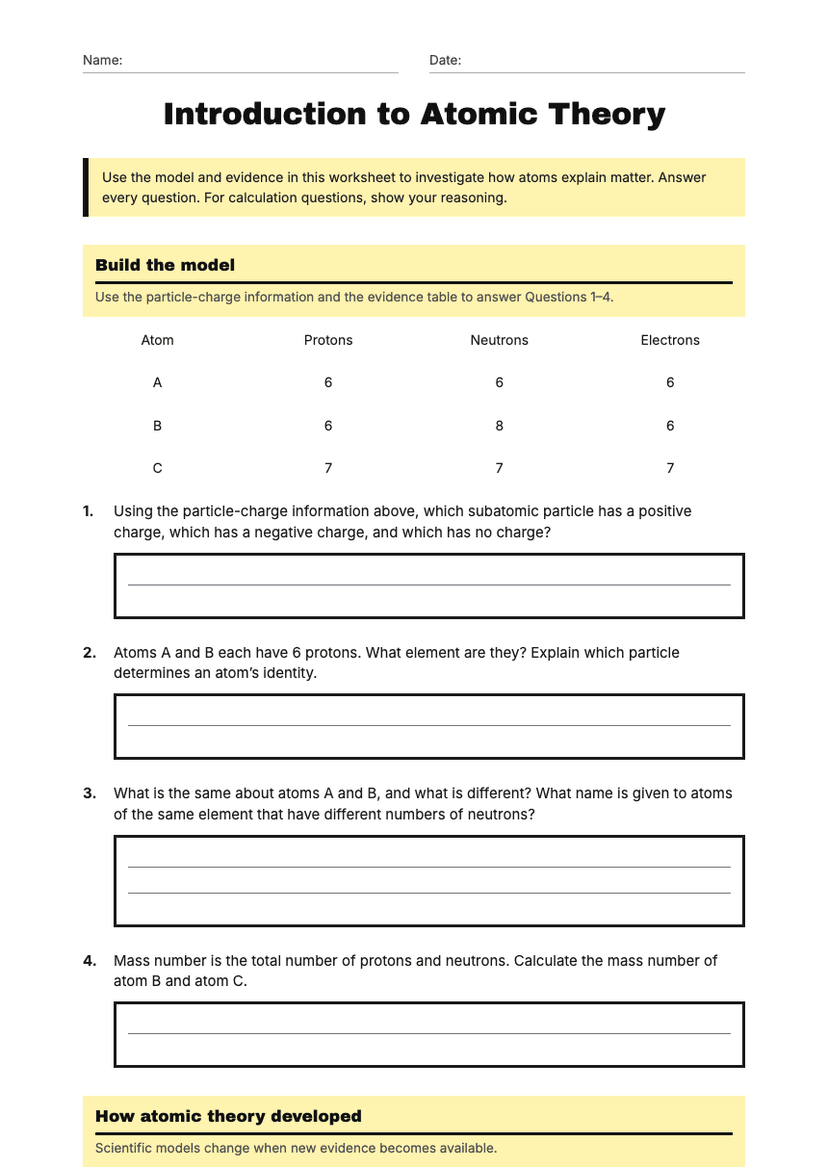
Introduction to Atomic Theory
Free