LanguagesFreePrintable

Latin American Poetry Introduction

A free languages worksheet ready for your classroom. Open in Kuraplan to grab the print-ready PDF, customize it for your students, or generate a fresh version in seconds.
Latin American Poetry Introduction worksheet preview
Name:Date:

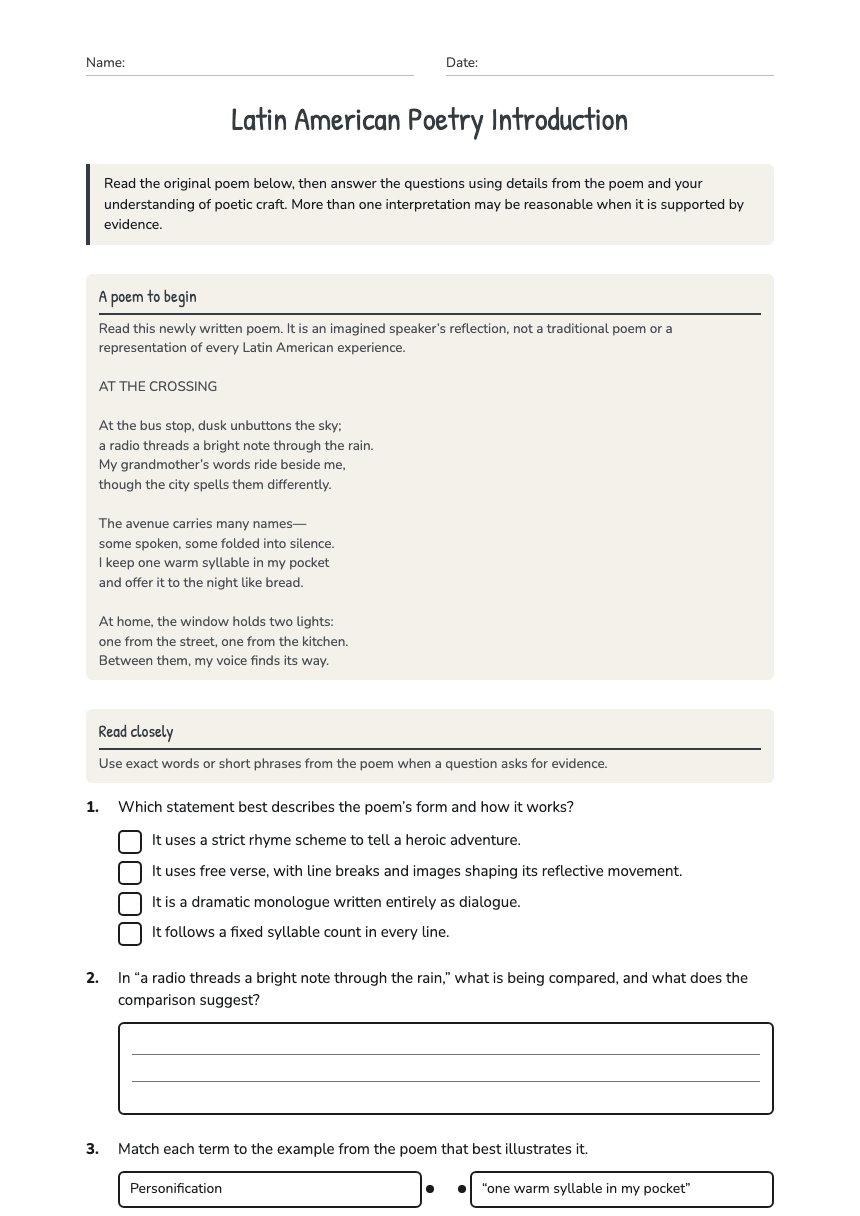
Latin American Poetry Introduction

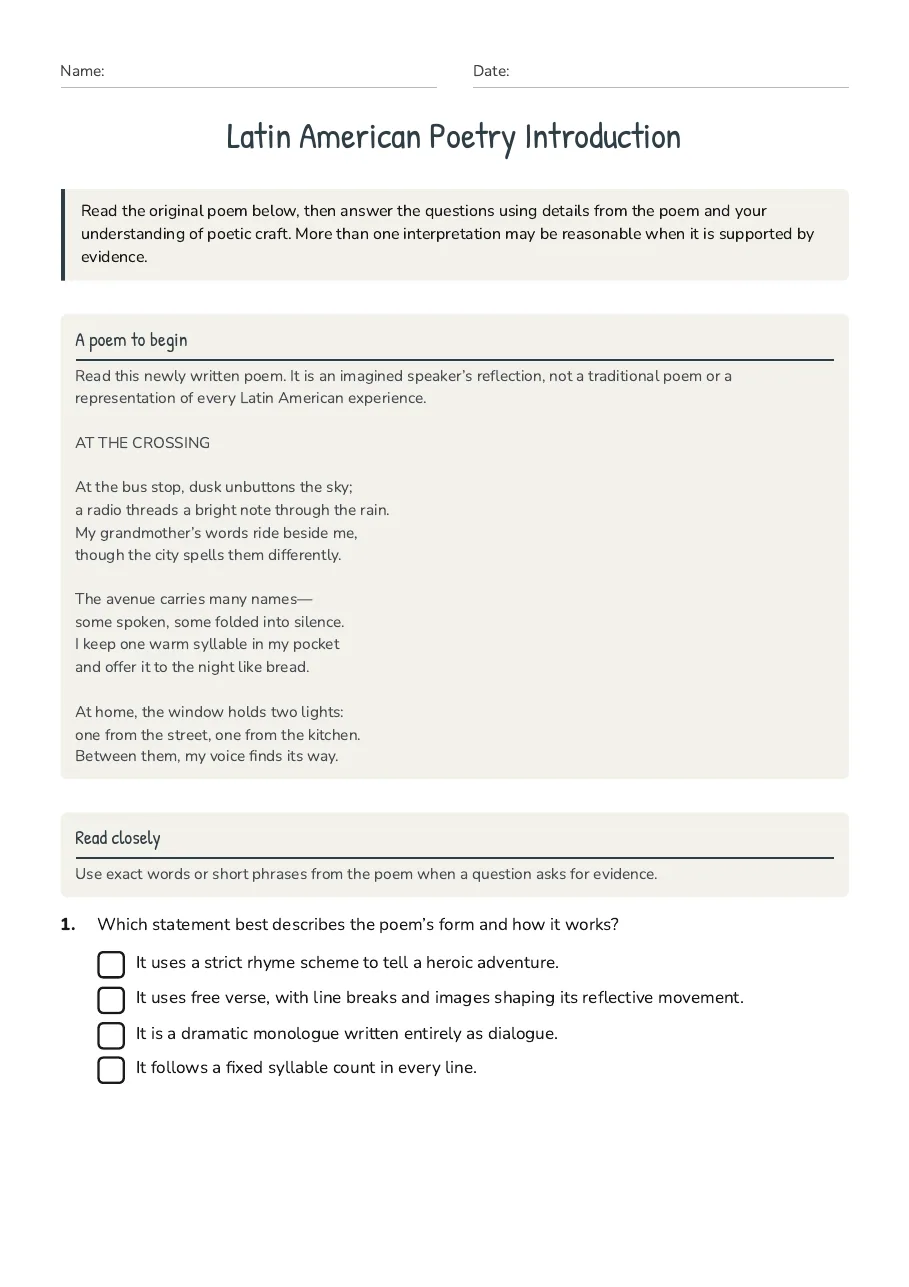
Read the original poem below, then answer the questions using details from the poem and your understanding of poetic craft. More than one interpretation may be reasonable when it is supported by evidence.

A poem to begin

Read this newly written poem. It is an imagined speaker’s reflection, not a traditional poem or a representation of every Latin American experience. AT THE CROSSING At the bus stop, dusk unbuttons the sky; a radio threads a bright note through the rain. My grandmother’s words ride beside me, though the city spells them differently. The avenue carries many names— some spoken, some folded into silence. I keep one warm syllable in my pocket and offer it to the night like bread. At home, the window holds two lights: one from the street, one from the kitchen. Between them, my voice finds its way.

Read closely

Use exact words or short phrases from the poem when a question asks for evidence.

1.Which statement best describes the poem’s form and how it works?
  • It uses a strict rhyme scheme to tell a heroic adventure.
  • It uses free verse, with line breaks and images shaping its reflective movement.
  • It is a dramatic monologue written entirely as dialogue.
  • It follows a fixed syllable count in every line.
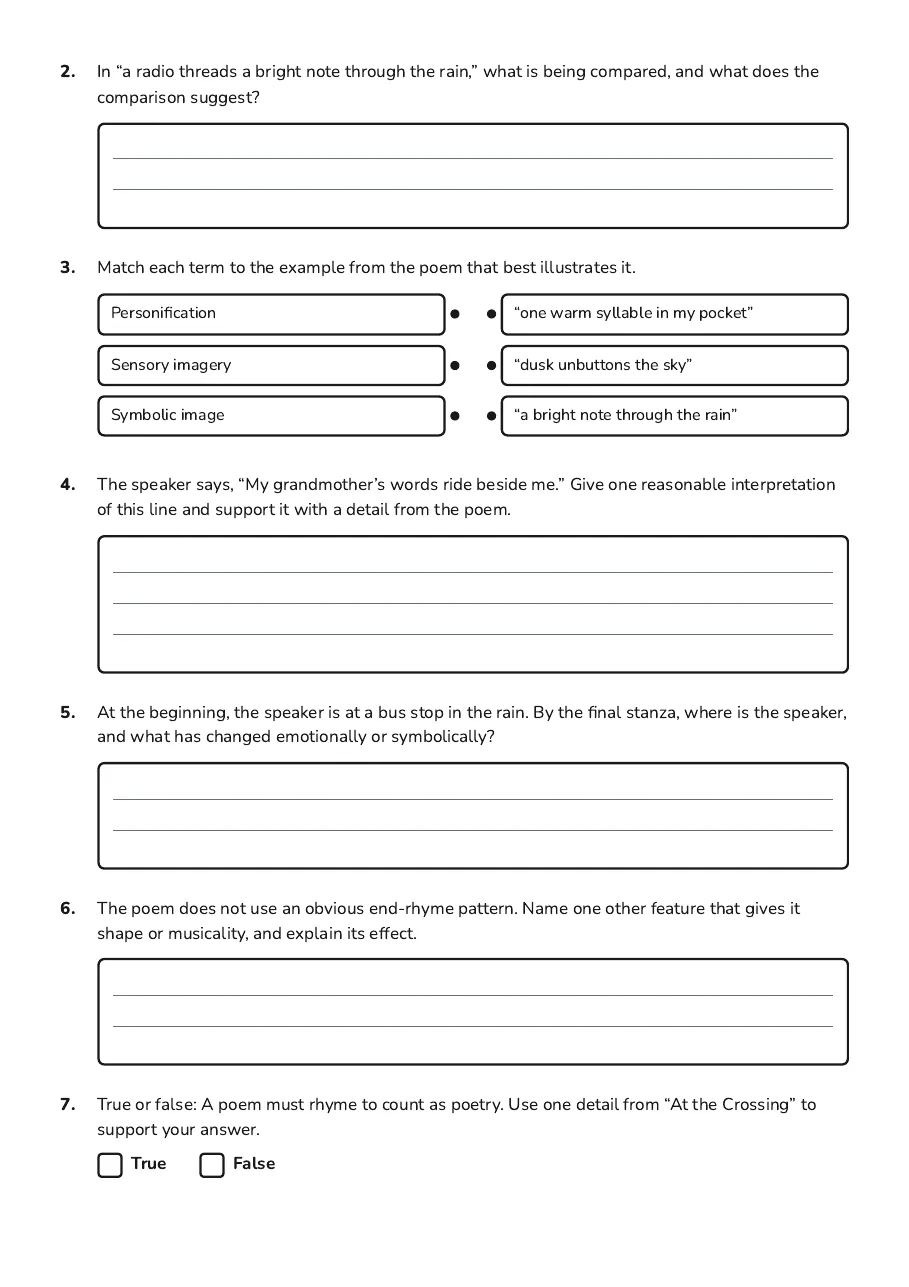
2.In “a radio threads a bright note through the rain,” what is being compared, and what does the comparison suggest?
3.Match each term to the example from the poem that best illustrates it.
  • Personification
  • Sensory imagery
  • Symbolic image
  • “one warm syllable in my pocket”
  • “dusk unbuttons the sky”
  • “a bright note through the rain”
4.The speaker says, “My grandmother’s words ride beside me.” Give one reasonable interpretation of this line and support it with a detail from the poem.
5.At the beginning, the speaker is at a bus stop in the rain. By the final stanza, where is the speaker, and what has changed emotionally or symbolically?
6.The poem does not use an obvious end-rhyme pattern. Name one other feature that gives it shape or musicality, and explain its effect.
7.True or false: A poem must rhyme to count as poetry. Use one detail from “At the Crossing” to support your answer.
TrueFalse
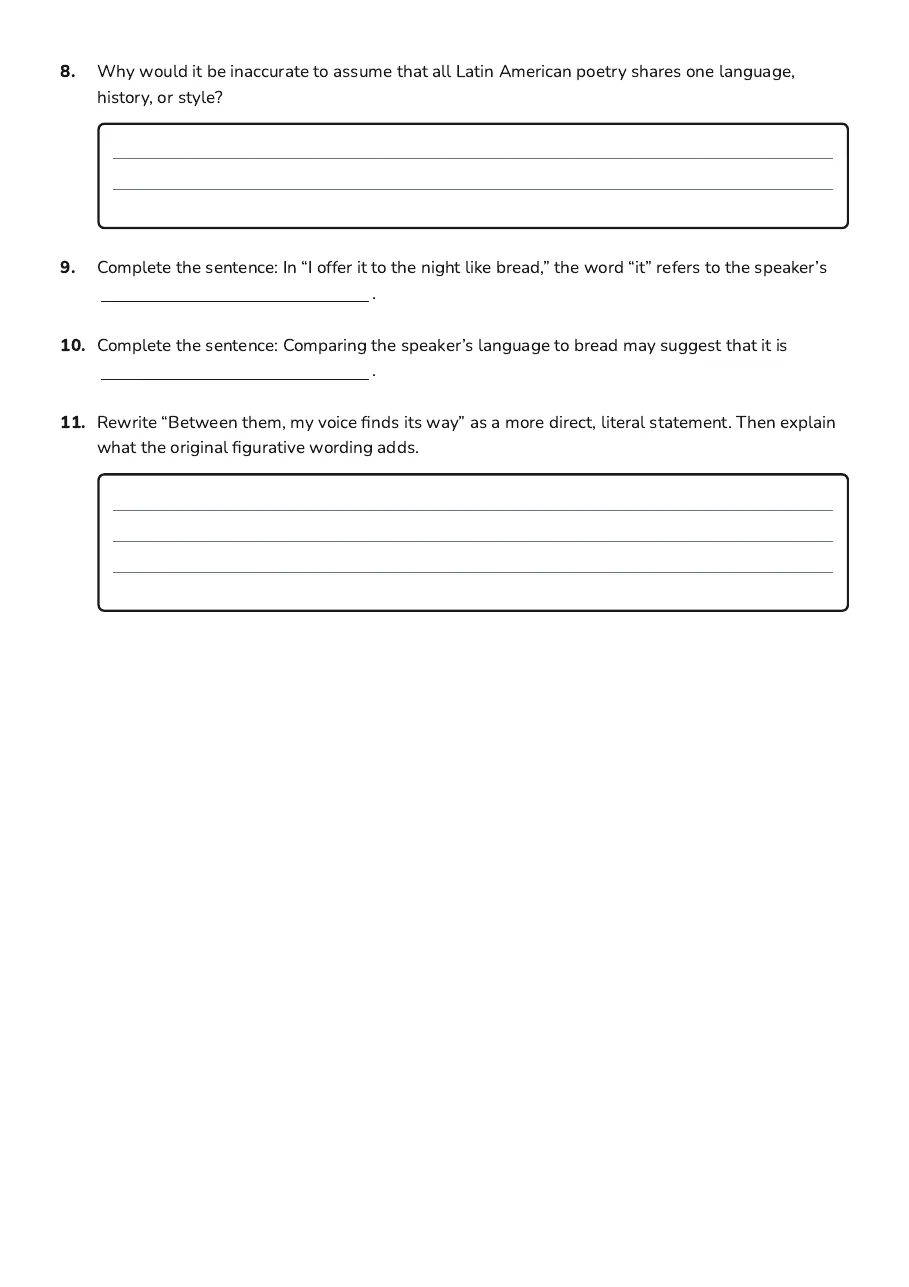
8.Why would it be inaccurate to assume that all Latin American poetry shares one language, history, or style?
9.Complete the sentence: In “I offer it to the night like bread,” the word “it” refers to the speaker’s .
10.Complete the sentence: Comparing the speaker’s language to bread may suggest that it is .
11.Rewrite “Between them, my voice finds its way” as a more direct, literal statement. Then explain what the original figurative wording adds.

3 printable pages

  • Latin American Poetry Introduction, page 1 of 3: A poem to begin, Read closely

    Page 1

  • Latin American Poetry Introduction, page 2 of 3: 2. In “a radio threads a bright note through the rain,” what is being compared, and what…

    Page 2

  • Latin American Poetry Introduction, page 3 of 3: 8. Why would it be inaccurate to assume that all Latin American poetry shares one…

    Page 3

About This Worksheet

Free in Kuraplan

Sign up free, grab the PDF, and customize it for your class.

Print-Ready

Formatted for standard paper. Clean layout, easy to read.

AI-Generated

Created with Kuraplan's AI, designed for real classroom use.

For Teachers & Parents

Use in classrooms, for homework, tutoring, or homeschool.

Need a custom version of this worksheet?

Kuraplan's AI generates custom worksheets in seconds — differentiated for every learner, aligned to your curriculum.

Generate Custom Worksheets — Free
No credit card Curriculum-aligned Under 60 seconds