Newton's Laws Reading
A free science worksheet ready for your classroom. Open in Kuraplan to grab the print-ready PDF, customize it for your students, or generate a fresh version in seconds.
Newton's Laws Reading
📖 Reading Passage
Focus: This passage explains Newton's three laws of motion and how they affect objects in our everyday lives.
Newton's Three Laws of Motion
Sir Isaac Newton was a brilliant scientist who lived over 300 years ago. He discovered three important rules about how objects move, which we call Newton's Laws of Motion.
Newton's First Law: The Law of Inertia
An object at rest stays at rest, and an object in motion stays in motion, unless acted upon by an outside force. This means that things don't start moving or stop moving by themselves - something has to push or pull them. For example, a soccer ball sitting on the ground won't move until you kick it. Once you kick it, it will keep rolling until friction from the grass slows it down.
Newton's Second Law: Force = Mass × Acceleration
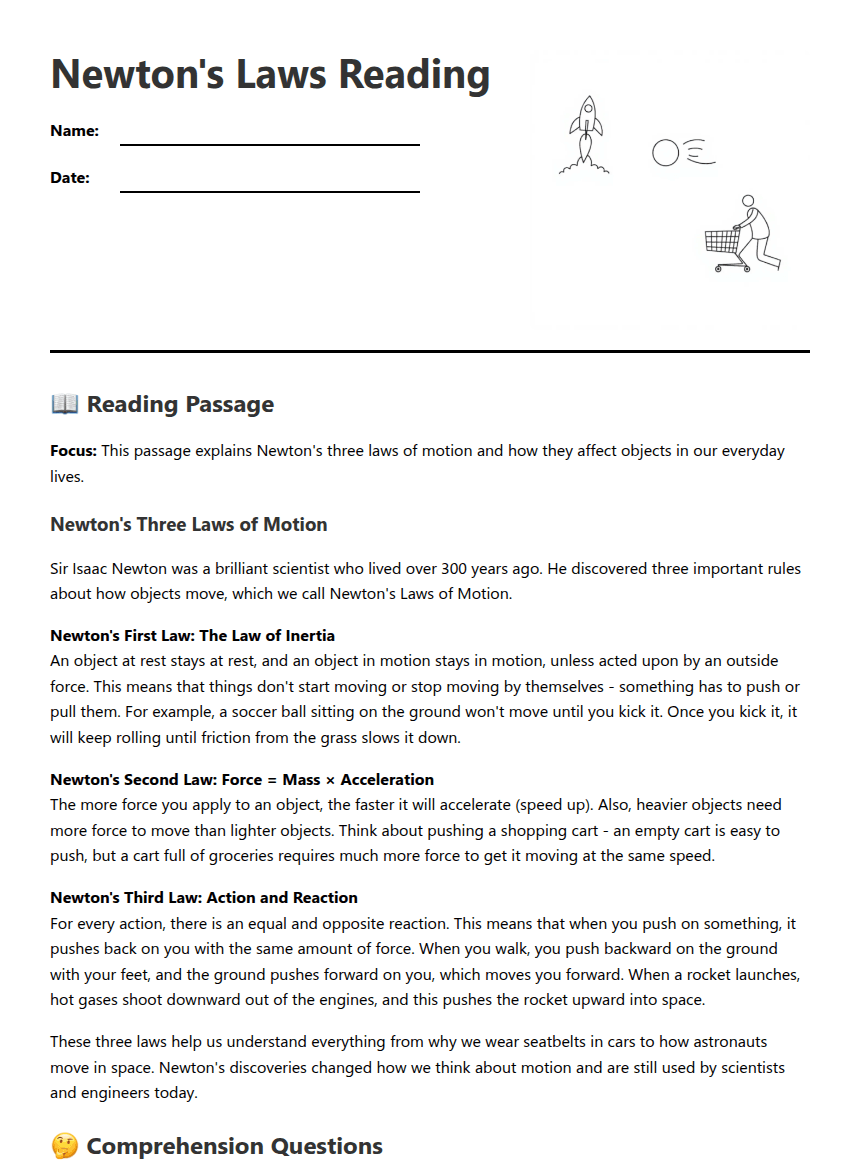
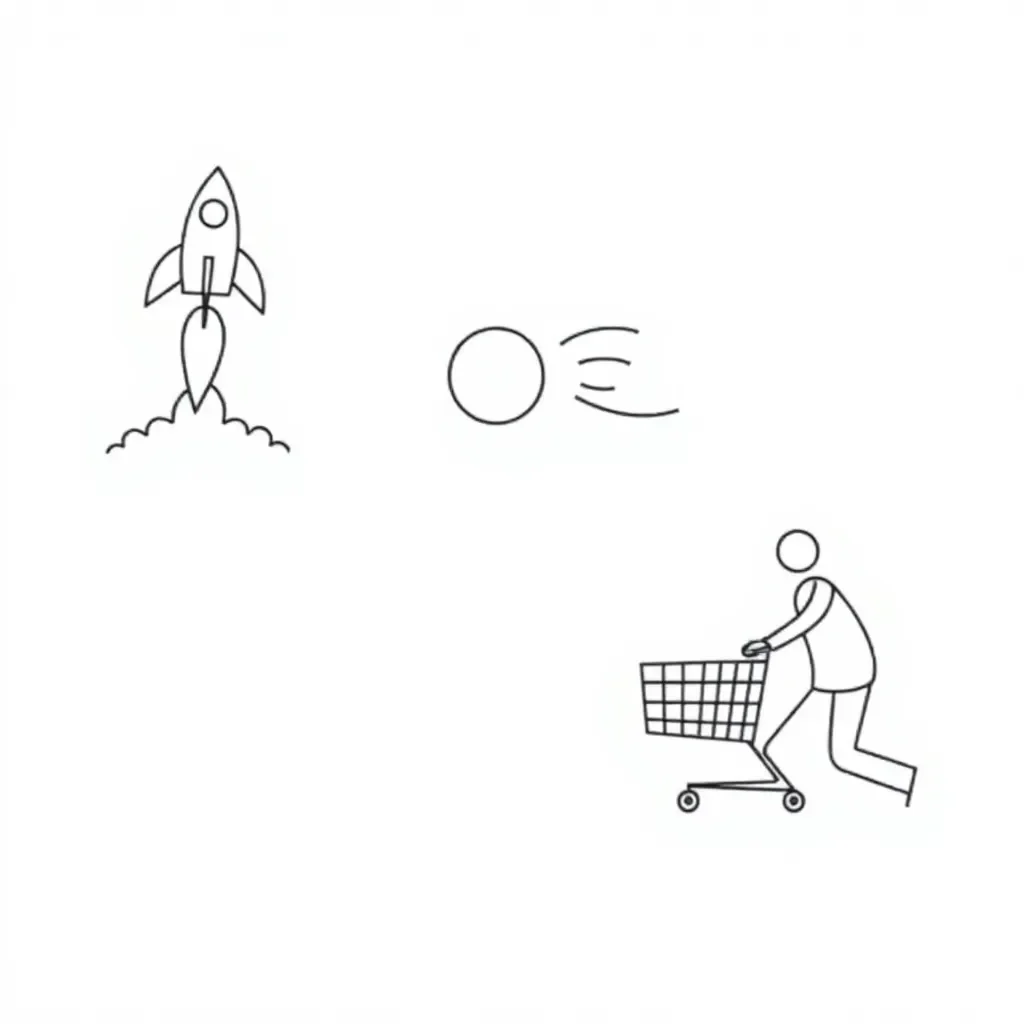
The more force you apply to an object, the faster it will accelerate (speed up). Also, heavier objects need more force to move than lighter objects. Think about pushing a shopping cart - an empty cart is easy to push, but a cart full of groceries requires much more force to get it moving at the same speed.
Newton's Third Law: Action and Reaction
For every action, there is an equal and opposite reaction. This means that when you push on something, it pushes back on you with the same amount of force. When you walk, you push backward on the ground with your feet, and the ground pushes forward on you, which moves you forward. When a rocket launches, hot gases shoot downward out of the engines, and this pushes the rocket upward into space.
These three laws help us understand everything from why we wear seatbelts in cars to how astronauts move in space. Newton's discoveries changed how we think about motion and are still used by scientists and engineers today.
🤔 Comprehension Questions
About This Worksheet
Free in Kuraplan
Sign up free, grab the PDF, and customize it for your class.
Print-Ready
Formatted for standard paper. Clean layout, easy to read.
AI-Generated
Created with Kuraplan's AI, designed for real classroom use.
For Teachers & Parents
Use in classrooms, for homework, tutoring, or homeschool.
Need a custom version of this worksheet?
Kuraplan's AI generates custom worksheets in seconds — differentiated for every learner, aligned to your curriculum.
Generate Custom Worksheets — FreeMore Science Worksheets
Force and Motion Investigations
Free
Pushes and Pulls Investigations
Free
Forces and Friction Investigation
Free
Forces and Motion Exploration
Free
Forces and Motion Experiments
Free
Forces: Cornell Notes Example
Free
Energy and Forces Worksheet
Free