PSHEFreePrintable

Mental Health vs Everyday Feelings

A free pshe worksheet ready for your classroom. Open in Kuraplan to grab the print-ready PDF, customize it for your students, or generate a fresh version in seconds.
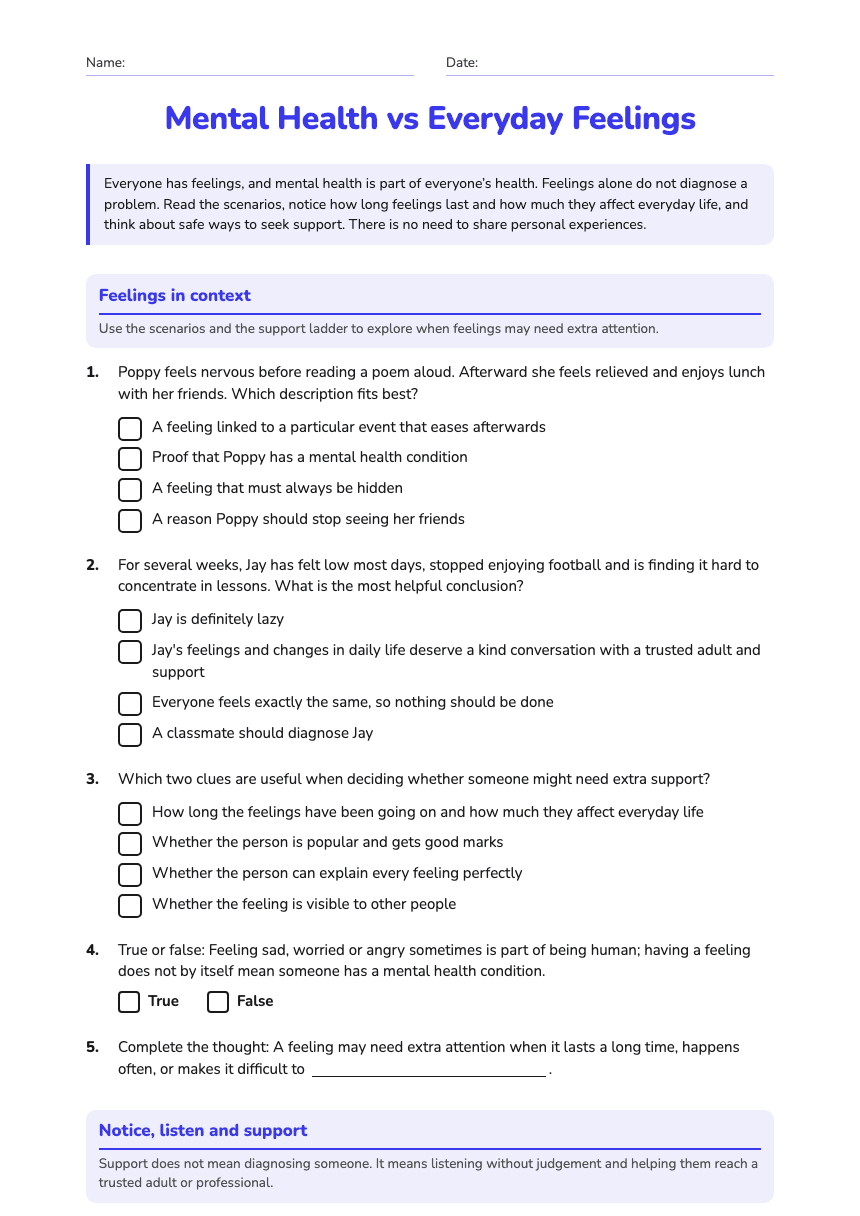
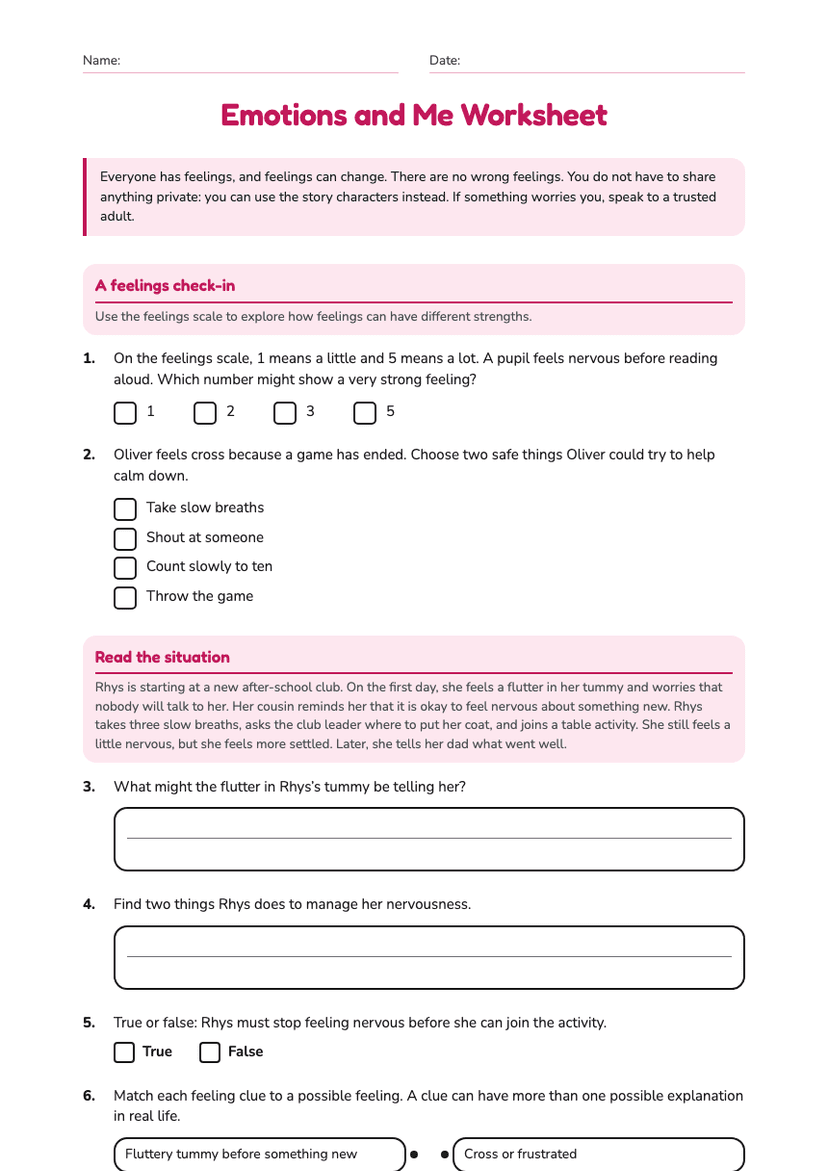
Mental Health vs Everyday Feelings worksheet preview
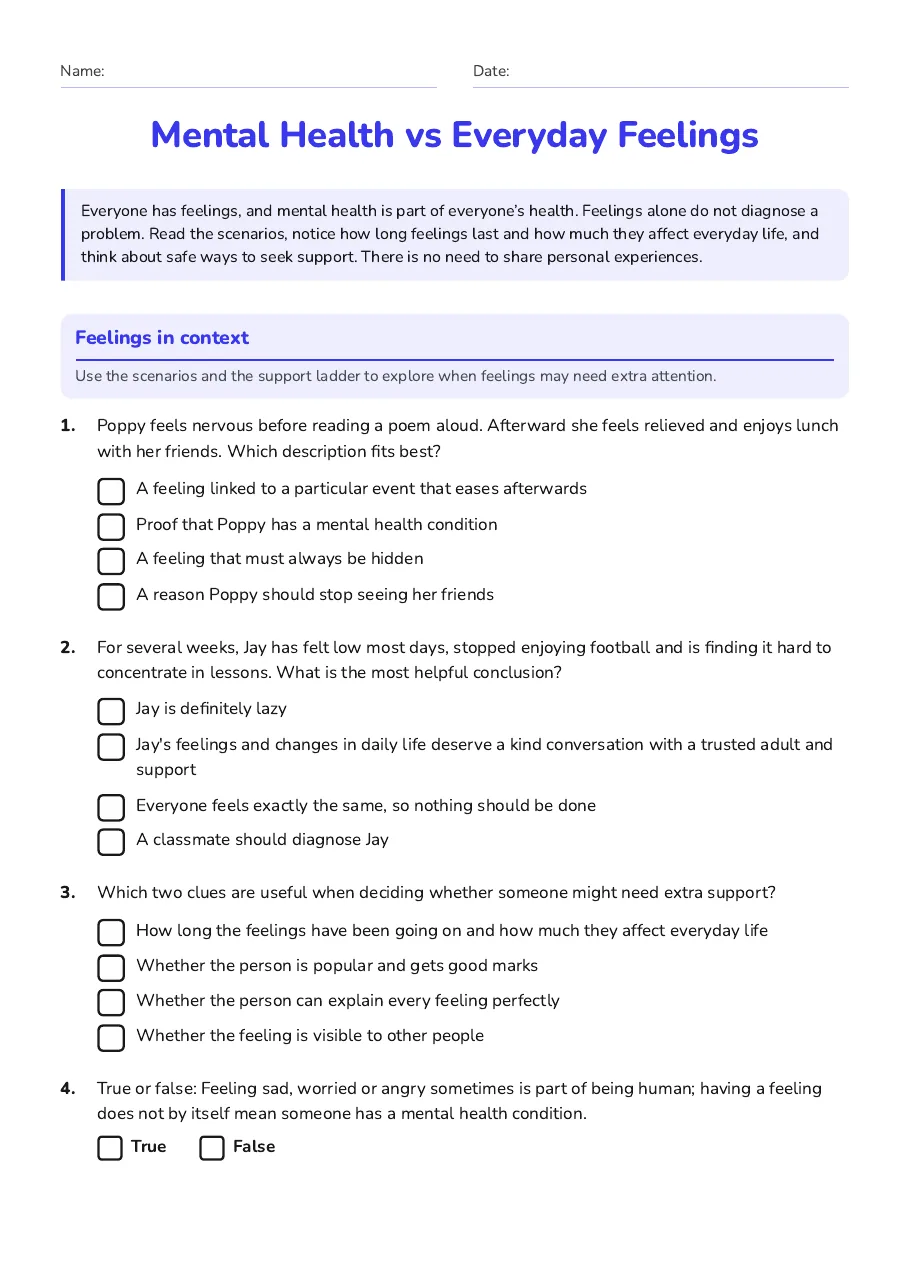
Name:Date:

Mental Health vs Everyday Feelings

Everyone has feelings, and mental health is part of everyone’s health. Feelings alone do not diagnose a problem. Read the scenarios, notice how long feelings last and how much they affect everyday life, and think about safe ways to seek support. There is no need to share personal experiences.

Feelings in context

Use the scenarios and the support ladder to explore when feelings may need extra attention.

1.Poppy feels nervous before reading a poem aloud. Afterward she feels relieved and enjoys lunch with her friends. Which description fits best?
  • A feeling linked to a particular event that eases afterwards
  • Proof that Poppy has a mental health condition
  • A feeling that must always be hidden
  • A reason Poppy should stop seeing her friends
2.For several weeks, Jay has felt low most days, stopped enjoying football and is finding it hard to concentrate in lessons. What is the most helpful conclusion?
  • Jay is definitely lazy
  • Jay's feelings and changes in daily life deserve a kind conversation with a trusted adult and support
  • Everyone feels exactly the same, so nothing should be done
  • A classmate should diagnose Jay
3.Which two clues are useful when deciding whether someone might need extra support?
  • How long the feelings have been going on and how much they affect everyday life
  • Whether the person is popular and gets good marks
  • Whether the person can explain every feeling perfectly
  • Whether the feeling is visible to other people
4.True or false: Feeling sad, worried or angry sometimes is part of being human; having a feeling does not by itself mean someone has a mental health condition.
TrueFalse
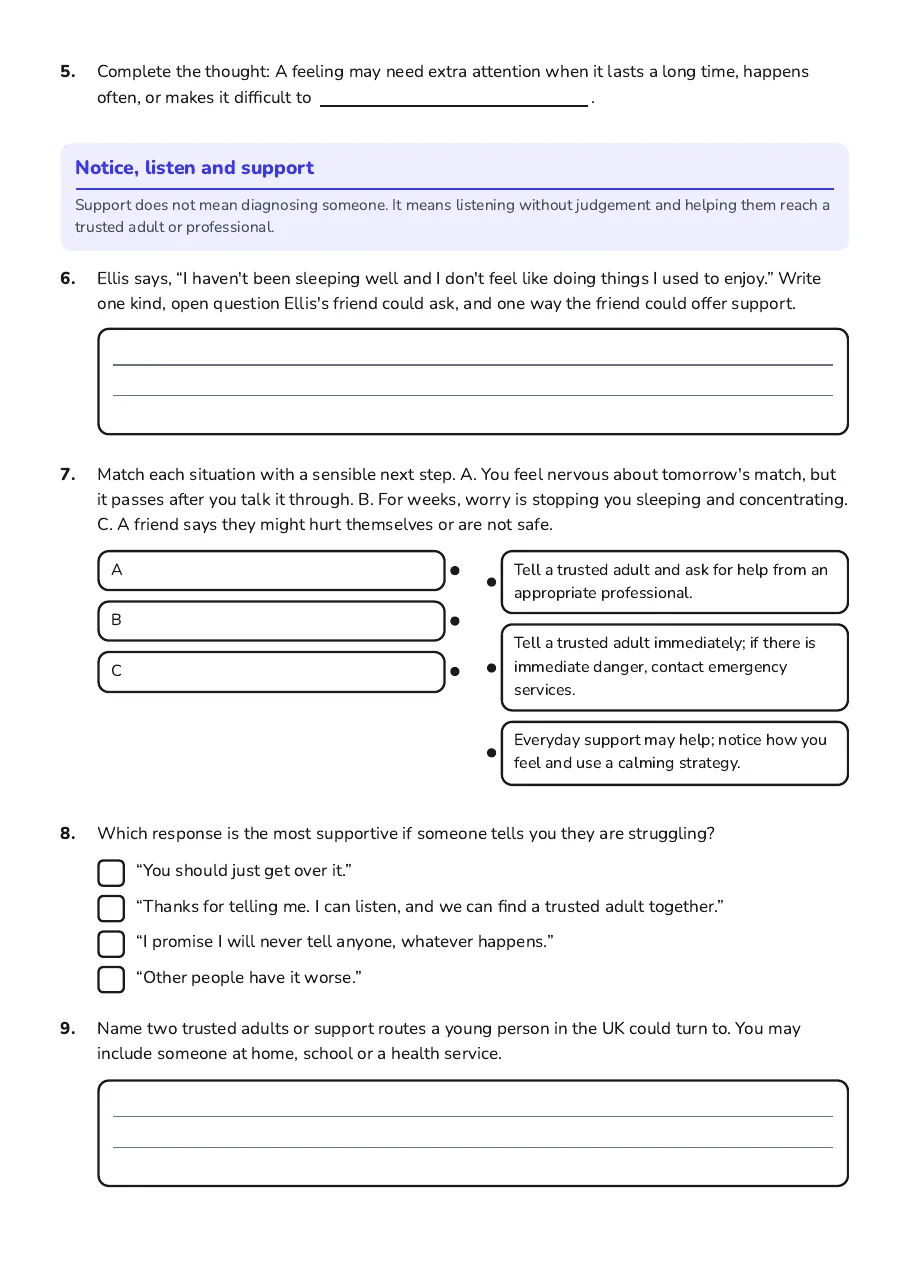
5.Complete the thought: A feeling may need extra attention when it lasts a long time, happens often, or makes it difficult to .

Notice, listen and support

Support does not mean diagnosing someone. It means listening without judgement and helping them reach a trusted adult or professional.

6.Ellis says, “I haven't been sleeping well and I don't feel like doing things I used to enjoy.” Write one kind, open question Ellis's friend could ask, and one way the friend could offer support.
7.Match each situation with a sensible next step. A. You feel nervous about tomorrow's match, but it passes after you talk it through. B. For weeks, worry is stopping you sleeping and concentrating. C. A friend says they might hurt themselves or are not safe.
  • A
  • B
  • C
  • Tell a trusted adult and ask for help from an appropriate professional.
  • Tell a trusted adult immediately; if there is immediate danger, contact emergency services.
  • Everyday support may help; notice how you feel and use a calming strategy.
8.Which response is the most supportive if someone tells you they are struggling?
  • “You should just get over it.”
  • “Thanks for telling me. I can listen, and we can find a trusted adult together.”
  • “I promise I will never tell anyone, whatever happens.”
  • “Other people have it worse.”
9.Name two trusted adults or support routes a young person in the UK could turn to. You may include someone at home, school or a health service.
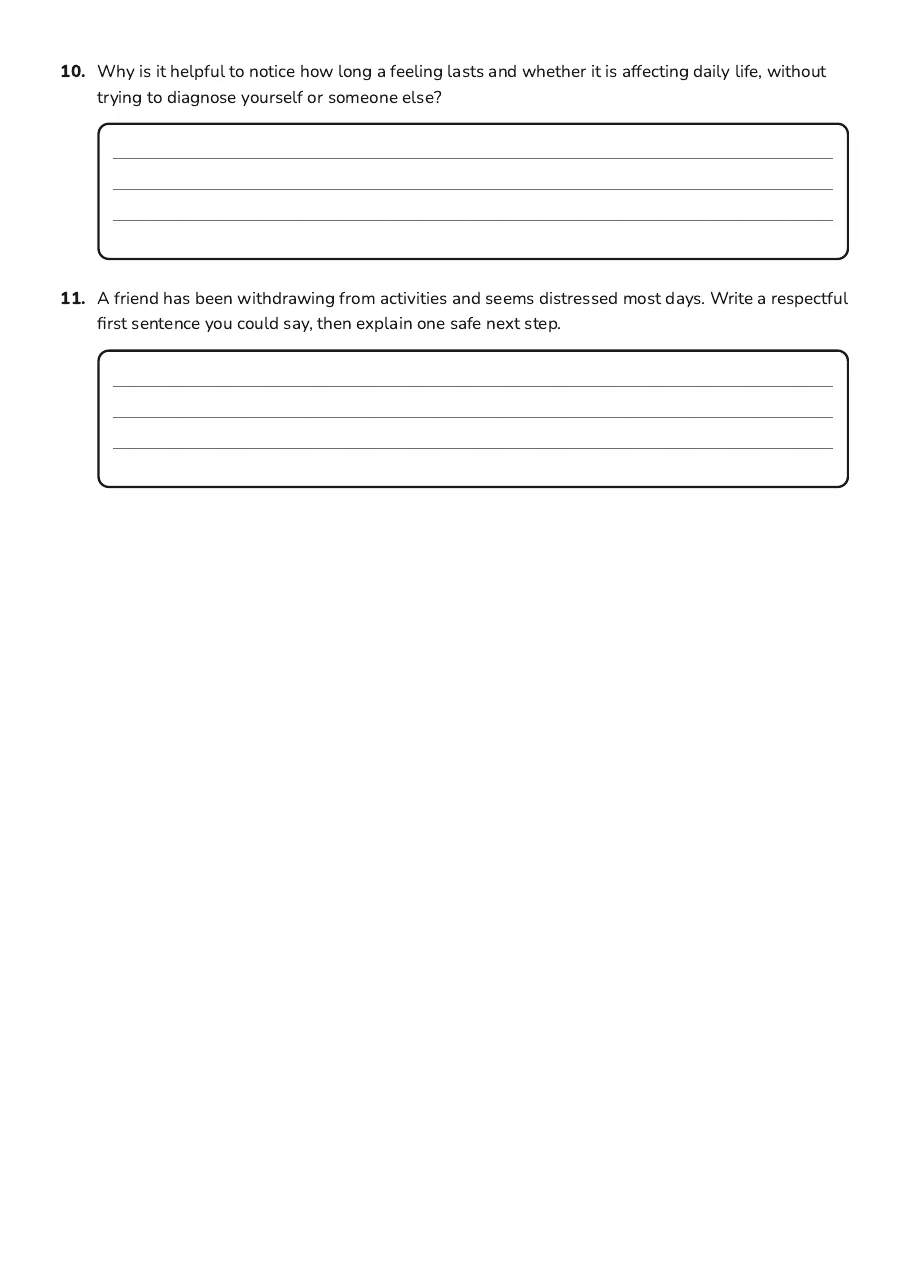
10.Why is it helpful to notice how long a feeling lasts and whether it is affecting daily life, without trying to diagnose yourself or someone else?
11.A friend has been withdrawing from activities and seems distressed most days. Write a respectful first sentence you could say, then explain one safe next step.

3 printable pages

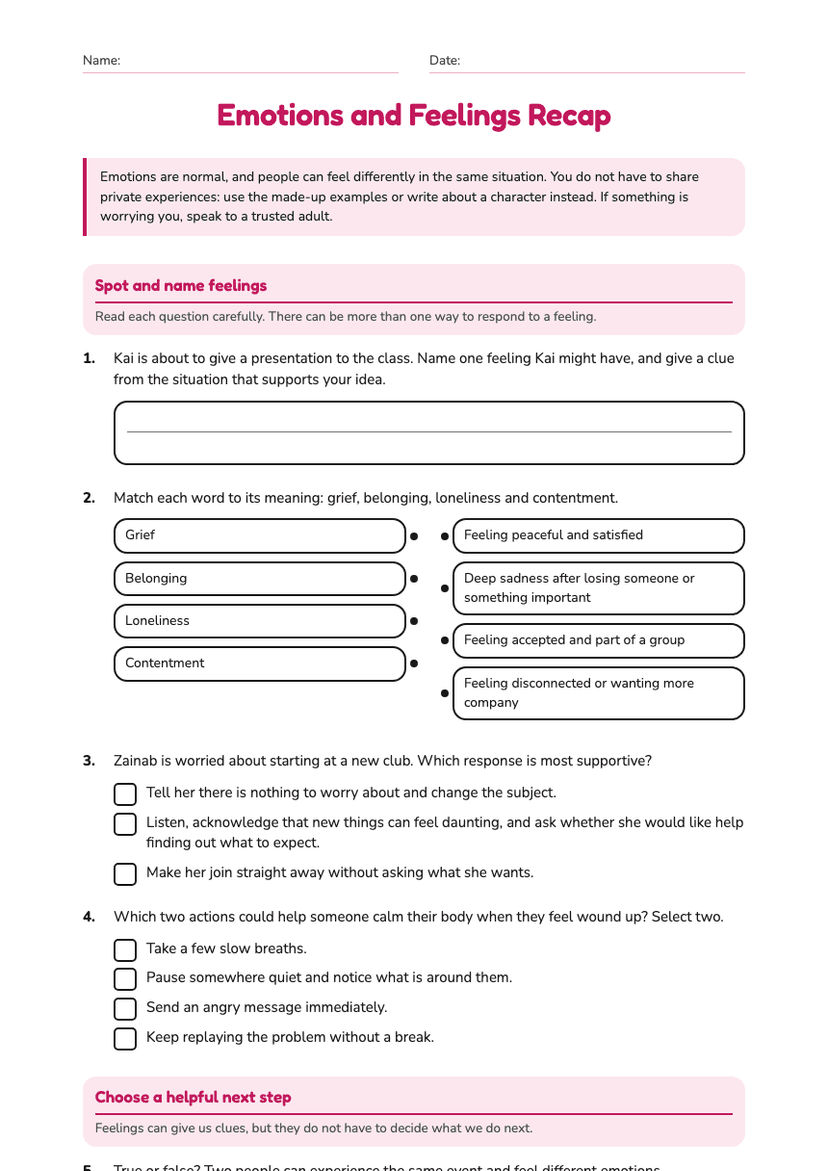
  • Mental Health vs Everyday Feelings, page 1 of 3: Feelings in context

    Page 1

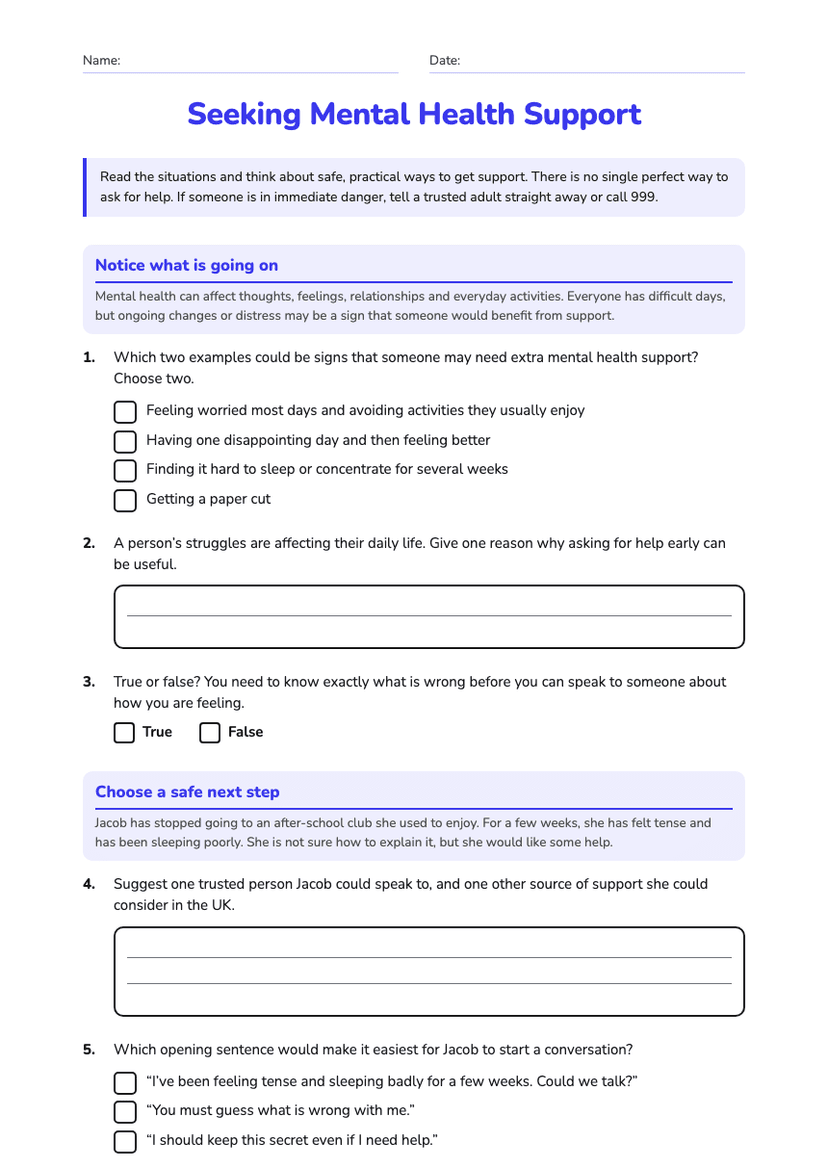
  • Mental Health vs Everyday Feelings, page 2 of 3: Notice, listen and support

    Page 2

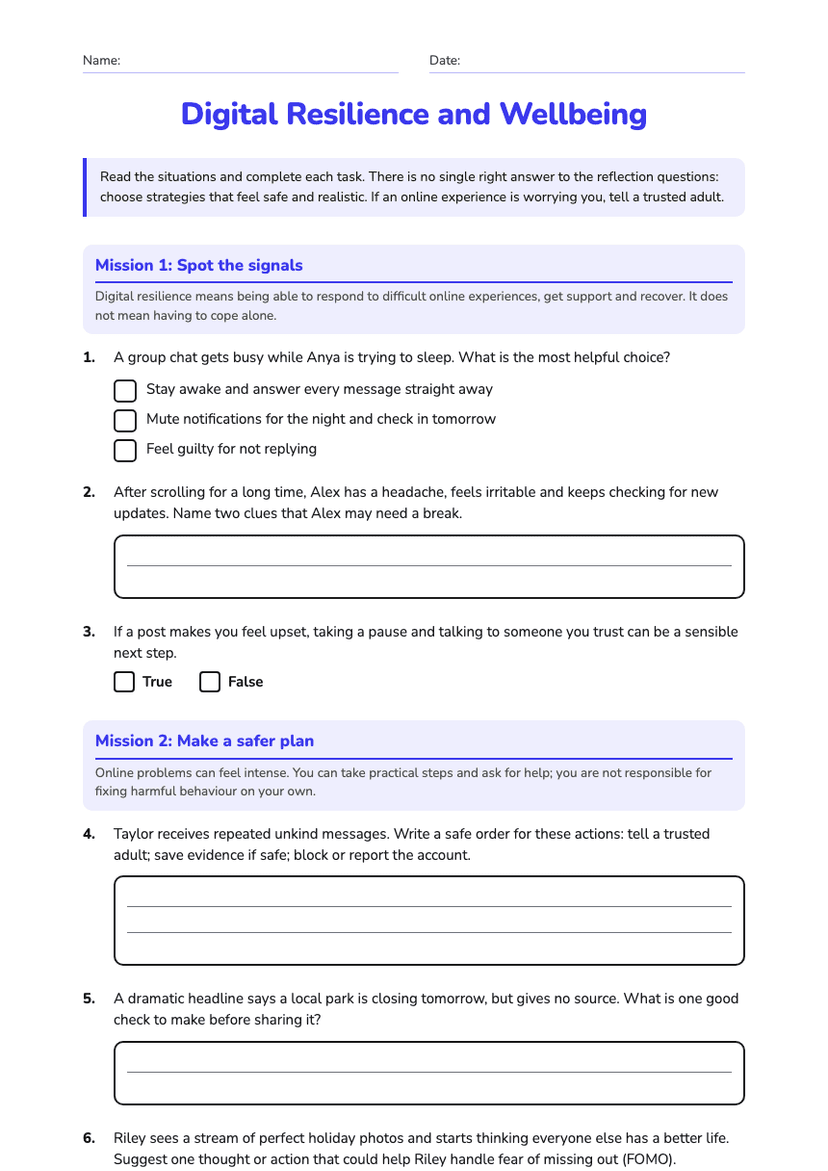
  • Mental Health vs Everyday Feelings, page 3 of 3: 10. Why is it helpful to notice how long a feeling lasts and whether it is affecting…

    Page 3

About This Worksheet

Free in Kuraplan

Sign up free, grab the PDF, and customize it for your class.

Print-Ready

Formatted for standard paper. Clean layout, easy to read.

AI-Generated

Created with Kuraplan's AI, designed for real classroom use.

For Teachers & Parents

Use in classrooms, for homework, tutoring, or homeschool.

Need a custom version of this worksheet?

Kuraplan's AI generates custom worksheets in seconds — differentiated for every learner, aligned to your curriculum.

Generate Custom Worksheets — Free
No credit card Curriculum-aligned Under 60 seconds