ScienceFreePrintable

Ecology and Resources Quiz

A free science worksheet ready for your classroom. Open in Kuraplan to grab the print-ready PDF, customize it for your students, or generate a fresh version in seconds.
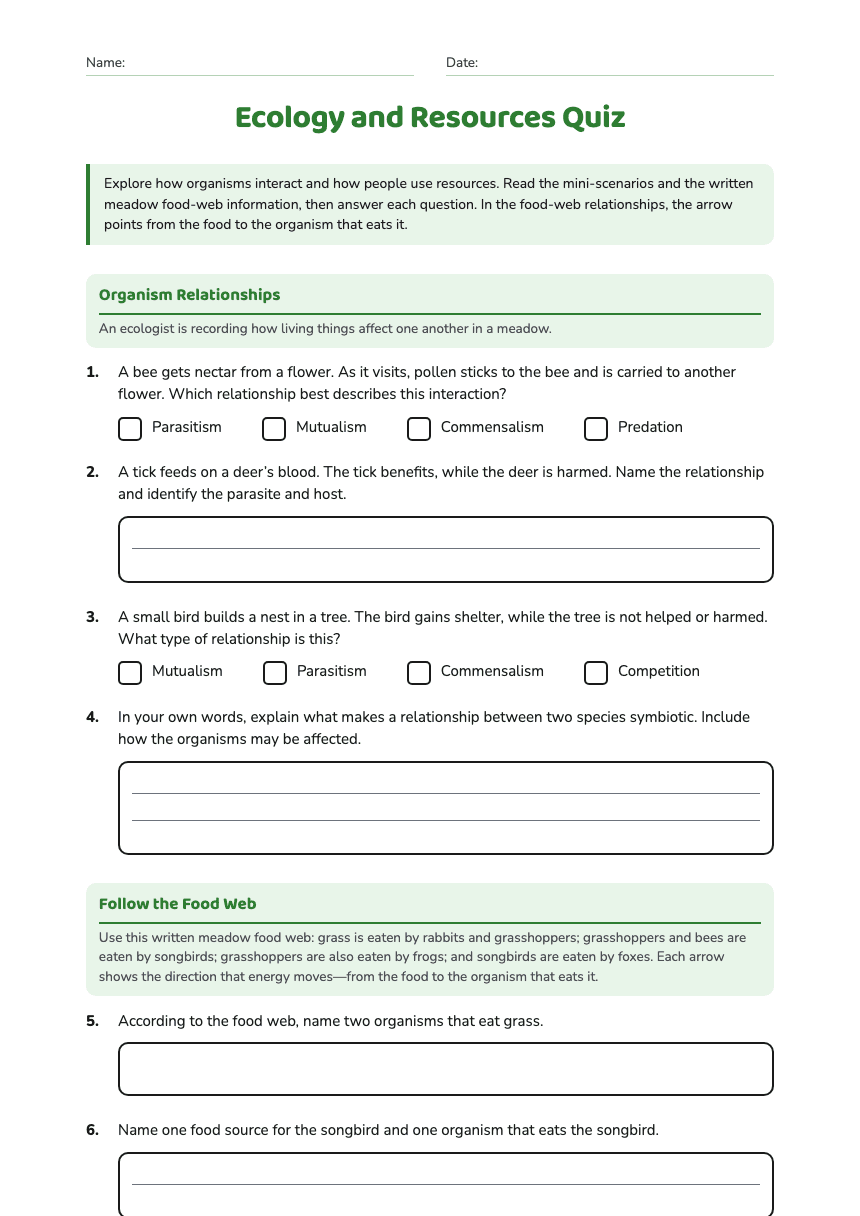
Ecology and Resources Quiz worksheet preview
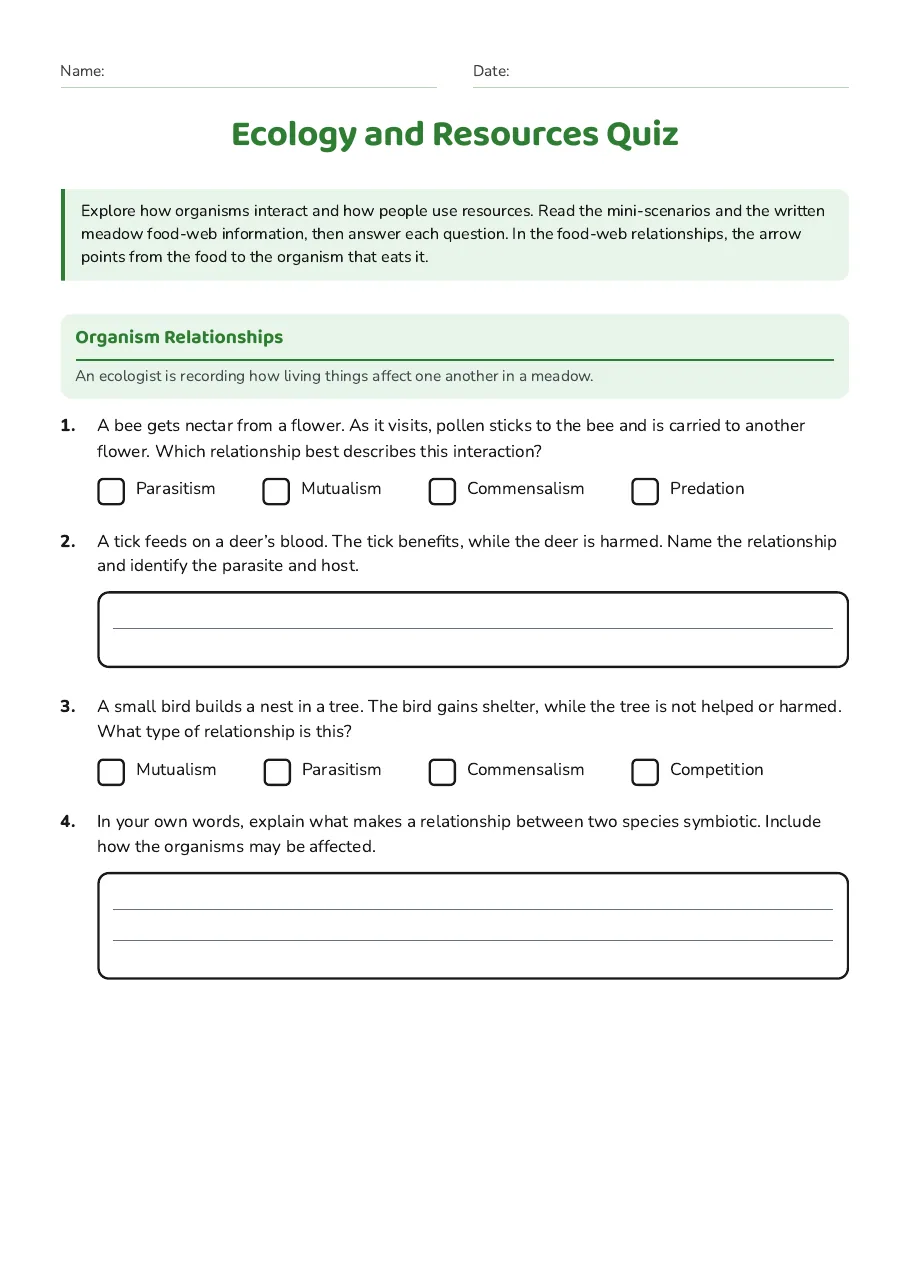
Name:Date:

Ecology and Resources Quiz

Explore how organisms interact and how people use resources. Read the mini-scenarios and the written meadow food-web information, then answer each question. In the food-web relationships, the arrow points from the food to the organism that eats it.

Organism Relationships

An ecologist is recording how living things affect one another in a meadow.

1.A bee gets nectar from a flower. As it visits, pollen sticks to the bee and is carried to another flower. Which relationship best describes this interaction?
  • Parasitism
  • Mutualism
  • Commensalism
  • Predation
2.A tick feeds on a deer’s blood. The tick benefits, while the deer is harmed. Name the relationship and identify the parasite and host.
3.A small bird builds a nest in a tree. The bird gains shelter, while the tree is not helped or harmed. What type of relationship is this?
  • Mutualism
  • Parasitism
  • Commensalism
  • Competition
4.In your own words, explain what makes a relationship between two species symbiotic. Include how the organisms may be affected.

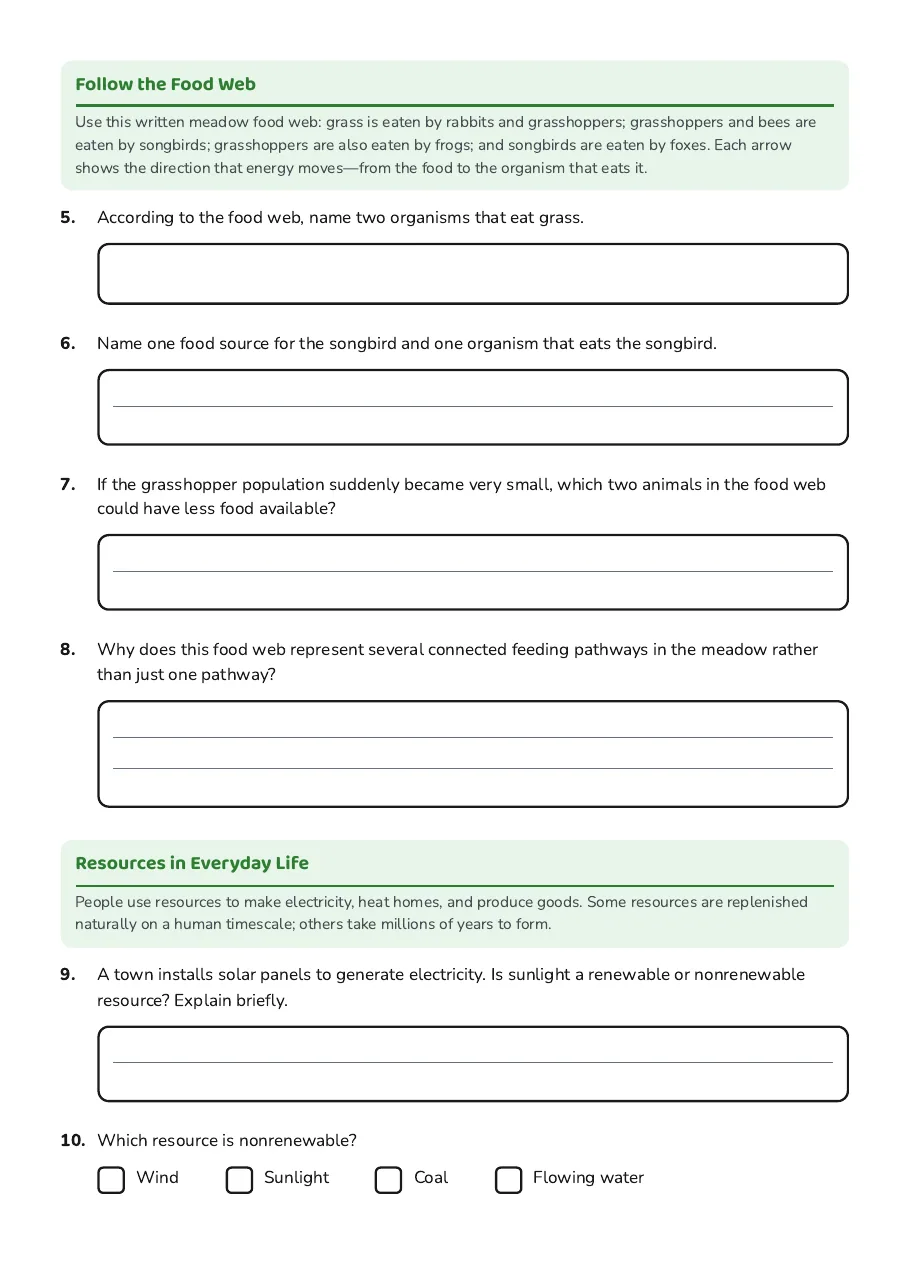
Follow the Food Web

Use this written meadow food web: grass is eaten by rabbits and grasshoppers; grasshoppers and bees are eaten by songbirds; grasshoppers are also eaten by frogs; and songbirds are eaten by foxes. Each arrow shows the direction that energy moves—from the food to the organism that eats it.

5.According to the food web, name two organisms that eat grass.
6.Name one food source for the songbird and one organism that eats the songbird.
7.If the grasshopper population suddenly became very small, which two animals in the food web could have less food available?
8.Why does this food web represent several connected feeding pathways in the meadow rather than just one pathway?

Resources in Everyday Life

People use resources to make electricity, heat homes, and produce goods. Some resources are replenished naturally on a human timescale; others take millions of years to form.

9.A town installs solar panels to generate electricity. Is sunlight a renewable or nonrenewable resource? Explain briefly.
10.Which resource is nonrenewable?
  • Wind
  • Sunlight
  • Coal
  • Flowing water
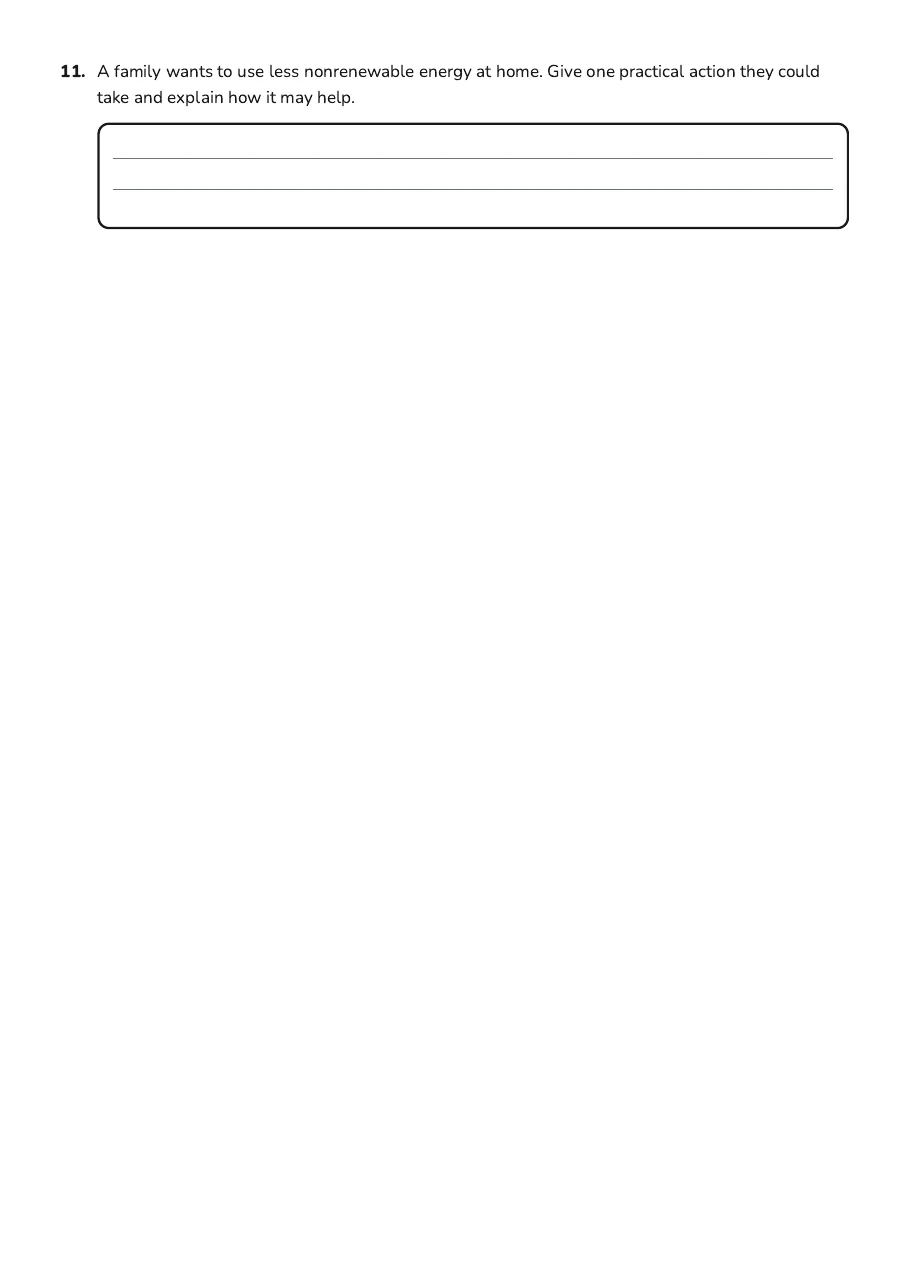
11.A family wants to use less nonrenewable energy at home. Give one practical action they could take and explain how it may help.

3 printable pages

  • Ecology and Resources Quiz, page 1 of 3: Organism Relationships

    Page 1

  • Ecology and Resources Quiz, page 2 of 3: Follow the Food Web, Resources in Everyday Life

    Page 2

  • Ecology and Resources Quiz, page 3 of 3: 11. A family wants to use less nonrenewable energy at home. Give one practical action…

    Page 3

About This Worksheet

Free in Kuraplan

Sign up free, grab the PDF, and customize it for your class.

Print-Ready

Formatted for standard paper. Clean layout, easy to read.

AI-Generated

Created with Kuraplan's AI, designed for real classroom use.

For Teachers & Parents

Use in classrooms, for homework, tutoring, or homeschool.

Need a custom version of this worksheet?

Kuraplan's AI generates custom worksheets in seconds — differentiated for every learner, aligned to your curriculum.

Generate Custom Worksheets — Free
No credit card Curriculum-aligned Under 60 seconds