ScienceFreePrintable

Ecosystems and Biomes Test

A free science worksheet ready for your classroom. Open in Kuraplan to grab the print-ready PDF, customize it for your students, or generate a fresh version in seconds.
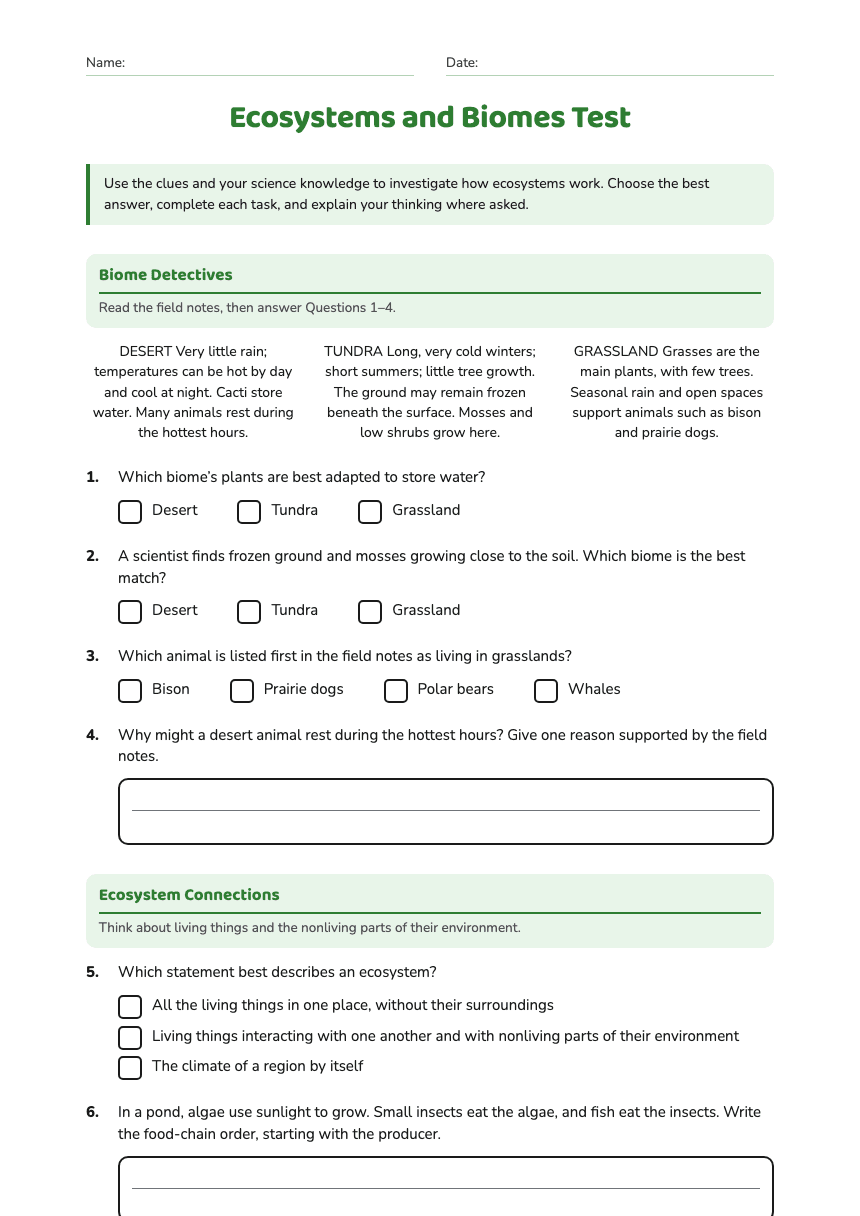
Ecosystems and Biomes Test worksheet preview
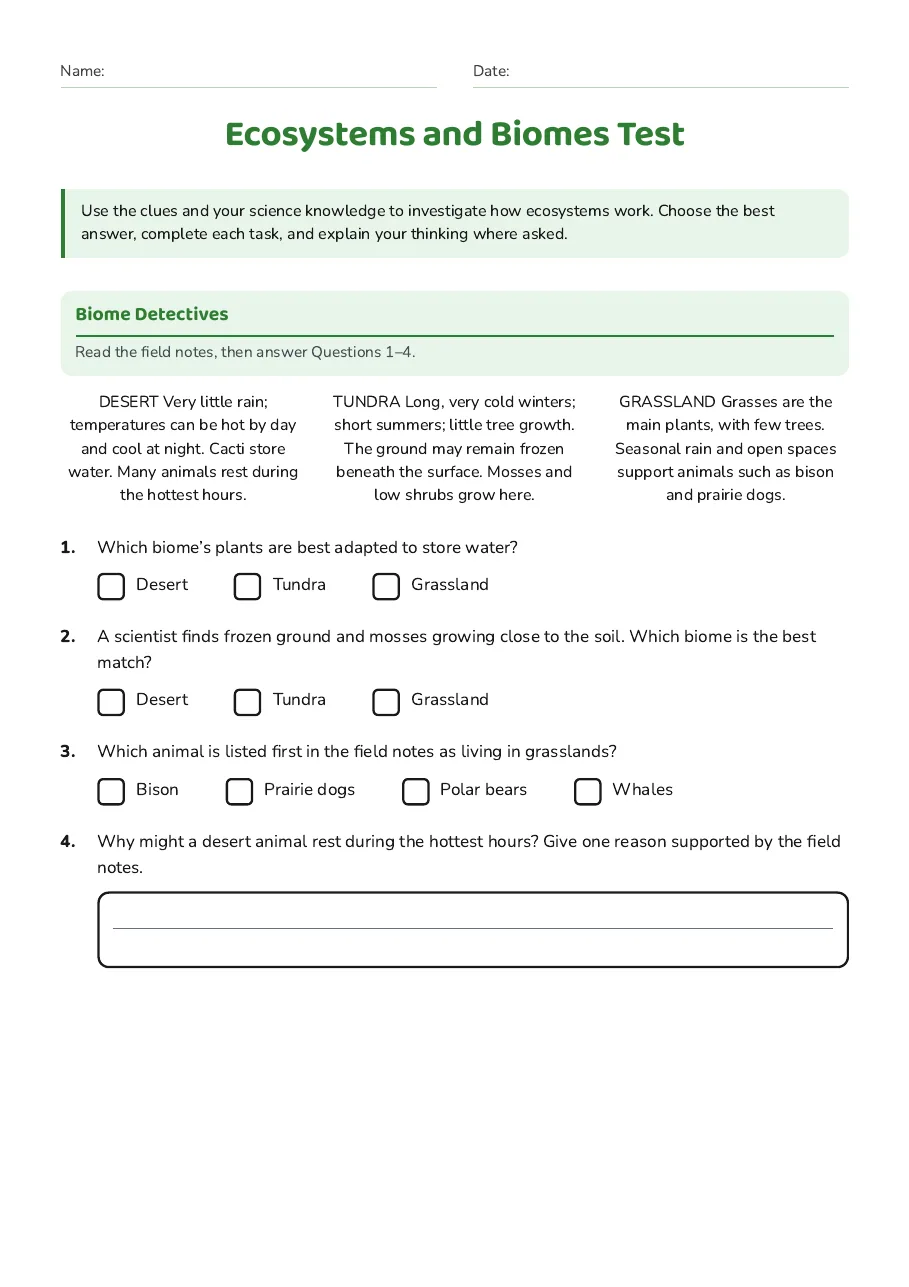
Name:Date:

Ecosystems and Biomes Test

Use the clues and your science knowledge to investigate how ecosystems work. Choose the best answer, complete each task, and explain your thinking where asked.

Biome Detectives

Read the field notes, then answer Questions 1–4.

DESERT Very little rain; temperatures can be hot by day and cool at night. Cacti store water. Many animals rest during the hottest hours.

TUNDRA Long, very cold winters; short summers; little tree growth. The ground may remain frozen beneath the surface. Mosses and low shrubs grow here.

GRASSLAND Grasses are the main plants, with few trees. Seasonal rain and open spaces support animals such as bison and prairie dogs.

1.Which biome’s plants are best adapted to store water?
  • Desert
  • Tundra
  • Grassland
2.A scientist finds frozen ground and mosses growing close to the soil. Which biome is the best match?
  • Desert
  • Tundra
  • Grassland
3.Which animal is listed first in the field notes as living in grasslands?
  • Bison
  • Prairie dogs
  • Polar bears
  • Whales
4.Why might a desert animal rest during the hottest hours? Give one reason supported by the field notes.

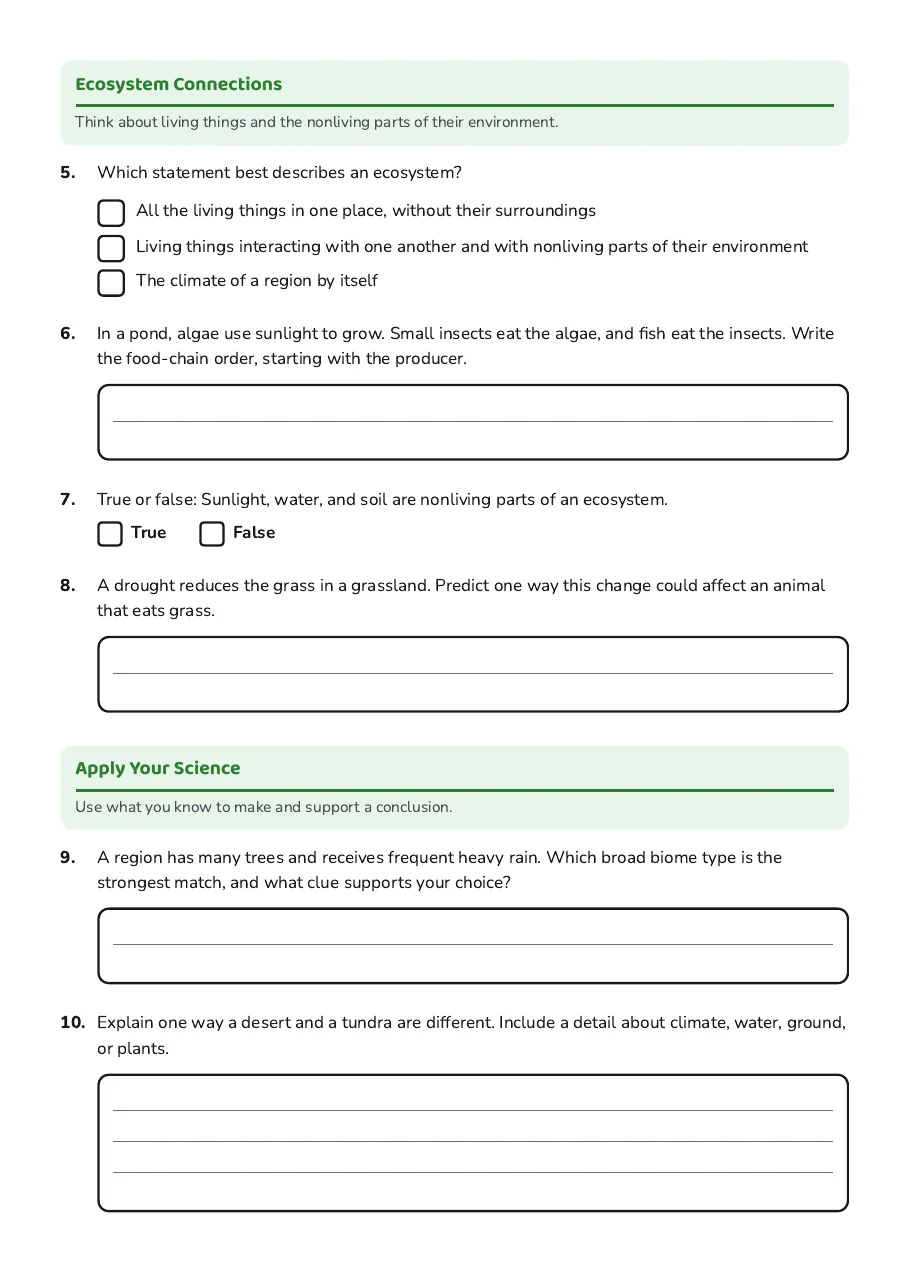
Ecosystem Connections

Think about living things and the nonliving parts of their environment.

5.Which statement best describes an ecosystem?
  • All the living things in one place, without their surroundings
  • Living things interacting with one another and with nonliving parts of their environment
  • The climate of a region by itself
6.In a pond, algae use sunlight to grow. Small insects eat the algae, and fish eat the insects. Write the food-chain order, starting with the producer.
7.True or false: Sunlight, water, and soil are nonliving parts of an ecosystem.
TrueFalse
8.A drought reduces the grass in a grassland. Predict one way this change could affect an animal that eats grass.

Apply Your Science

Use what you know to make and support a conclusion.

9.A region has many trees and receives frequent heavy rain. Which broad biome type is the strongest match, and what clue supports your choice?
10.Explain one way a desert and a tundra are different. Include a detail about climate, water, ground, or plants.
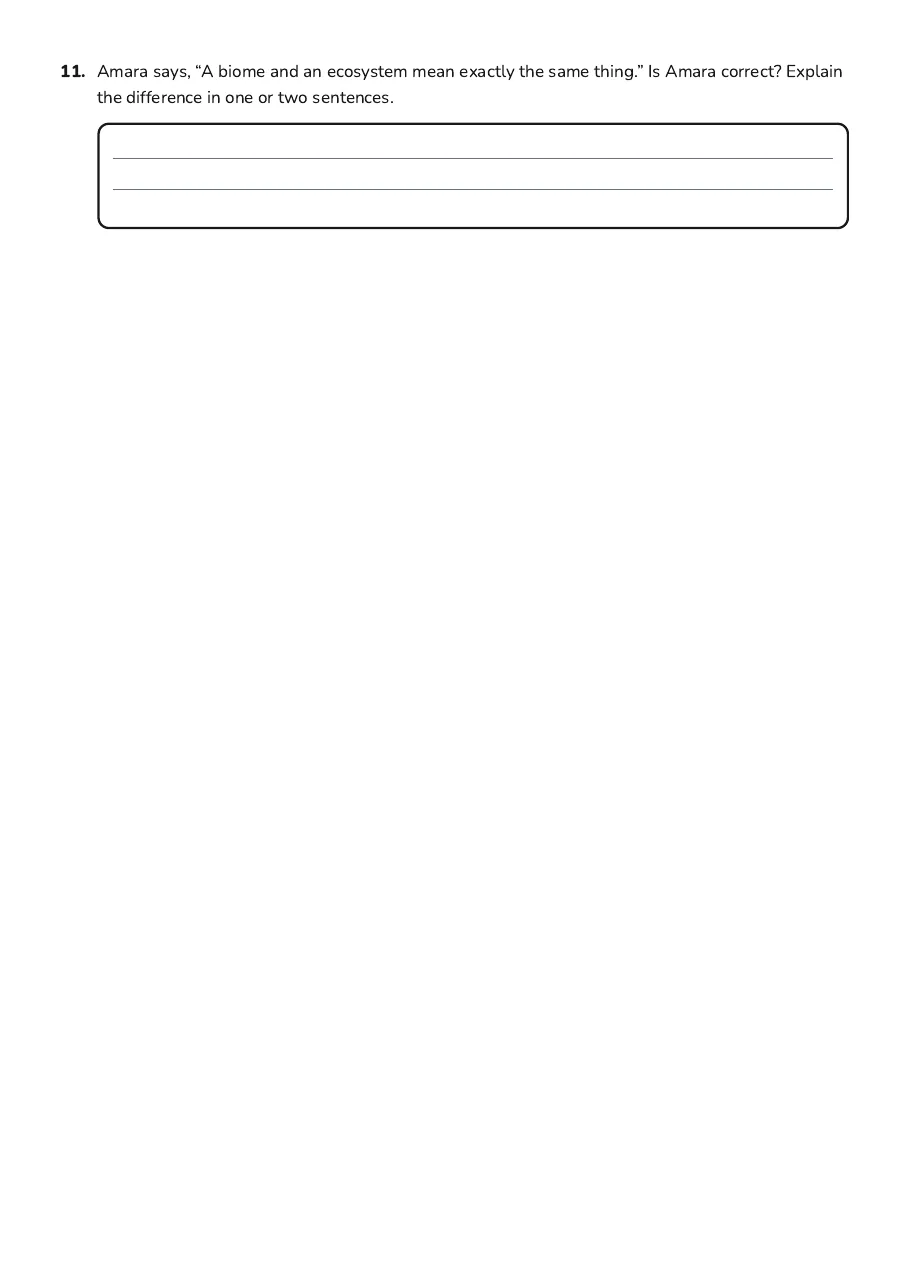
11.Amara says, “A biome and an ecosystem mean exactly the same thing.” Is Amara correct? Explain the difference in one or two sentences.

3 printable pages

  • Ecosystems and Biomes Test, page 1 of 3: Biome Detectives

    Page 1

  • Ecosystems and Biomes Test, page 2 of 3: Ecosystem Connections, Apply Your Science

    Page 2

  • Ecosystems and Biomes Test, page 3 of 3: 11. Amara says, “A biome and an ecosystem mean exactly the same thing.” Is Amara correct?…

    Page 3

About This Worksheet

Free in Kuraplan

Sign up free, grab the PDF, and customize it for your class.

Print-Ready

Formatted for standard paper. Clean layout, easy to read.

AI-Generated

Created with Kuraplan's AI, designed for real classroom use.

For Teachers & Parents

Use in classrooms, for homework, tutoring, or homeschool.

Need a custom version of this worksheet?

Kuraplan's AI generates custom worksheets in seconds — differentiated for every learner, aligned to your curriculum.

Generate Custom Worksheets — Free
No credit card Curriculum-aligned Under 60 seconds