ScienceFreePrintable

Getting to Know You: Environmental Science

A free science worksheet ready for your classroom. Open in Kuraplan to grab the print-ready PDF, customize it for your students, or generate a fresh version in seconds.
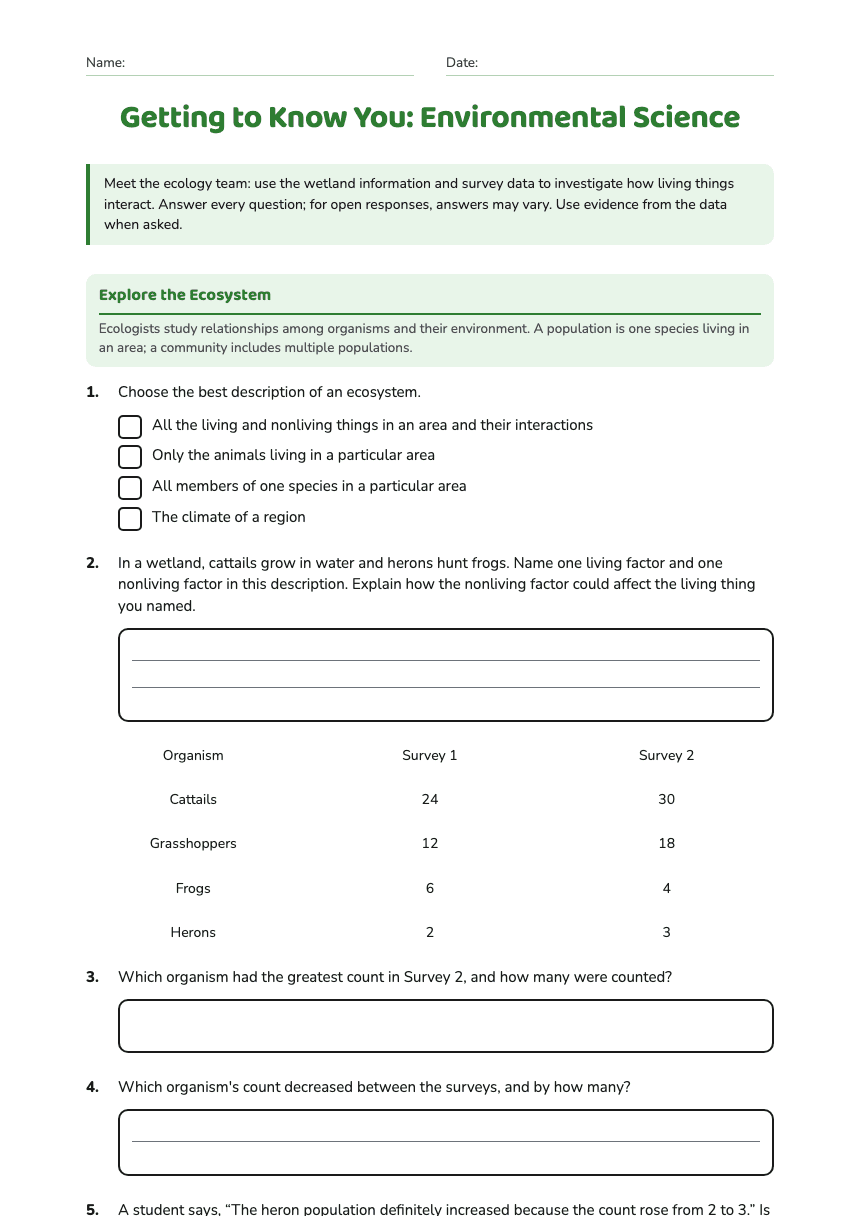
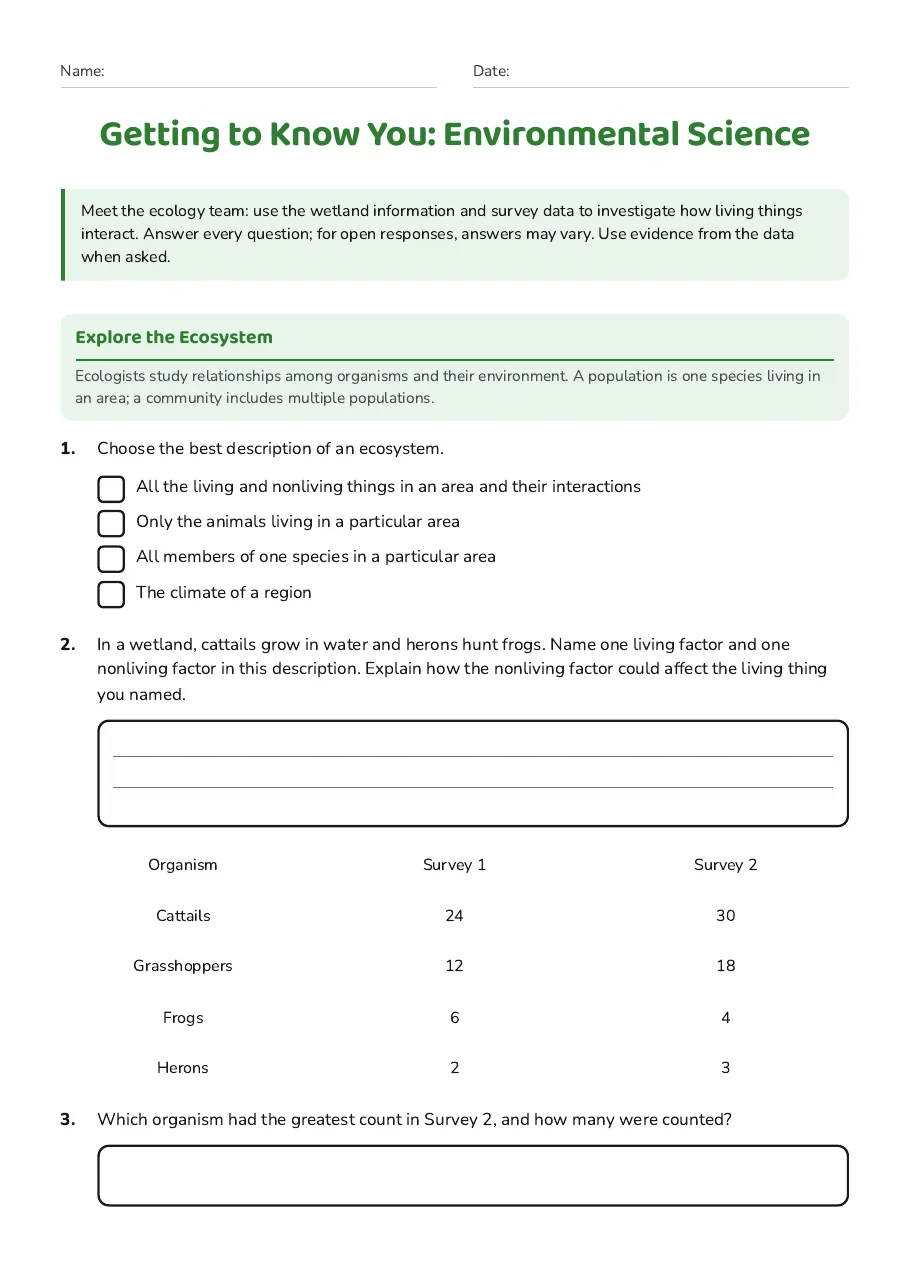
Getting to Know You: Environmental Science worksheet preview
Name:Date:

Getting to Know You: Environmental Science

Meet the ecology team: use the wetland information and survey data to investigate how living things interact. Answer every question; for open responses, answers may vary. Use evidence from the data when asked.

Explore the Ecosystem

Ecologists study relationships among organisms and their environment. A population is one species living in an area; a community includes multiple populations.

1.Choose the best description of an ecosystem.
  • All the living and nonliving things in an area and their interactions
  • Only the animals living in a particular area
  • All members of one species in a particular area
  • The climate of a region
2.In a wetland, cattails grow in water and herons hunt frogs. Name one living factor and one nonliving factor in this description. Explain how the nonliving factor could affect the living thing you named.

Organism

Survey 1

Survey 2

Cattails

24

30

Grasshoppers

12

18

Frogs

6

4

Herons

2

3

3.Which organism had the greatest count in Survey 2, and how many were counted?
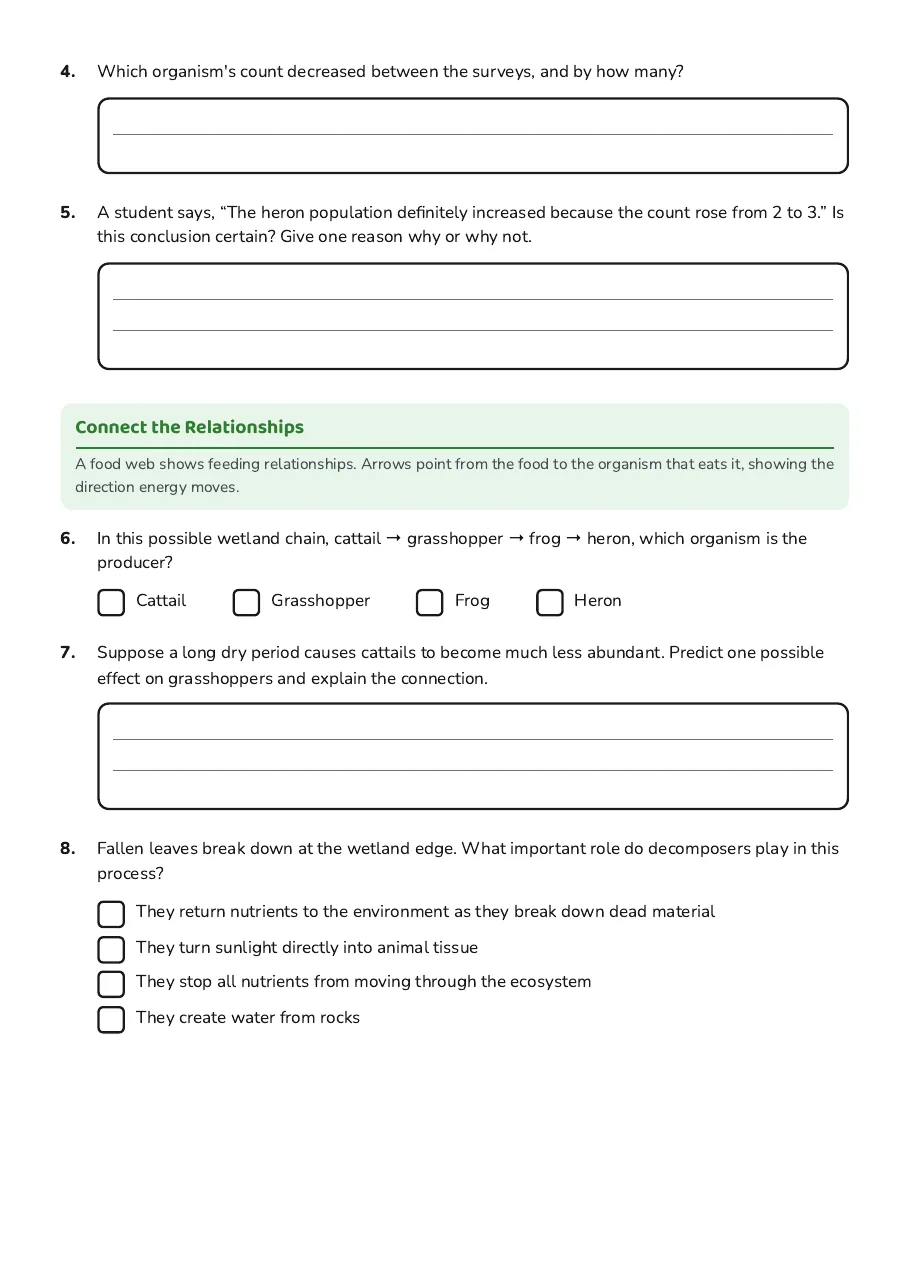
4.Which organism's count decreased between the surveys, and by how many?
5.A student says, “The heron population definitely increased because the count rose from 2 to 3.” Is this conclusion certain? Give one reason why or why not.

Connect the Relationships

A food web shows feeding relationships. Arrows point from the food to the organism that eats it, showing the direction energy moves.

6.In this possible wetland chain, cattail → grasshopper → frog → heron, which organism is the producer?
  • Cattail
  • Grasshopper
  • Frog
  • Heron
7.Suppose a long dry period causes cattails to become much less abundant. Predict one possible effect on grasshoppers and explain the connection.
8.Fallen leaves break down at the wetland edge. What important role do decomposers play in this process?
  • They return nutrients to the environment as they break down dead material
  • They turn sunlight directly into animal tissue
  • They stop all nutrients from moving through the ecosystem
  • They create water from rocks
9.Your team wants to find out whether a shaded or sunny part of the wetland has more grasshoppers. Name one thing to measure, one factor to keep the same, and one way to make the comparison fair.

3 printable pages

  • Getting to Know You: Environmental Science, page 1 of 3: Explore the Ecosystem

    Page 1

  • Getting to Know You: Environmental Science, page 2 of 3: Connect the Relationships

    Page 2

  • Getting to Know You: Environmental Science, page 3 of 3: 9. Your team wants to find out whether a shaded or sunny part of the wetland has more

    Page 3

About This Worksheet

Free in Kuraplan

Sign up free, grab the PDF, and customize it for your class.

Print-Ready

Formatted for standard paper. Clean layout, easy to read.

AI-Generated

Created with Kuraplan's AI, designed for real classroom use.

For Teachers & Parents

Use in classrooms, for homework, tutoring, or homeschool.

Need a custom version of this worksheet?

Kuraplan's AI generates custom worksheets in seconds — differentiated for every learner, aligned to your curriculum.

Generate Custom Worksheets — Free
No credit card Curriculum-aligned Under 60 seconds