Identifying and Categorising Feelings
A free health worksheet ready for your classroom. Open in Kuraplan to grab the print-ready PDF, customize it for your students, or generate a fresh version in seconds.

Identifying and Categorising Feelings
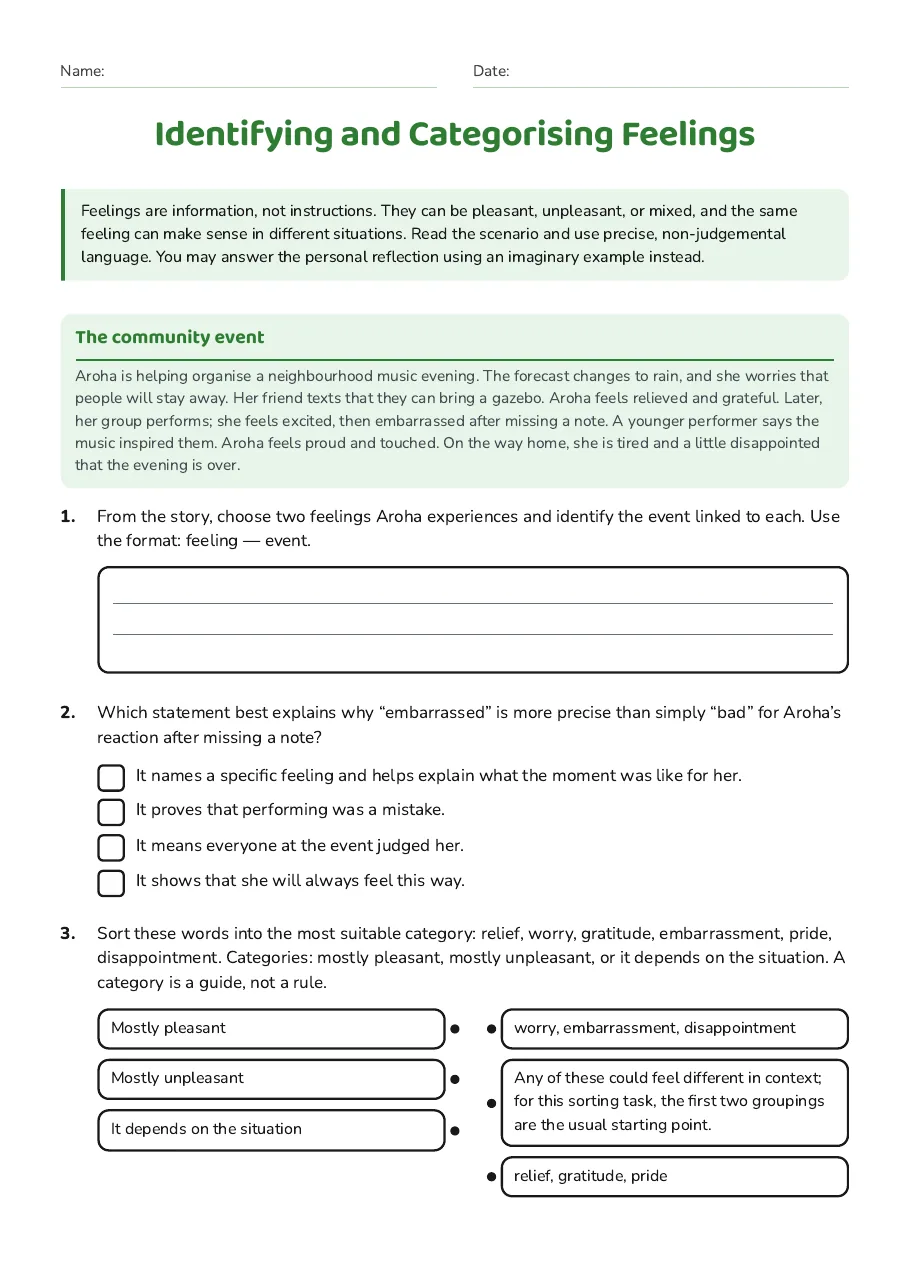
The community event
Aroha is helping organise a neighbourhood music evening. The forecast changes to rain, and she worries that people will stay away. Her friend texts that they can bring a gazebo. Aroha feels relieved and grateful. Later, her group performs; she feels excited, then embarrassed after missing a note. A younger performer says the music inspired them. Aroha feels proud and touched. On the way home, she is tired and a little disappointed that the evening is over.
- It names a specific feeling and helps explain what the moment was like for her.
- It proves that performing was a mistake.
- It means everyone at the event judged her.
- It shows that she will always feel this way.
- Mostly pleasant
- Mostly unpleasant
- It depends on the situation
- worry, embarrassment, disappointment
- Any of these could feel different in context; for this sorting task, the first two groupings are the usual starting point.
- relief, gratitude, pride
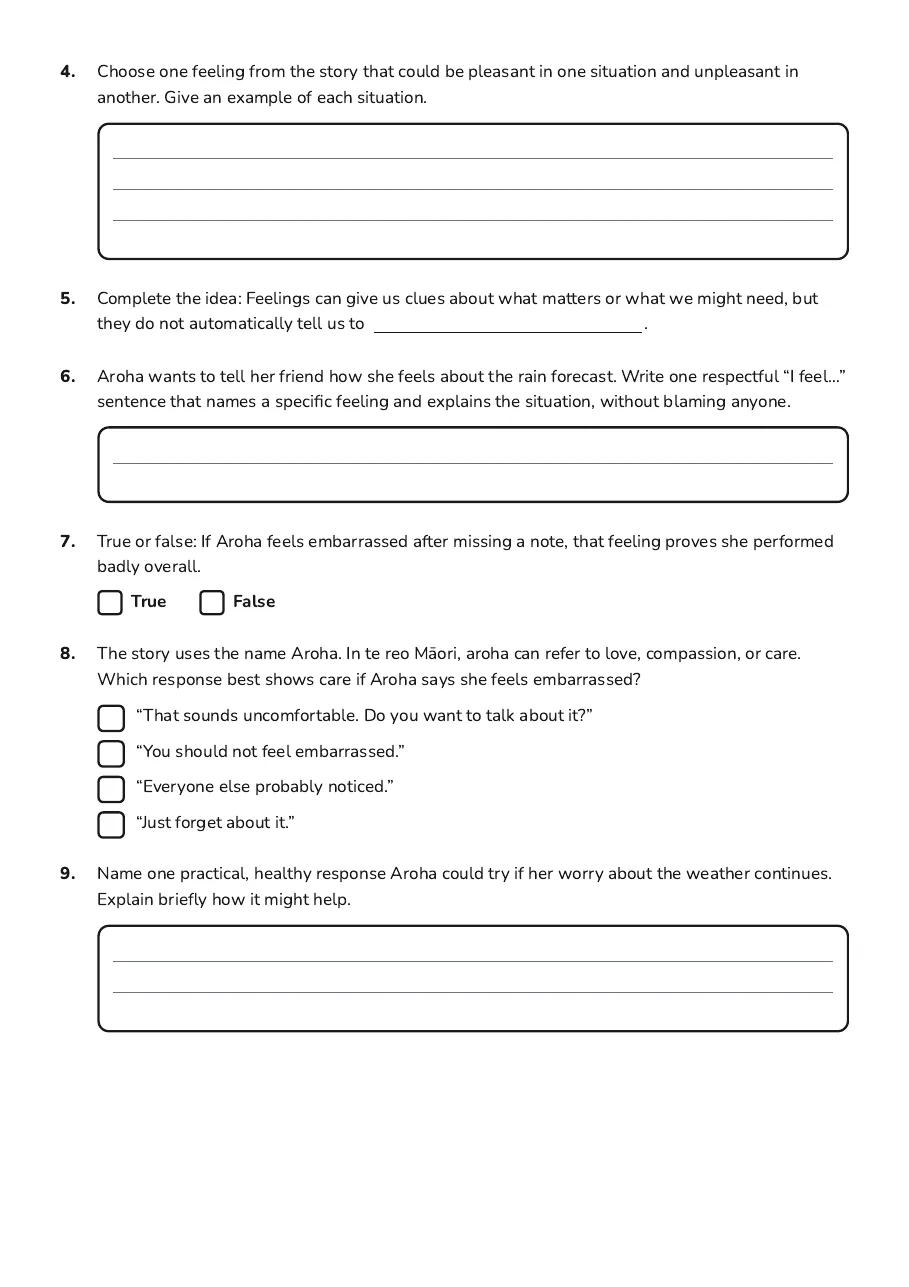
- “That sounds uncomfortable. Do you want to talk about it?”
- “You should not feel embarrassed.”
- “Everyone else probably noticed.”
- “Just forget about it.”
3 printable pages
Page 1
Page 2
Page 3
About This Worksheet
Free in Kuraplan
Sign up free, grab the PDF, and customize it for your class.
Print-Ready
Formatted for standard paper. Clean layout, easy to read.
AI-Generated
Created with Kuraplan's AI, designed for real classroom use.
For Teachers & Parents
Use in classrooms, for homework, tutoring, or homeschool.
Need a custom version of this worksheet?
Kuraplan's AI generates custom worksheets in seconds — differentiated for every learner, aligned to your curriculum.
Generate Custom Worksheets — Free