ScienceFreePrintable

Introduction to Atomic Theory

A free science worksheet ready for your classroom. Open in Kuraplan to grab the print-ready PDF, customize it for your students, or generate a fresh version in seconds.
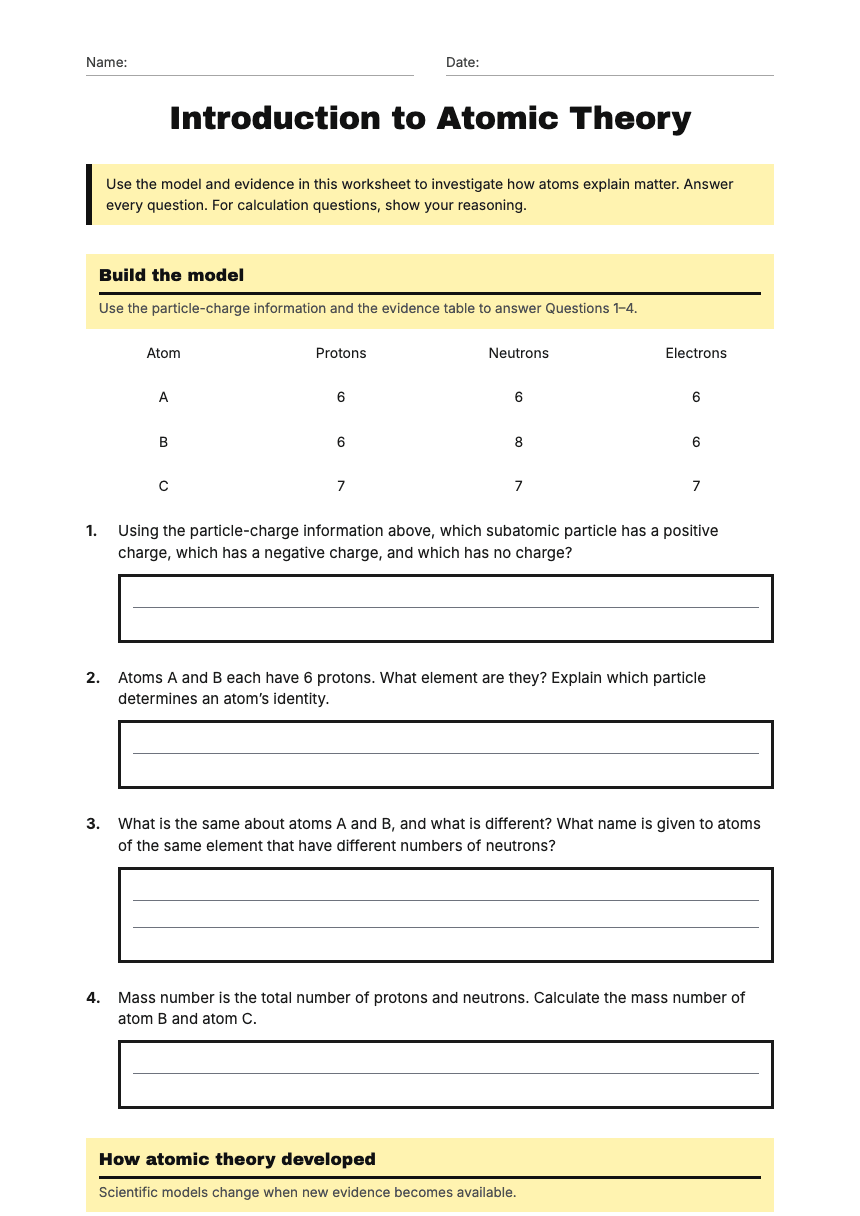
Introduction to Atomic Theory worksheet preview
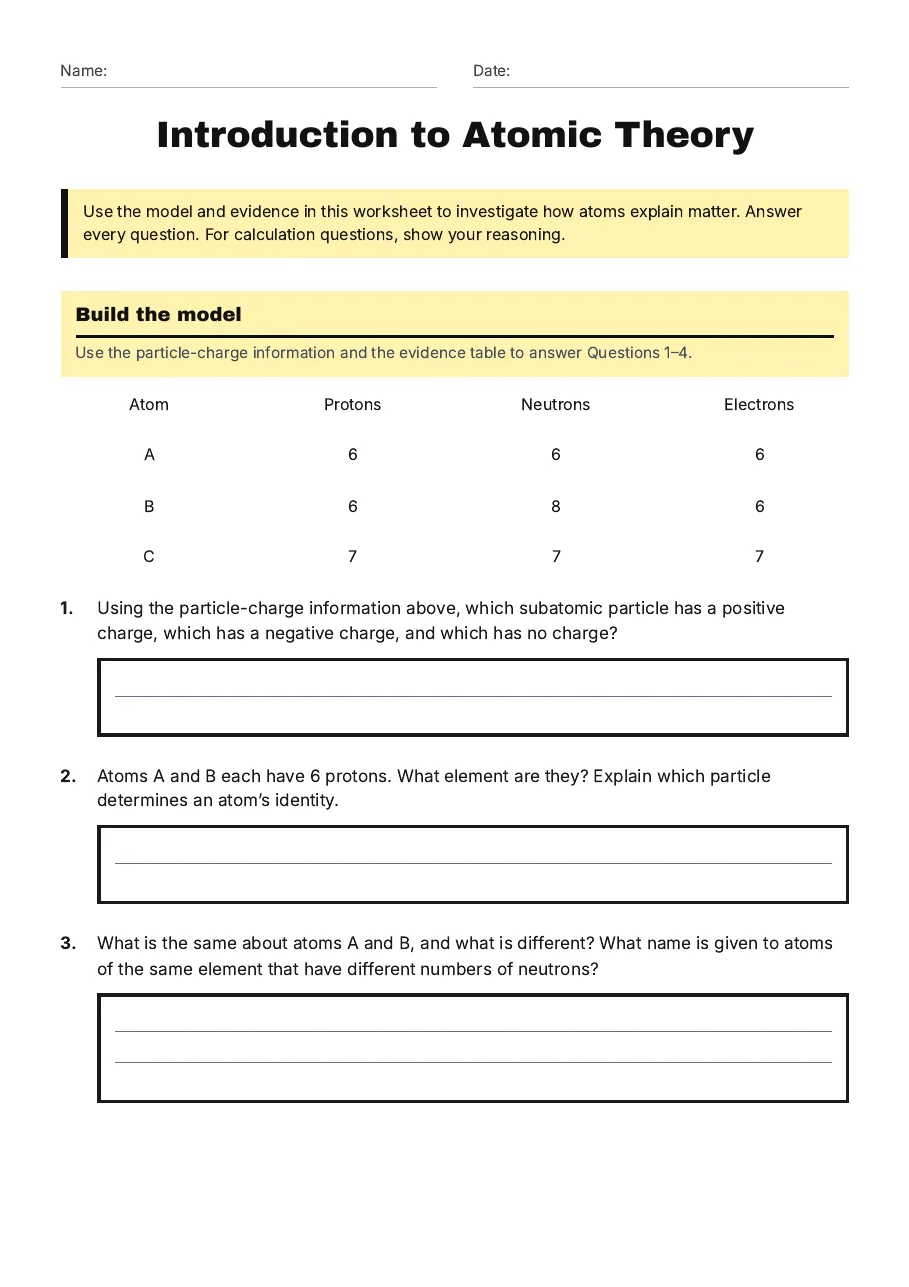
Name:Date:

Introduction to Atomic Theory

Use the model and evidence in this worksheet to investigate how atoms explain matter. Answer every question. For calculation questions, show your reasoning.

Build the model

Use the particle-charge information and the evidence table to answer Questions 1–4.

Atom

Protons

Neutrons

Electrons

A

6

6

6

B

6

8

6

C

7

7

7

1.Using the particle-charge information above, which subatomic particle has a positive charge, which has a negative charge, and which has no charge?
2.Atoms A and B each have 6 protons. What element are they? Explain which particle determines an atom’s identity.
3.What is the same about atoms A and B, and what is different? What name is given to atoms of the same element that have different numbers of neutrons?
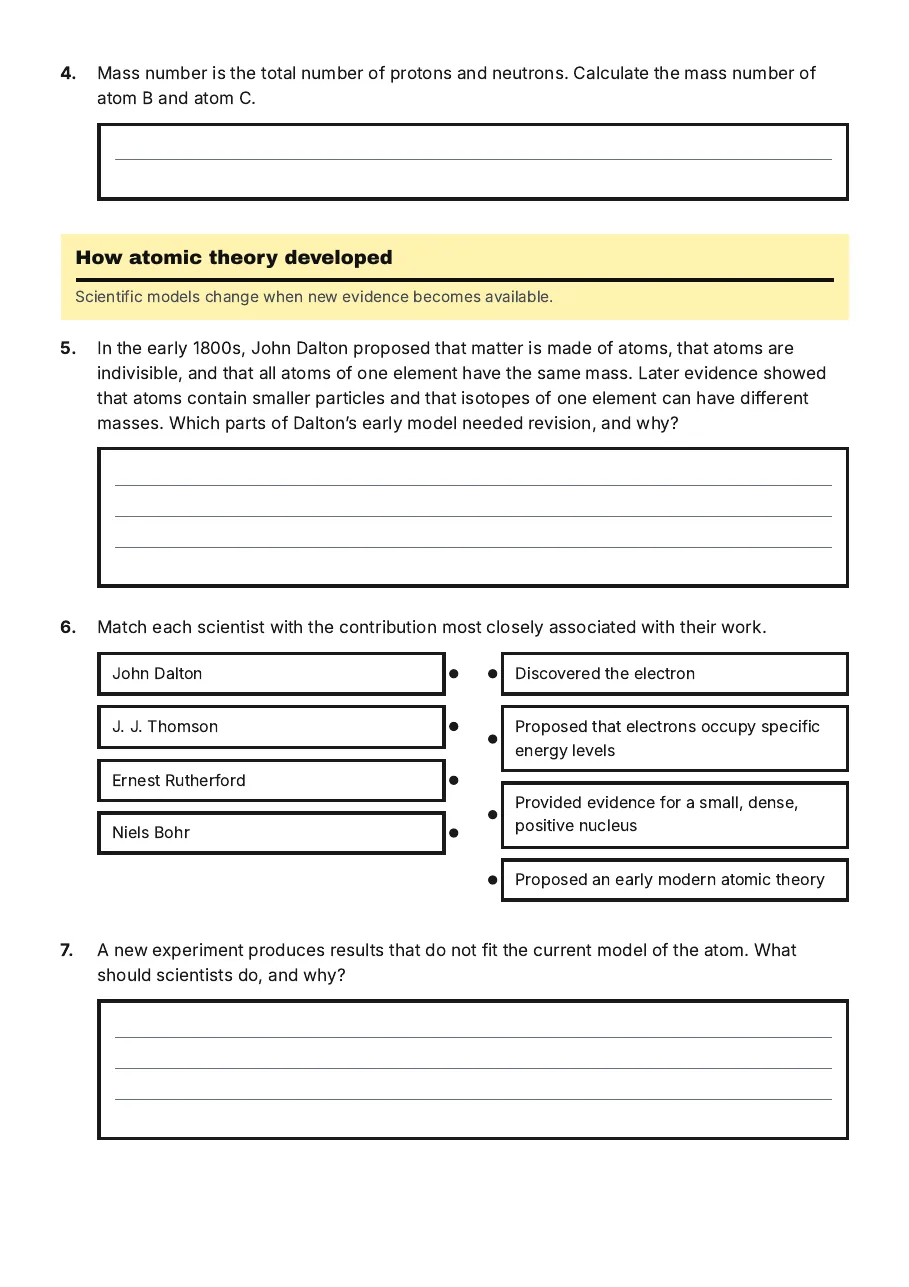
4.Mass number is the total number of protons and neutrons. Calculate the mass number of atom B and atom C.

How atomic theory developed

Scientific models change when new evidence becomes available.

5.In the early 1800s, John Dalton proposed that matter is made of atoms, that atoms are indivisible, and that all atoms of one element have the same mass. Later evidence showed that atoms contain smaller particles and that isotopes of one element can have different masses. Which parts of Dalton’s early model needed revision, and why?
6.Match each scientist with the contribution most closely associated with their work.
  • John Dalton
  • J. J. Thomson
  • Ernest Rutherford
  • Niels Bohr
  • Discovered the electron
  • Proposed that electrons occupy specific energy levels
  • Provided evidence for a small, dense, positive nucleus
  • Proposed an early modern atomic theory
7.A new experiment produces results that do not fit the current model of the atom. What should scientists do, and why?

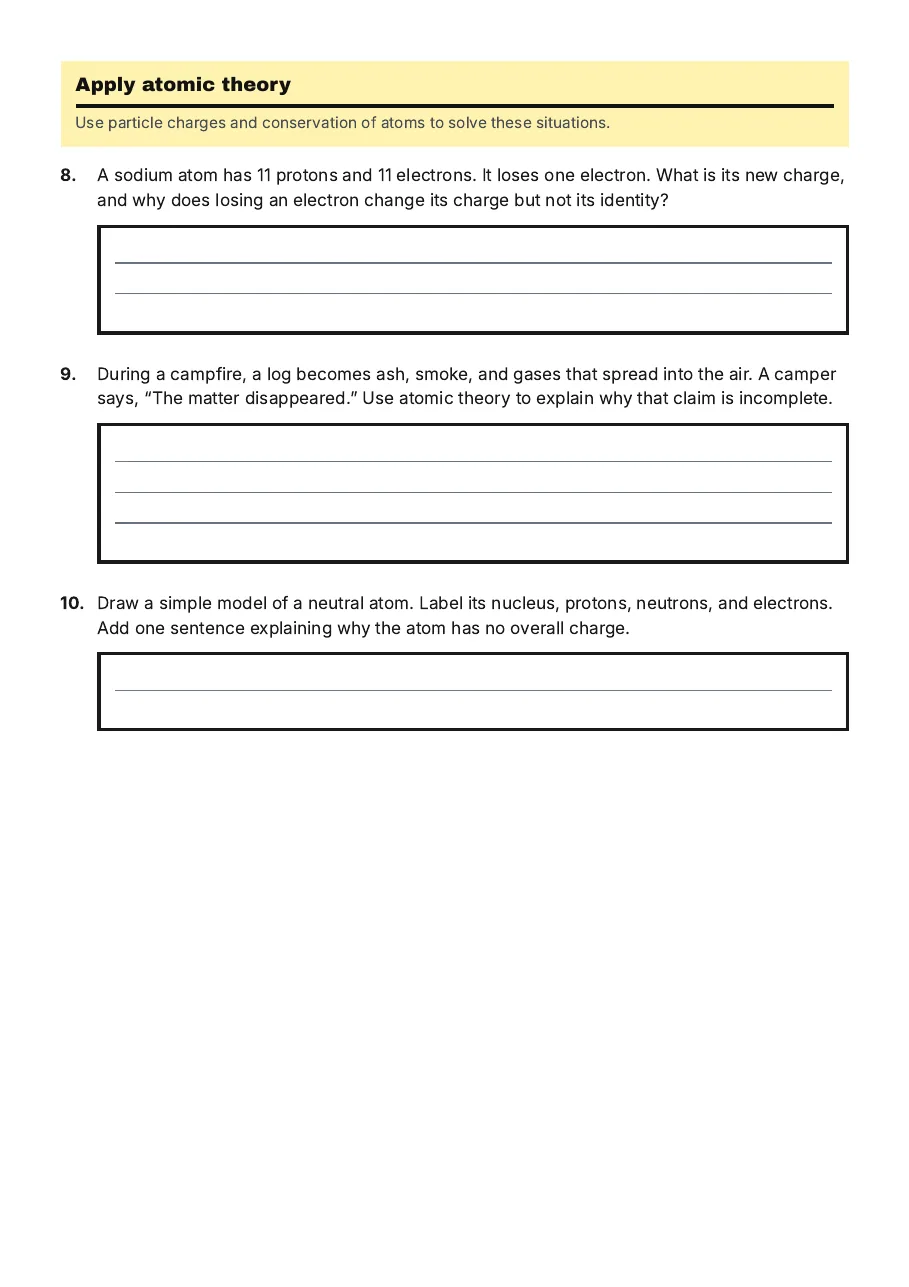
Apply atomic theory

Use particle charges and conservation of atoms to solve these situations.

8.A sodium atom has 11 protons and 11 electrons. It loses one electron. What is its new charge, and why does losing an electron change its charge but not its identity?
9.During a campfire, a log becomes ash, smoke, and gases that spread into the air. A camper says, “The matter disappeared.” Use atomic theory to explain why that claim is incomplete.
10.Draw a simple model of a neutral atom. Label its nucleus, protons, neutrons, and electrons. Add one sentence explaining why the atom has no overall charge.

3 printable pages

  • Introduction to Atomic Theory, page 1 of 3: Build the model

    Page 1

  • Introduction to Atomic Theory, page 2 of 3: How atomic theory developed

    Page 2

  • Introduction to Atomic Theory, page 3 of 3: Apply atomic theory

    Page 3

About This Worksheet

Free in Kuraplan

Sign up free, grab the PDF, and customize it for your class.

Print-Ready

Formatted for standard paper. Clean layout, easy to read.

AI-Generated

Created with Kuraplan's AI, designed for real classroom use.

For Teachers & Parents

Use in classrooms, for homework, tutoring, or homeschool.

Need a custom version of this worksheet?

Kuraplan's AI generates custom worksheets in seconds — differentiated for every learner, aligned to your curriculum.

Generate Custom Worksheets — Free
No credit card Curriculum-aligned Under 60 seconds