HealthFreePrintable

Emotions Categorisation Worksheet

A free health worksheet ready for your classroom. Open in Kuraplan to grab the print-ready PDF, customize it for your students, or generate a fresh version in seconds.
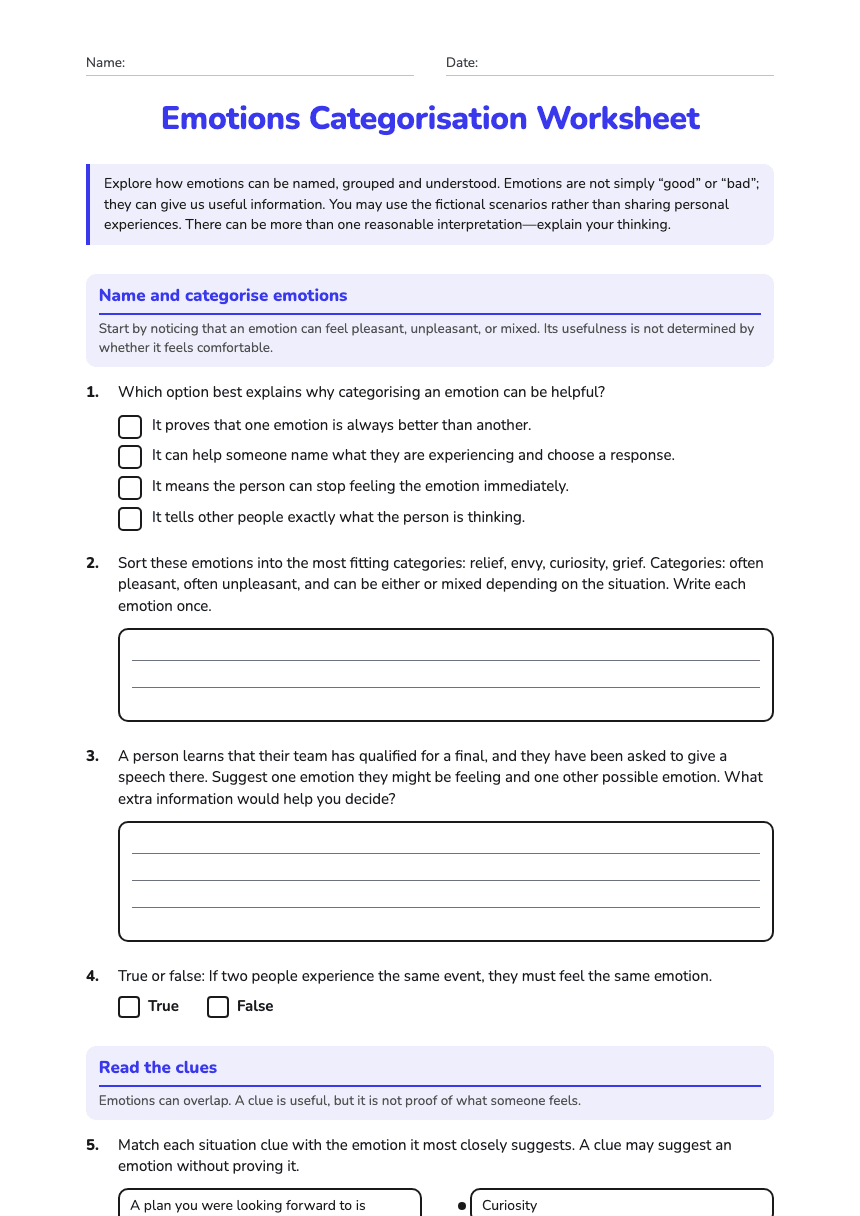
Emotions Categorisation Worksheet worksheet preview
Name:Date:

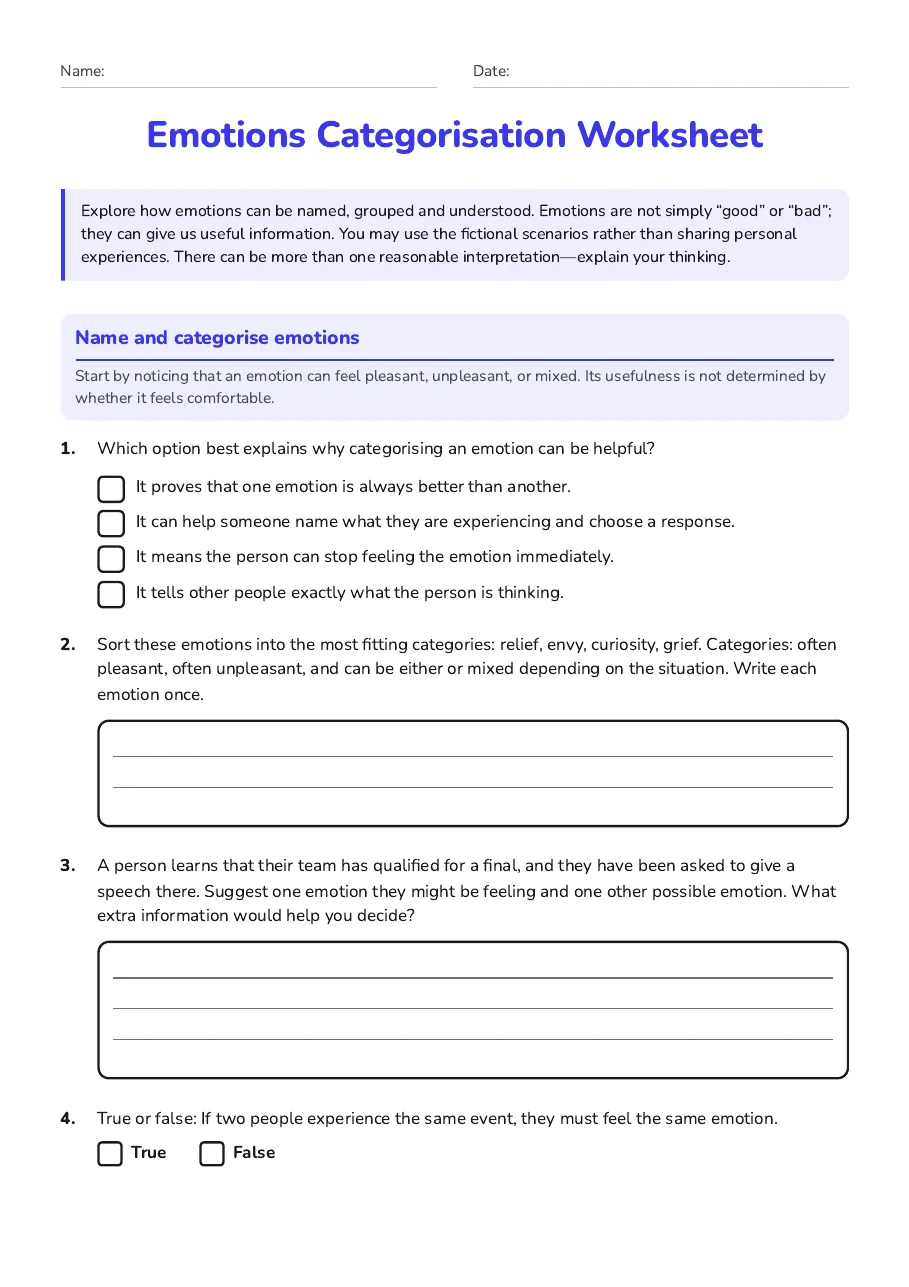
Emotions Categorisation Worksheet

Explore how emotions can be named, grouped and understood. Emotions are not simply “good” or “bad”; they can give us useful information. You may use the fictional scenarios rather than sharing personal experiences. There can be more than one reasonable interpretation—explain your thinking.

Name and categorise emotions

Start by noticing that an emotion can feel pleasant, unpleasant, or mixed. Its usefulness is not determined by whether it feels comfortable.

1.Which option best explains why categorising an emotion can be helpful?
  • It proves that one emotion is always better than another.
  • It can help someone name what they are experiencing and choose a response.
  • It means the person can stop feeling the emotion immediately.
  • It tells other people exactly what the person is thinking.
2.Sort these emotions into the most fitting categories: relief, envy, curiosity, grief. Categories: often pleasant, often unpleasant, and can be either or mixed depending on the situation. Write each emotion once.
3.A person learns that their team has qualified for a final, and they have been asked to give a speech there. Suggest one emotion they might be feeling and one other possible emotion. What extra information would help you decide?
4.True or false: If two people experience the same event, they must feel the same emotion.
TrueFalse

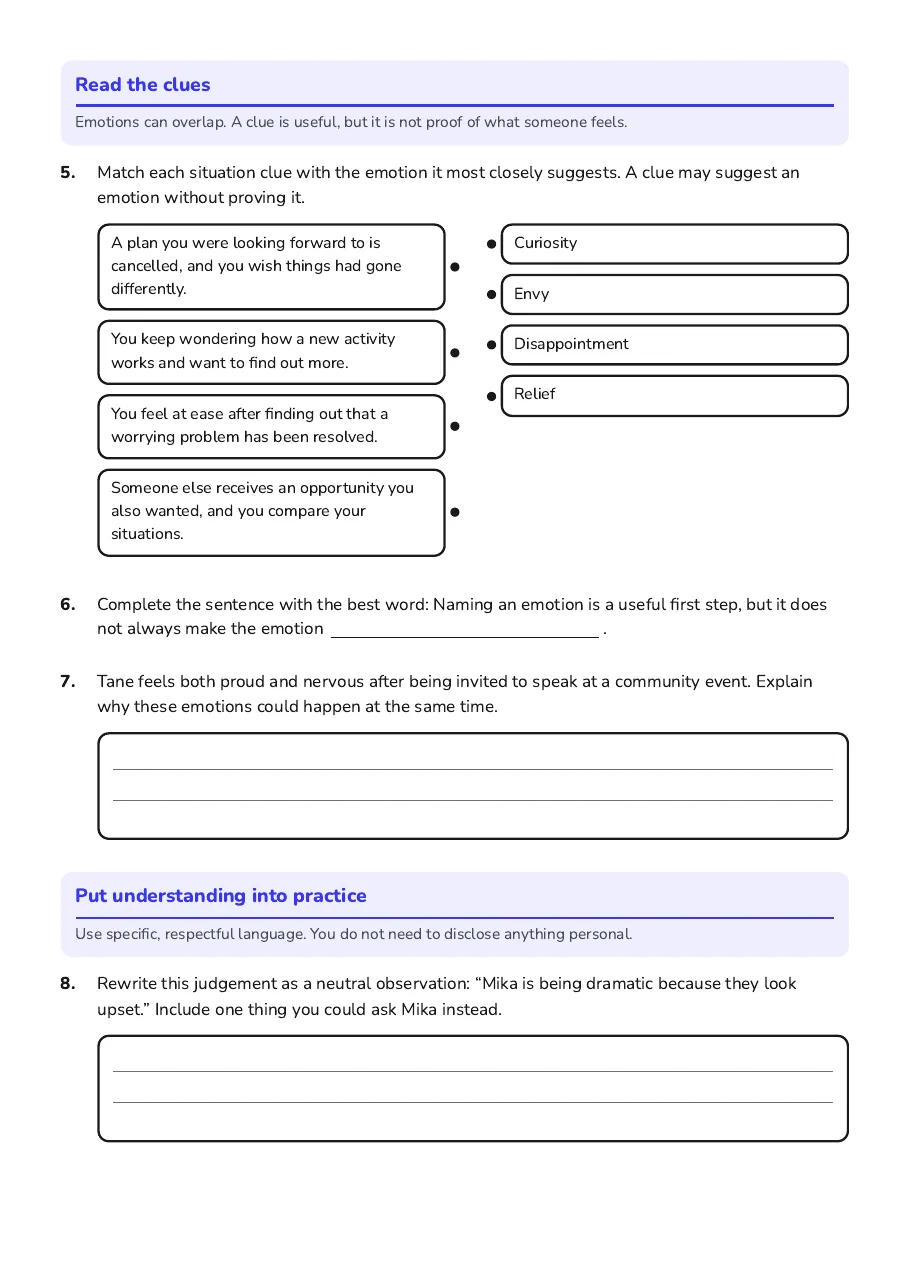
Read the clues

Emotions can overlap. A clue is useful, but it is not proof of what someone feels.

5.Match each situation clue with the emotion it most closely suggests. A clue may suggest an emotion without proving it.
  • A plan you were looking forward to is cancelled, and you wish things had gone differently.
  • You keep wondering how a new activity works and want to find out more.
  • You feel at ease after finding out that a worrying problem has been resolved.
  • Someone else receives an opportunity you also wanted, and you compare your situations.
  • Curiosity
  • Envy
  • Disappointment
  • Relief
6.Complete the sentence with the best word: Naming an emotion is a useful first step, but it does not always make the emotion .
7.Tane feels both proud and nervous after being invited to speak at a community event. Explain why these emotions could happen at the same time.

Put understanding into practice

Use specific, respectful language. You do not need to disclose anything personal.

8.Rewrite this judgement as a neutral observation: “Mika is being dramatic because they look upset.” Include one thing you could ask Mika instead.
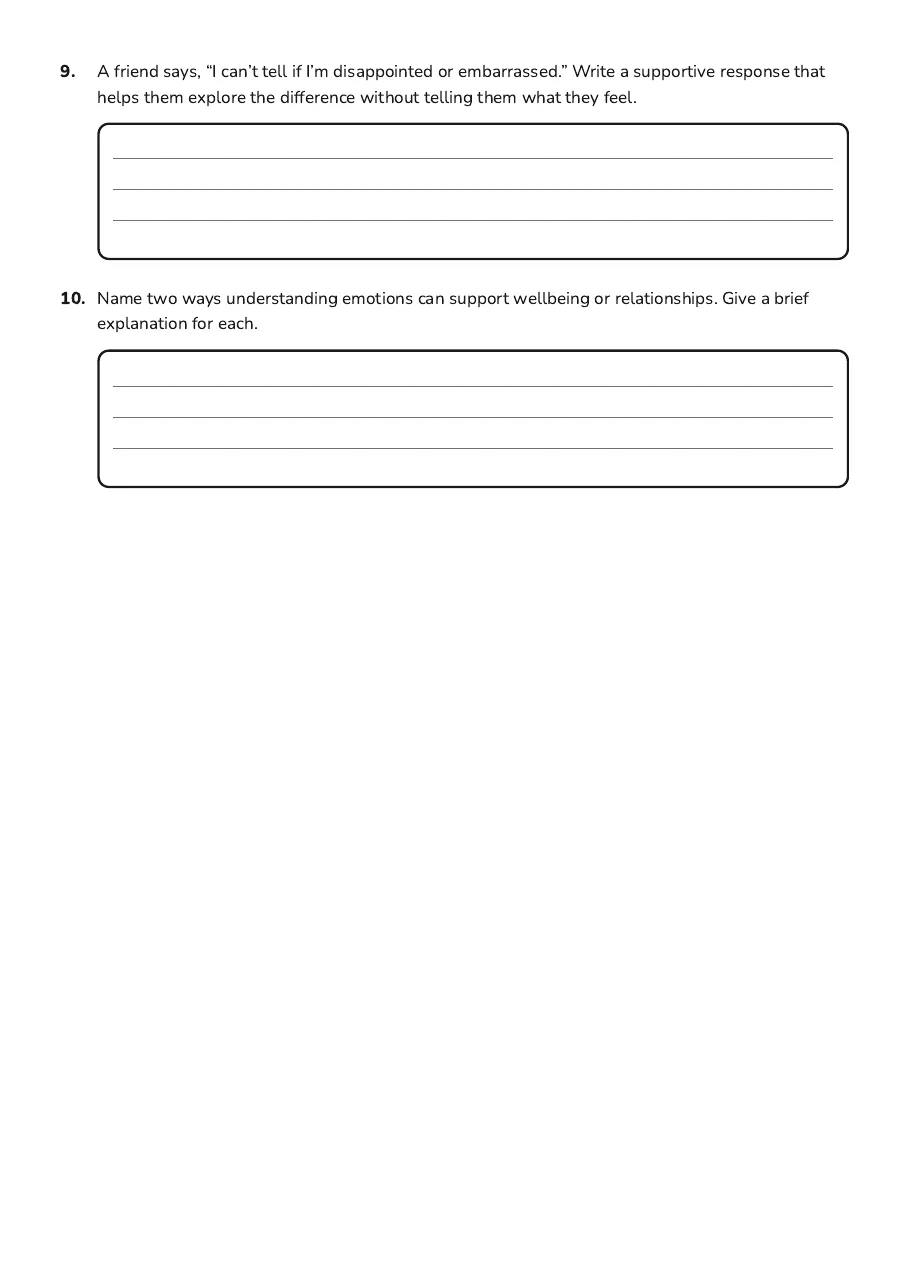
9.A friend says, “I can’t tell if I’m disappointed or embarrassed.” Write a supportive response that helps them explore the difference without telling them what they feel.
10.Name two ways understanding emotions can support wellbeing or relationships. Give a brief explanation for each.

3 printable pages

  • Emotions Categorisation Worksheet, page 1 of 3: Name and categorise emotions

    Page 1

  • Emotions Categorisation Worksheet, page 2 of 3: Read the clues, Put understanding into practice

    Page 2

  • Emotions Categorisation Worksheet, page 3 of 3: 9. A friend says, “I can’t tell if I’m disappointed or embarrassed.” Write a supportive…

    Page 3

About This Worksheet

Free in Kuraplan

Sign up free, grab the PDF, and customize it for your class.

Print-Ready

Formatted for standard paper. Clean layout, easy to read.

AI-Generated

Created with Kuraplan's AI, designed for real classroom use.

For Teachers & Parents

Use in classrooms, for homework, tutoring, or homeschool.

Need a custom version of this worksheet?

Kuraplan's AI generates custom worksheets in seconds — differentiated for every learner, aligned to your curriculum.

Generate Custom Worksheets — Free
No credit card Curriculum-aligned Under 60 seconds