Math · Grades 2–4
How to teach multiplication
Multiplication done well is two distinct jobs: building the concept (multiplication as equal groups, then arrays, then area) and building fluency (facts recalled without effort). Classrooms that skip the first job produce students who can chant tables but can't spot a multiplication situation; classrooms that skip the second leave students counting on fingers in grade 5, with no working memory left for the actual problem. Teach meaning first, then automatize deliberately.
Before you start: what students need first
- Fluent addition and comfort with skip counting (2s, 5s, 10s)
- Equal-grouping experience: sharing objects into groups of the same size
- Reading and writing two-digit numbers with place-value understanding
A teaching sequence that works
- 1
Ground it in equal groups
Start with real contexts: 4 bags of 6 apples. Students draw the groups, write the repeated addition, then meet 4 × 6 as the compact way to say it. "Groups of" language does heavy lifting here — keep it consistent.
- 2
Move to arrays
Arrange the groups into rows and columns. Arrays make the commutative property visible (rotate the array: 4 × 6 is 6 × 4) — which immediately halves the number of facts to learn.
- 3
Derive new facts from known ones
Teach the derived-fact strategies explicitly: doubles for ×2 and ×4, tens for ×5 and ×9, and the distributive split (7 × 6 = 5 × 6 + 2 × 6). This is the bridge between counting and recall, and it's what strong fact learners do naturally.
- 4
Build fluency in short, spaced bursts
Practise small fact families to automaticity with brief daily retrieval — a few minutes of low-stakes recall beats a weekly 100-question timed sheet, and doesn't manufacture math anxiety.
- 5
Extend to the area model and multi-digit work
Reframe arrays as area: a 13 × 6 rectangle splits into 10 × 6 and 3 × 6. The area model carries students through multi-digit multiplication and returns later for fractions and algebra — it's worth teaching properly.
Common misconceptions — and how to fix them
"Multiplication always makes numbers bigger"
True for whole numbers above 1, and students over-generalize it hard — it resurfaces as confusion with fractions and decimals. Seed the counter-idea early: 1 × n and 0 × n, and "half of" as multiplication in grade-appropriate language.
Memorizing tables equals understanding multiplication
A student who knows 6 × 7 = 42 but can't draw it or spot it in a word problem has a label, not a concept. Keep representation work (groups, arrays, contexts) running alongside fact practice, and ask "how do you know?" often.
4 × 6 and 6 × 4 are different problems to learn separately
Rotate an array once and the commutative property stops being a rule and becomes obvious. Exploit it explicitly — it halves the fact-learning load and reveals structure.
Differentiation notes
- Students stuck at skip counting need derived-fact strategies taught explicitly, not more speed drill — drill automatizes whatever strategy the student currently has, including finger counting.
- Confident students go deeper via the distributive property and mental two-digit multiplication, not just "bigger tables".
- Keep timed elements optional or private (beat your own time) — public speed pressure is the most reliable generator of math anxiety in this unit.
The multiplication teaching kit
Our best picks from the Kuraplan library — free to view, and each opens with the full resource.
Lesson plan · Grade 3
Multiplication Magic
An equal-groups introduction lesson — the concept-building first step of the sequence, ready to run.
Open free
Slideshow · Grade 3
Equal Groups Make Multiplication Fun
Whole-class visuals for the equal-groups-to-arrays move, with worked examples to think aloud through.
Open free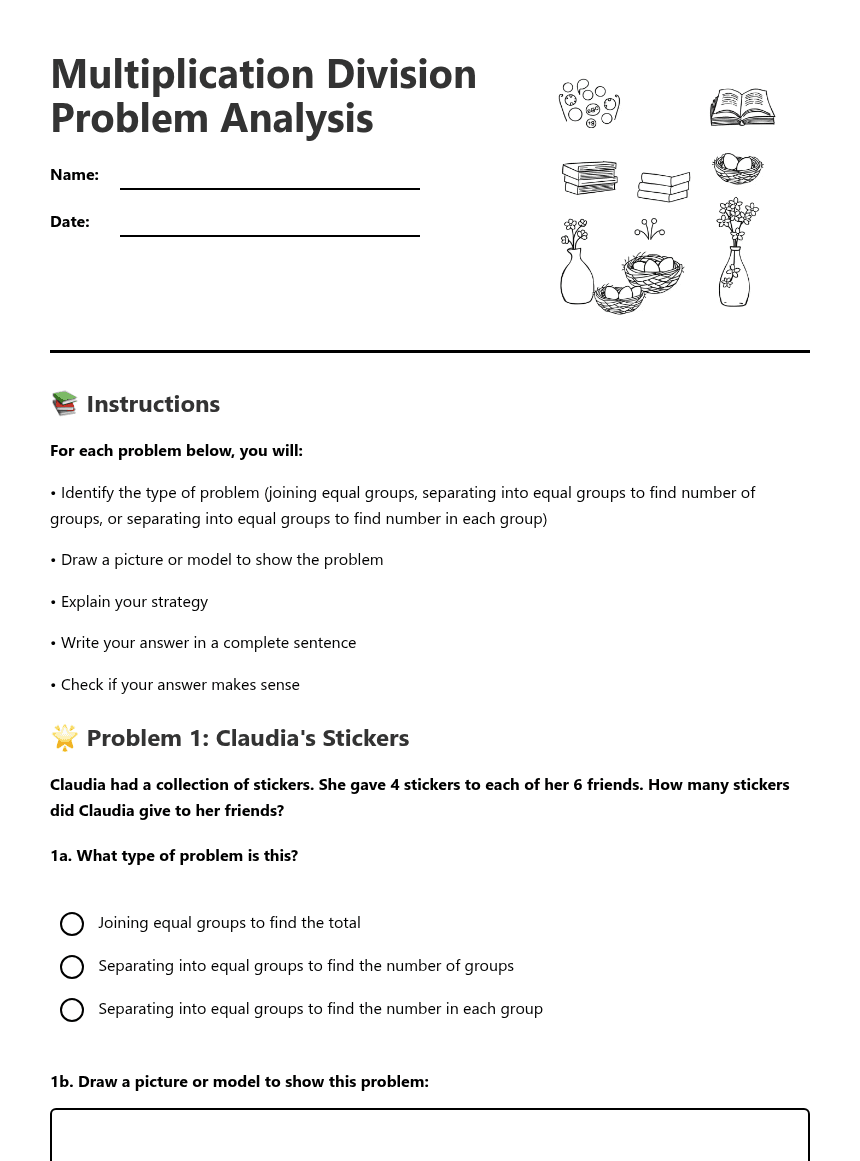
Worksheet · Grades 3–4
Multiplication & Division Problem Analysis
Word-problem analysis that forces students to identify the operation from structure — the transfer step drill sheets never test.
Open freeTeaching multiplication — common questions
What order should I teach multiplication facts in?
2s, 5s and 10s first (they ride on skip counting), then 4s as doubled 2s, 9s from 10s, squares, and finally the handful of stragglers like 6 × 7 and 7 × 8. Commutativity means the genuinely new facts run out fast.
Are timed multiplication tests a good idea?
Fluency matters, but public timed tests are a blunt tool with a real anxiety cost. Short, frequent, low-stakes retrieval practice — with students tracking their own progress — builds the same automaticity without the fallout.
When should students learn multi-digit multiplication?
After single-digit facts are reasonably automatic and the area model is understood — typically grade 4. Students who reach the standard algorithm without the area model tend to execute steps they can't explain or check.
Keep going
Create your own multiplication lesson in seconds
Kuraplan's AI builds curriculum-aligned lessons, worksheets and slides - free to try.