Math · Grades 1–3
How to teach telling time
An analog clock is one of the hardest displays we hand young children: two scales on one dial, a hidden count-by-fives, and a small hand that's almost never pointing exactly at a number. The classic mistake is teaching both hands at once. Teach the hour hand alone first — children can tell approximate time ("a little past 3") from it — then layer in the minute hand as a separate count-by-fives scale. Along the way you're also teaching duration, which is the part of time children actually use.
Before you start: what students need first
- Counting to 60 and skip counting by 5s confidently
- Number recognition 1–12 and basic fraction language (half, quarter) helps later
- Day-structure vocabulary: morning, afternoon, before, after
A teaching sequence that works
- 1
Start with the hour hand only
Use a one-handed clock (or remove the minute hand). Children read "3 o'clock", "a bit past 3", "almost 4". This builds the between-numbers reading the hour hand needs, without the second scale interfering.
- 2
Add the minute hand as a count-by-fives scale
Introduce the 60-minute track: every big number is worth 5 minutes. Count around by fives together, and mark minute values around a practice clock face before asking anyone to read one.
- 3
Read both hands as a routine
Teach a consistent two-step: hour hand first (which hour has it passed?), minute hand second (count the fives). Half past, quarter past, and quarter to slot in as landmarks on the minute track, tied to fractions of the circle.
- 4
Connect analog to digital and to language
Match clock faces to digital times and to spoken forms ("7:45", "quarter to eight"). The translations between the three representations are where understanding shows — and where errors hide.
- 5
Work on elapsed time with a number line
"Soccer starts at 3:30 and ends at 4:15 — how long?" Jump on an open time line: 3:30 → 4:00 → 4:15. Elapsed time is the payoff of the whole unit and the part that keeps mattering after everyone owns a phone.
Common misconceptions — and how to fix them
Reading the hour hand at the nearest number
At 3:55 children say "4 o'clock-ish is 4". Return to the one-handed clock and read hands mid-journey: the hour is the number the hand has passed, not the one it's near.
Reading the minute hand's number at face value
The hand points at 6, the child says "6 minutes". The minute track is a second, hidden scale — rebuild it by counting fives around the face and labelling the minute values outside the numbers.
Swapping the hands
Hands that differ only in length are easy to confuse. Use clocks with clearly contrasting hands, name them by job ("the slow hour hand, the fast minute hand"), and have children set times themselves — setting exposes the swap instantly.
Treating time as base-ten
Children compute 3:80 or think 1.5 hours is 1 hour 5 minutes. Make the 60-boundary explicit with number-line jumps to the next hour, and always convert aloud: "70 minutes — that's 1 hour 10."
Differentiation notes
- Give every child a mini clock with geared hands — setting times is more diagnostic and more engaging than reading them off worksheets.
- Strugglers stay on hour-hand-only and o'clock/half-past far longer than feels natural; the five-minute scale can wait.
- Extend quick finishers into elapsed-time problems and schedule reading rather than one-minute precision drills.
The telling time teaching kit
Our best picks from the Kuraplan library — free to view, and each opens with the full resource.
Lesson plan · Grade 2
Telling Time Adventure
A hands-on introduction to reading clock faces with the hour-then-minute routine at its core.
Open free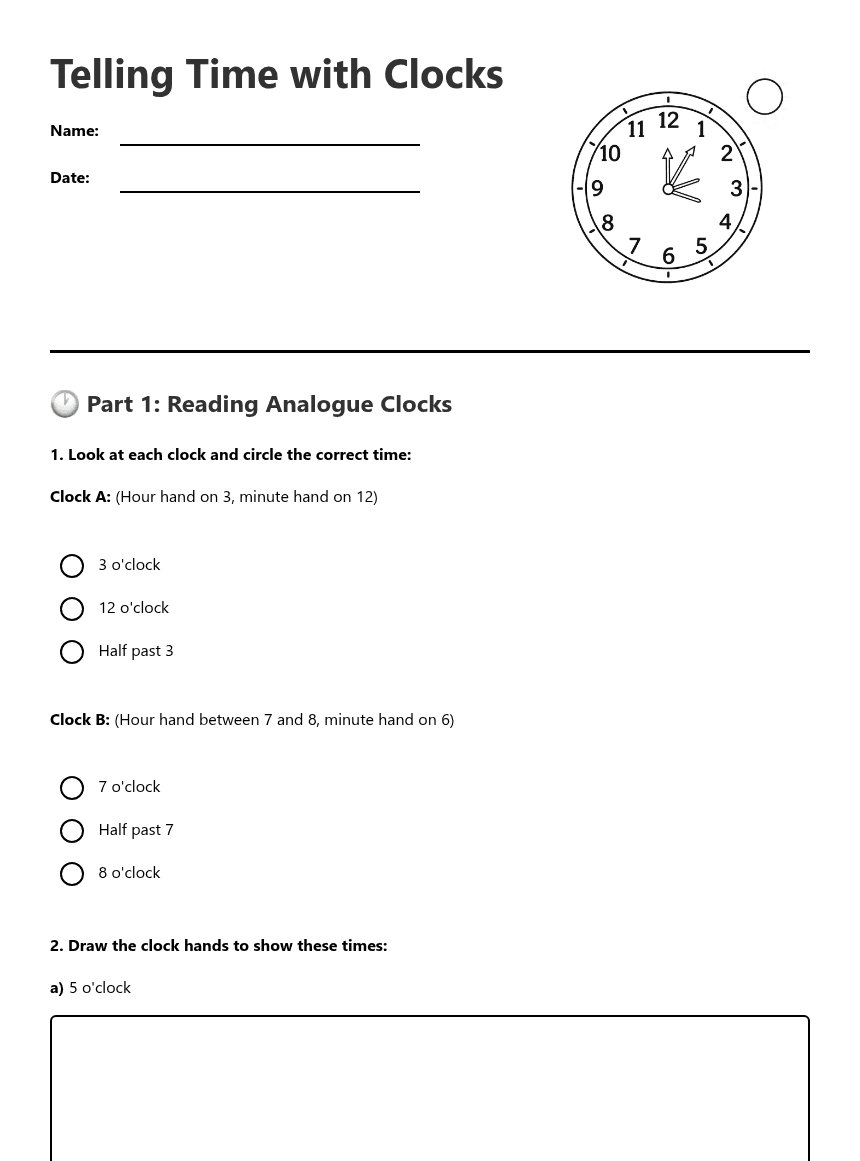
Worksheet · Early elementary
Telling Time with Clocks
Clock-face reading practice from o'clock upward — a clean match for the first half of the sequence.
Open freeNo telling-time slideshow met the bar yet — a whole-class deck for the count-by-fives minute track is the missing piece; the plan and worksheet above cover teach and practice.
Teaching telling time — common questions
What grade should students learn to tell time?
Typically: time to the hour and half hour in grade 1, five-minute intervals in grade 2, to the minute plus elapsed time in grade 3. The sequence matters more than the timetable — hour hand first, minute scale second.
Is teaching analog clocks still worth it?
Yes — beyond the clocks still on classroom walls and exams, the analog face is a genuinely useful model of cyclic time and of fractions of a whole, and elapsed-time reasoning is easier to see on a dial or time line than on digits.
Why do students confuse the hour and minute hands?
Because the hands differ only in length while doing completely different jobs, and children usually meet both at once. Start with the hour hand alone, use clocks with strongly contrasting hands, and have children set times — not just read them.
Keep going
Create your own telling time lesson in seconds
Kuraplan's AI builds curriculum-aligned lessons, worksheets and slides - free to try.