Math · K–5
How to teach place value
Place value is the load-bearing wall of arithmetic: every algorithm, every estimate, and later every decimal leans on it. The core idea students must construct — not memorize — is unitizing: ten ones can be treated as one ten, ten tens as one hundred, and position tells you which unit a digit counts. Students who miss this can still fill in place value charts; the gap only surfaces later as mysterious regrouping errors and decimal confusion.
Before you start: what students need first
- Counting to 100 with one-to-one correspondence and counting on from a number
- Making and using groups — especially making ten (8 + 2, 7 + 3)
- Comparing quantities with more/less language
A teaching sequence that works
- 1
Bundle real objects into tens
Count a pile of 34 straws, bundle every ten with a rubber band, and land on "3 tens and 4 ones". Physical bundling — where students make the ten themselves — is where unitizing starts; pre-grouped blocks come later.
- 2
Move to base-ten blocks and drawings
Trade bundles for rods and cubes, then quick-draw them (lines and dots). Have students represent the same number multiple ways: 34 as 3 tens 4 ones, but also 2 tens 14 ones — flexibility here is exactly what regrouping will demand.
- 3
Connect materials to notation
Link every representation to written digits and expanded form: 34 = 30 + 4. Ask "what does this 3 mean?" relentlessly. The digit-position-value triangle has to be explicit, not assumed.
- 4
Work the number line and benchmarks
Place numbers on 0–100 lines, round to nearby tens, and count forwards and backwards over the decade boundaries (…38, 39, 40, 41…). Crossing boundaries aloud exposes and fixes fragile place-value understanding fast.
- 5
Extend the pattern to large numbers and decimals
Generalize the times-ten relationship between adjacent places — then run it rightward for decimal places in grades 4–5. Students who learned places as a memorized chart, rather than a repeating ×10 structure, hit the decimal wall hard.
Common misconceptions — and how to fix them
"The 4 in 46 is just four"
Face-value thinking. Make it concrete: build 46 with blocks and ask the student to show what the 4 is — four rods, forty. Expanded form and "what does this digit mean?" questioning keep the value, not the face, in focus.
"More digits always means bigger" — and its decimal collapse
True for whole numbers, disastrous when transferred to decimals (0.35 read as bigger than 0.4). Pre-empt it by teaching places as a ×10 structure, and compare decimals on the number line, not by digit-counting.
Zero is "nothing", so it can be dropped
Students write 306 as 36 or read it as thirty-six. Build such numbers with blocks — 3 hundreds, an empty tens column, 6 ones — and make zero's job explicit: it holds the place so every other digit keeps its value.
Regrouping is crossing out digits by rule
If "borrowing" is pure ritual, place value never made it into the algorithm. Return to materials: physically trade one ten for ten ones while writing the notation alongside, until the notation is a record of the trade, not a trick.
Differentiation notes
- Strugglers usually lack unitizing, not effort — go back to physical bundling with counting materials they group themselves, before any pre-made blocks or charts.
- Use non-standard representations (46 as 3 tens 16 ones) as your stretch task — it separates chart-fillers from students who genuinely own the structure.
- Extend confident students into large numbers, decimal places, or other-base puzzles rather than more of the same chart work.
The place value teaching kit
Our best picks from the Kuraplan library — free to view, and each opens with the full resource.
Lesson plan · Grade 4
Understanding Place Value
A structured concept lesson linking materials, drawings, and notation — the representation triangle this guide is built on.
Open free
Slideshow · Grade 2
Adding & Subtracting with Place Value
Shows place value doing its real job — powering computation — rather than sitting in a chart as an end in itself.
Open free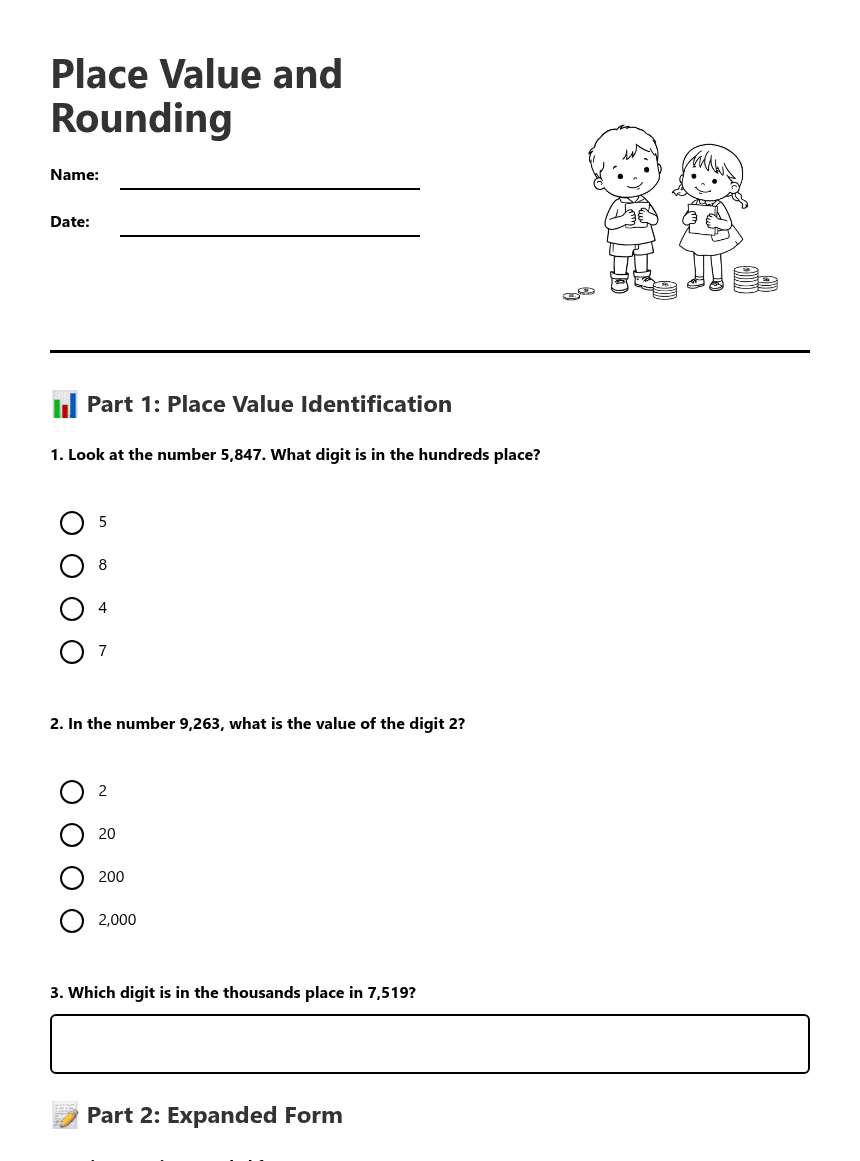
Worksheet · Grade 4
Place Value and Rounding
Pairs place-value identification with rounding — the application that reveals whether digit-value understanding is real.
Open freeTeaching place value — common questions
What is unitizing and why does it matter?
Unitizing is treating a group as a single countable thing — ten ones as one ten. It's the conceptual heart of place value: without it, multi-digit numbers are just digit strings, and regrouping in addition and subtraction never quite makes sense.
When should students use base-ten blocks vs. drawings vs. numbers?
In that order, but overlapping — that's the CRA progression. Keep materials available even after students go abstract; asking a student to prove an answer with blocks is your best diagnostic when errors appear.
Why do students who know place value still make regrouping errors?
Usually the algorithm was learned as a digit ritual, disconnected from the trades it records. Re-teach the algorithm alongside physical trading — one ten exchanged for ten ones while the notation is written step by step — until the digits mean the materials.
Keep going
Create your own place value lesson in seconds
Kuraplan's AI builds curriculum-aligned lessons, worksheets and slides - free to try.