Reading · Grades 2–6
How to teach reading comprehension
Reading comprehension isn't a transferable skill you drill like a jump shot — it's heavily dependent on what the reader already knows about the topic, the vocabulary in the text, and whether decoding is automatic enough to free up working memory. That's why the same student can "find the main idea" in a baseball passage and fail in a passage about coral reefs. Effective comprehension teaching spends most of its time building knowledge and vocabulary through rich texts, and teaches a small set of strategies explicitly — as tools for thinking, not as weekly units.
Before you start: what students need first
- Decoding fluent enough that word reading isn't consuming working memory — comprehension problems are often disguised decoding problems
- Oral language: students can follow and retell a text read aloud at the target level
- A text worth comprehending — knowledge-rich content, not leveled strips written around a skill
A teaching sequence that works
- 1
Front-load knowledge and vocabulary deliberately
Before reading, build what the text assumes: a short read-aloud, images, or a two-minute discussion of key concepts, plus explicit teaching of 3–5 high-value words. This is the single highest-leverage move in comprehension instruction.
- 2
Read closely with the thinking made audible
Model your own comprehension out loud — questioning, connecting, noticing confusion and repairing it. Students need to hear that skilled readers monitor and re-read; it isn't obvious.
- 3
Teach a small strategy set explicitly, then retire the scaffold
Summarizing, questioning, monitoring, and using text structure have solid evidence — taught briefly and applied to real texts. Weeks-long units on a single strategy hit diminishing returns fast; the strategy is a can-opener, not the meal.
- 4
Use text structure as a comprehension tool
Teach students to spot how a text is organized — compare/contrast, cause/effect, problem/solution, chronology — and to use signal words and structure to organize their recall. Structure knowledge transfers across topics in a way most strategies don't.
- 5
Talk about the text, then write about it
Structured discussion (with sentence frames and accountable follow-ups) deepens comprehension more than silent questions; writing a summary or response consolidates it. Both force the reader to build a coherent model of the text, which is the actual goal.
Common misconceptions — and how to fix them
"Comprehension is a set of skills you practise on any text"
Performance is knowledge-dependent: students comprehend well on familiar topics and poorly on unfamiliar ones regardless of "skill". Spend the bulk of instructional time on content-rich text sequences that build knowledge cumulatively.
"Struggling comprehenders need easier texts"
A diet of below-level text caps vocabulary and knowledge growth — the very things comprehension depends on. Keep grade-level, knowledge-rich texts in play with scaffolds (read-alouds, partner reading, pre-taught vocabulary) rather than swapping the text out.
"If they can read the words, they understand the text"
Fluent word-calling with no model of the text's meaning is common. Check comprehension with retells, summaries, and why-questions rather than pace and accuracy — and when comprehension fails, diagnose whether the gap is decoding, vocabulary, or knowledge.
"More strategy practice means more comprehension"
Strategy instruction shows most of its benefit quickly, then plateaus. If students can already summarize and self-monitor, the next gains come from harder, richer texts — not another cycle of the strategy carousel.
Differentiation notes
- Diagnose before differentiating: a listening-comprehension check separates decoding problems (understands when read to) from language/knowledge gaps (doesn't).
- Scaffold access to the same rich text — pre-taught vocabulary, partner reads, chunked sections — instead of assigning thinner texts to weaker readers.
- Push strong comprehenders into synthesis across multiple texts and defended interpretations, not more literal question sets.
The reading comprehension teaching kit
Our best picks from the Kuraplan library — free to view, and each opens with the full resource.
Lesson plan · Grade 4
Building Comprehension Skills
An explicit strategy lesson with modelling and guided practice — the teach-then-apply structure this guide argues for.
Open freeSlideshow · Grade 3
Grade 3 Reading Comprehension Scaffolding
Whole-class scaffolds for working through a shared text — useful for the think-aloud and structured discussion steps.
Open free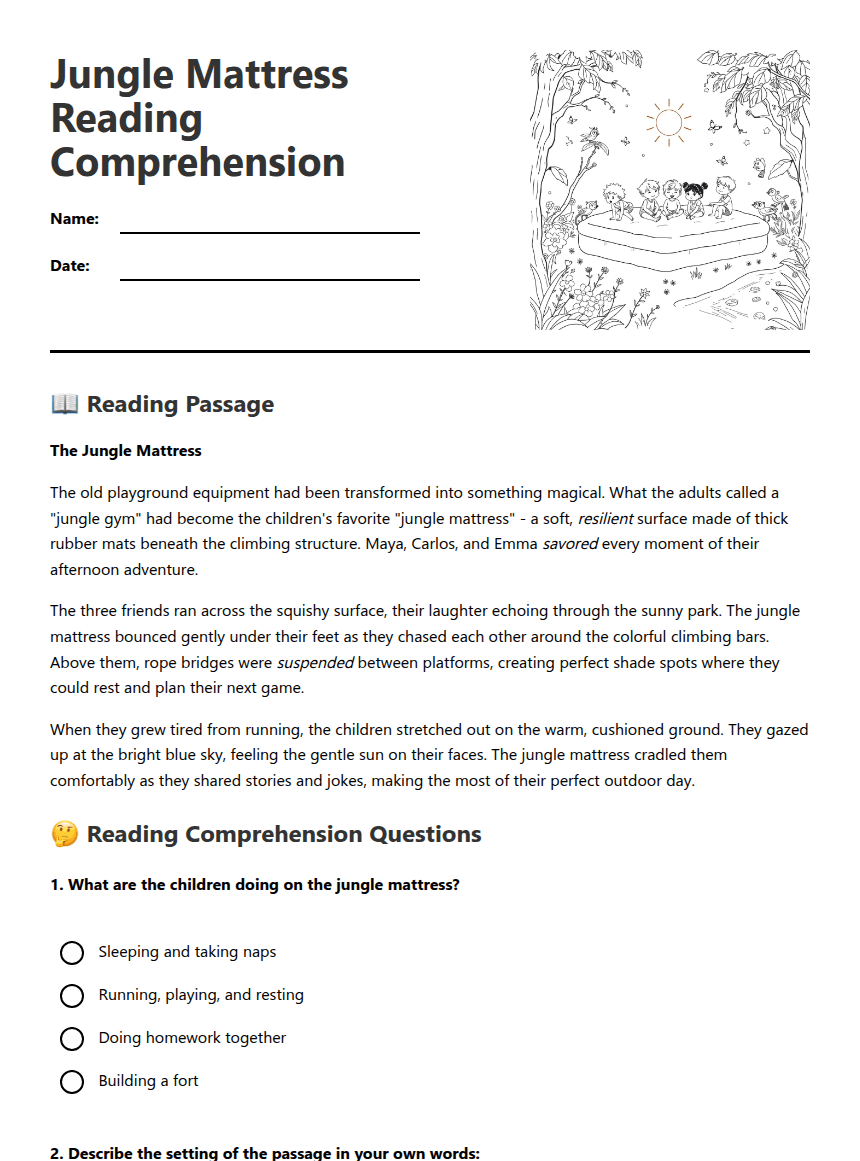
Worksheet · Elementary
Jungle Mattress Reading Comprehension
A full passage with layered questions — literal through inferential — rather than a strategy drill sheet.
Open freeTeaching reading comprehension — common questions
Why can my student decode fluently but not comprehend?
Usually a language gap, not a reading gap: missing vocabulary or background knowledge for that text, or weaker oral language overall. Check listening comprehension of the same passage — if that's also weak, the intervention is knowledge and language, not more reading practice.
Which comprehension strategies are actually worth teaching?
The short list with solid evidence: summarizing, self-questioning, monitoring and repairing understanding, and using text structure. Teach them explicitly but briefly, then spend the recovered time reading and discussing rich texts.
How do I build background knowledge if I have to cover reading skills?
Merge them: run your comprehension instruction through content-rich text sets (science, history, biography) sequenced so each text builds on the last. Students practise every "skill" you'd otherwise drill — while accumulating the knowledge that actually drives comprehension.
Keep going
Create your own reading comprehension lesson in seconds
Kuraplan's AI builds curriculum-aligned lessons, worksheets and slides - free to try.