Language arts · Grades 2–8
How to teach grammar
The awkward research finding about grammar is decades old: teaching it as an isolated labeling exercise has little to no effect on students' writing. What does work is grammar taught in the context of writing — sentence combining, imitation of strong model sentences, and revising real drafts with a specific structure in focus. The goal isn't students who can underline the adverb; it's students who can deploy one, and who can hear why a sentence is broken and fix it.
Before you start: what students need first
- Students are writing regularly — grammar instruction needs live writing to land in
- A shared minimal vocabulary (sentence, noun, verb) built as needed, not front-loaded for a term
- Model texts at hand: you'll borrow sentences from what the class is reading
A teaching sequence that works
- 1
Anchor everything at the sentence
The sentence is the unit where grammar becomes visible and fixable. Start lessons with one great sentence from a class text and ask what makes it work — before naming any part of speech.
- 2
Use sentence combining as your core routine
Give two or three kernel sentences (The dog barked. The dog was enormous.) and have students merge them every way they can. Sentence combining is the single best-evidenced grammar activity for improving actual writing — ten minutes, most days, beats a unit.
- 3
Teach structures through imitation
Take a model sentence with a target structure — an opening subordinate clause, say — and have students write their own sentence to the same frame about their own topic. Name the structure while they use it; the label rides on the experience.
- 4
Attack fragments and run-ons through sentence sense
Read aloud, ask "is that a complete thought?", and have students expand fragments and split or join run-ons. Boundary errors are ear problems before they're rule problems — train the ear.
- 5
Close the loop in revision
Every grammar focus ends in students' own drafts: "find two sentences to combine", "open one sentence with a clause". This transfer step is the entire point — without it, grammar knowledge stays in the worksheet.
Common misconceptions — and how to fix them
"Labeling parts of speech improves writing"
Identification and production are different skills, and the research is blunt about the first not causing the second. Keep terminology light and functional — enough shared language to discuss sentences students are actually building.
"A sentence starts with a capital and ends with a period"
That's punctuation, not sentence-hood — it leaves students defenceless against fragments that look right. Teach completeness: a sentence has a subject and predicate and stands alone. "Because the dog barked." wears a capital and period and still isn't one.
"Grammar errors mean careless students"
Most errors are developmental or dialect-transfer, and they spike when writers attempt more complex sentences — an ambitious run-on is often growth, not regression. Correct selectively, teach the pattern behind frequent errors, and never grade ambition down into safe, simple sentences.
"Never start a sentence with because" (and other zombie rules)
Prohibitions like this are classroom folklore that published writers ignore. Teach the actual risk (the fragment) and the actual structure (a fronted subordinate clause needs its main clause) rather than banning constructions students will need.
Differentiation notes
- Sentence combining self-differentiates: the same kernels can yield a compound sentence or an embedded relative clause — share the range in class discussion.
- For multilingual learners, contrast the target structure with the home language explicitly where you can; many "errors" are systematic transfer, not confusion.
- Strong writers get stylistic challenges — write it three ways and defend the best — rather than next year's terminology list.
The grammar teaching kit
Our best picks from the Kuraplan library — free to view, and each opens with the full resource.
Lesson plan · Grade 7
Grammar Essentials Workshop
A workshop-format grammar lesson — structured practice you can point at whichever sentence structure your class needs.
Open freeSlideshow · Grades 4–7
Grammar Essentials: Building Better Sentences
A deck framed exactly right — sentence building, not part-labeling — for the modelling half of a grammar mini-lesson.
Open free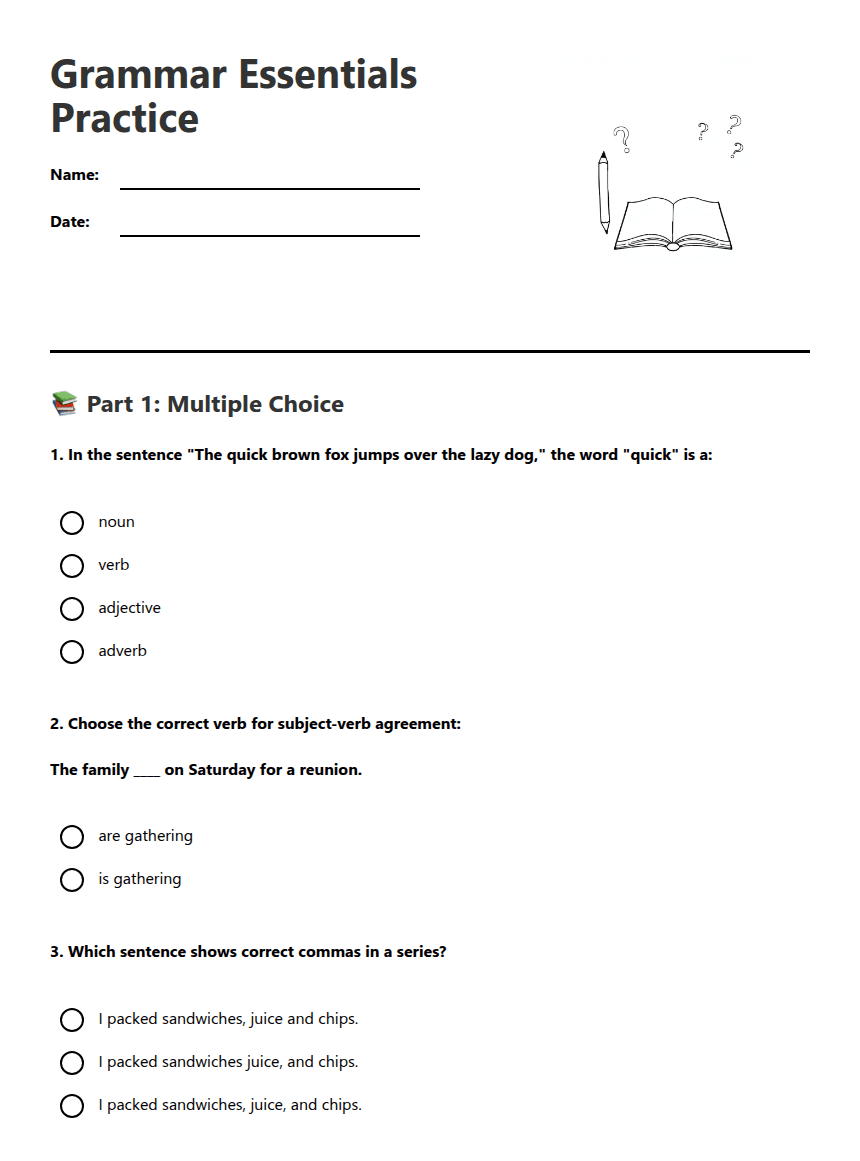
Worksheet · Grades 4–7
Grammar Essentials Practice
Mixed sentence-level practice for the guided stage — follow it into students' own drafts for the transfer step.
Open freeTeaching grammar — common questions
Does teaching grammar improve writing?
Isolated grammar drill — identifying and labeling in exercises — shows little effect on writing quality. Grammar taught inside writing does help: sentence combining in particular has strong evidence, and revision-focused mini-lessons transfer because they end in students' own drafts.
How much grammar terminology should students learn?
Enough to talk about sentences precisely — sentence, clause, subject, verb, and names for structures as students use them. Terminology should trail usage: name the fronted adverbial after the class has written a dozen, not before.
How do I fix run-on sentences and fragments?
Through sentence sense, not rule recitation: read the sentence aloud, ask whether it's a complete thought, then practise expanding fragments and splitting or joining run-ons. Daily oral sentence work and combining practice cures most boundary errors within a term.
Keep going
Create your own grammar lesson in seconds
Kuraplan's AI builds curriculum-aligned lessons, worksheets and slides - free to try.