Reading · K–2
How to teach phonics
Phonics is the one part of early reading where the research verdict is unambiguous: systematic, explicit instruction in letter-sound relationships beats incidental exposure, every time. That means you teach grapheme-phoneme correspondences in a planned order, model blending directly, and give children decodable practice that uses only what they've been taught — rather than hoping they absorb the code from books and word walls.
Before you start: what students need first
- Phonemic awareness: children can orally blend (/c/ /a/ /t/ → cat) and segment spoken words before, or alongside, mapping sounds to letters
- Concept of print: left-to-right tracking and the idea that letters represent sounds, not names
- You have a defined GPC (grapheme-phoneme correspondence) sequence to follow — most programs start with s, a, t, p, i, n because they build many words fast
A teaching sequence that works
- 1
Teach a small set of letter-sounds explicitly
Introduce 1–2 new correspondences per lesson: show the grapheme, say the pure sound (/m/, not "muh"), have children repeat, write it, and find it in words. Keep the pace brisk — a review-heavy 10-minute burst beats a slow half hour.
- 2
Model blending from day one
As soon as children know a handful of sounds, model pushing them together: point under each letter, say the sounds, then sweep and say the word. Blending is the point of phonics — don't wait until all letters are "done".
- 3
Segment for spelling in the same lesson
Reverse the process: say a word, have children tap or count the sounds, then write a grapheme for each. Encoding cements decoding — reading and spelling are the same knowledge used in two directions.
- 4
Practise with decodable words and texts
Give children words and short texts built only from taught correspondences, so they must decode rather than guess from pictures or context. Predictable texts that reward guessing actively undermine the habit you're building.
- 5
Teach irregular high-frequency words by their tricky part
For words like said or was, map the regular parts to sounds and explicitly flag the irregular grapheme — the "heart part" children learn by heart. Most of even these words is decodable.
- 6
Review cumulatively and assess by listening
Every lesson revisits previously taught sounds and words. Check progress by having individual children read fresh decodable words aloud — accuracy on untaught-word guessing tells you nothing.
Common misconceptions — and how to fix them
"Children learn letter names first, sounds later"
Sounds are what unlock reading; names come along easily afterwards. If a child reads m-a-t as "em-ay-tee", they've been taught names in place of sounds — rebuild with pure sounds and blending practice.
"Sound it out" works for every word
It fails on irregular words (was, the, said) and frustrates children when applied blindly. Teach irregulars explicitly by their tricky part, and keep "sound it out" for words within the taught code.
Adding "uh" to consonants doesn't matter
It does — "cuh-a-tuh" doesn't blend into cat. Model clipped, pure sounds and correct children's schwa additions immediately; it's the most common cause of blending failure.
Phonics is finished once children know the alphabet
The 26 letters map to 44 phonemes through 100+ spellings — digraphs, vowel teams, and alternative spellings carry on well into grade 2. Plan the whole journey, not just single letters.
Differentiation notes
- Strugglers need more cycles, not a different method: shrink the set of correspondences, double the review, and keep blending practice daily — avoid drifting to whole-word memorisation as a shortcut.
- Advanced decoders move into the extended code (vowel teams, alternative spellings) and multisyllabic word work rather than being parked on independent reading.
- For multilingual learners, contrast sounds that don't exist in the home language explicitly and give extra oral rehearsal before written work.
The phonics teaching kit
Our best picks from the Kuraplan library — free to view, and each opens with the full resource.
Lesson plan · Grade 1
Cracking the Phonics Code
A full explicit-instruction phonics lesson for grade 1 — model, guided blending, and independent practice in one sequence you can teach tomorrow.
Open free
Slideshow · Kindergarten
Phonics Detectives: Crack the Code
A whole-class deck that frames sound-spotting as detective work — ideal for the explicit-teach portion of a K phonics block.
Open free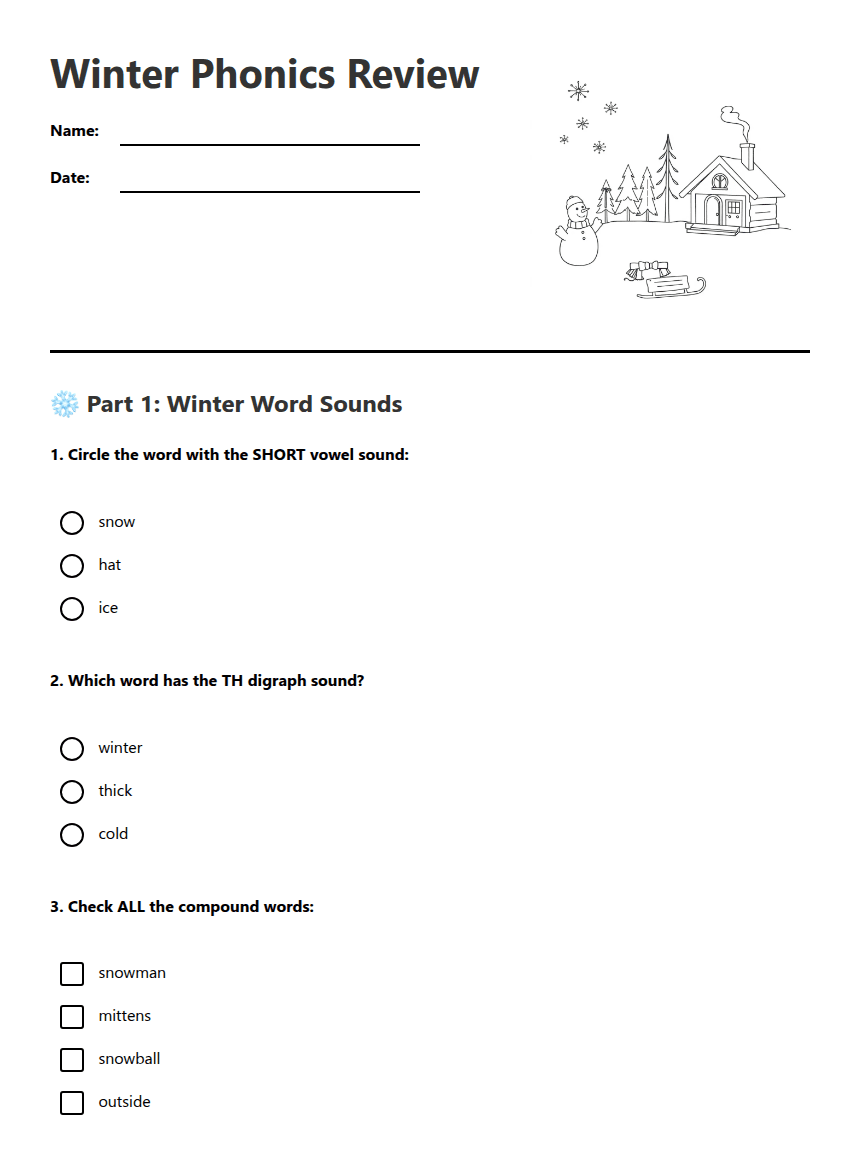
Worksheet · Grades 1–2
Winter Phonics Review
Cumulative review across taught patterns — exactly the mixed practice step most phonics lessons skip.
Open freeTeaching phonics — common questions
What order should I teach phonics sounds in?
Follow a planned sequence that builds words quickly — most systematic programs start with s, a, t, p, i, n, then add common consonants and short vowels, then digraphs (sh, ch, th), then long-vowel spellings. The exact order matters less than having one and reviewing cumulatively.
How long should a phonics lesson be?
Around 15–25 minutes daily beats a long weekly block. A tight lesson reviews known sounds, teaches one or two new correspondences, and gets children blending and segmenting with them the same day.
Should I still teach sight words if I teach phonics?
Yes, but as "heart words": map every regular sound-spelling in the word and explicitly teach only the irregular part. Most high-frequency words are largely decodable, so they reinforce the code rather than competing with it.
Keep going
Create your own phonics lesson in seconds
Kuraplan's AI builds curriculum-aligned lessons, worksheets and slides - free to try.