Language arts · Grades 1–6
How to teach spelling
The weekly ritual — Monday list, Friday test, forgotten by Tuesday — persists because it looks like teaching. But spelling is not visual memorization of word shapes; it's knowledge of how the language maps sounds to letters, which patterns appear where, and how meaning units (morphemes) hold their spelling across words. Roughly half of English words are fully predictable from sound-spelling rules, and most of the rest miss by a single letter or become regular once you factor in origin and morphology. Teach the system, and the system spells thousands of words.
Before you start: what students need first
- Phonemic segmentation: students can break a spoken word into sounds
- Letter-sound correspondences from phonics instruction (spelling is its encoding half)
- For morphology work: base word, prefix, suffix as working concepts
A teaching sequence that works
- 1
Spell from sounds, not shapes
The default routine for any unknown word: say it, segment it, choose a grapheme for each sound. This keeps spelling attached to the phonics code and makes errors diagnosable — you can see which sound-spelling failed.
- 2
Teach patterns and their positions
English spelling is positional: ck after short vowels at the end (duck), ai mid-word but ay at the end (rain/play), -tch after short vowels (catch). Teach one pattern at a time with sorting: students group words, find the rule, then hunt for it in reading.
- 3
Use word sorts to make students do the thinking
Give a scatter of words (coat, note, snow, bone, road…) and have students sort by spelling of the long o, then articulate when each spelling shows up. Discovered generalizations stick far better than dictated rules.
- 4
Bring in morphology from grade 2 up
Meaning beats sound in English spelling: sign keeps its g because of signal; jumped keeps -ed despite saying /t/. Teach the doubling rule, drop-e rule, and y-to-i with prefix/suffix building — one morphology insight spells hundreds of words.
- 5
Practise with retrieval and dictation, then hold the line in writing
Short daily retrieval (say-cover-write-check, sentence dictation) beats a weekly cram, and taught words become non-negotiable in everyday writing. A word spelled right on Friday and wrong in Monday's journal wasn't learned.
Common misconceptions — and how to fix them
"English spelling is hopelessly irregular, so memorize everything"
About half of words are fully sound-regular and most others are near-misses or regular via morphology and origin. Teach the layers — sound, pattern, meaning — and true outliers shrink to a small set worth explicit memorization.
"Good spellers have photographic memory"
Skilled spelling is linguistic knowledge, not imagery — which is why rainbow-writing and word-shape boxes underdeliver. Practice should involve sound analysis and pattern choice, not decorating letters.
"The Friday test proves the words are learned"
It proves short-term cramming. The real test is unprompted use in writing weeks later. Spot-check old words in dictation, recycle patterns across weeks, and audit journals for taught-pattern errors.
"Invented spelling teaches bad habits"
In K–1, phonetically plausible attempts (KAT for cat) are evidence the sound-mapping system is working, and encouraging them accelerates both spelling and reading — as long as instruction keeps upgrading the attempts toward conventional patterns.
Differentiation notes
- Differentiate by pattern, not list length: a struggler consolidating short-vowel words shouldn't be decorating this week's -tion list with everyone else.
- Use a spelling inventory (error analysis) to place students by developmental stage — errors tell you exactly which layer of the system to teach next.
- Strong spellers go into etymology and morphology puzzles — why does two have a w? (twin, twice) — rather than longer lists of the same pattern.
The spelling teaching kit
Our best picks from the Kuraplan library — free to view, and each opens with the full resource.
Lesson plan · Grade 3
Spelling in Motion
An active spelling lesson that gets pattern practice out of the copy-three-times rut.
Open freeSlideshow · Grade 4
Special Spelling Patterns Adventure
A whole-class deck for pattern instruction — the teach-and-sort portion of the sequence.
Open free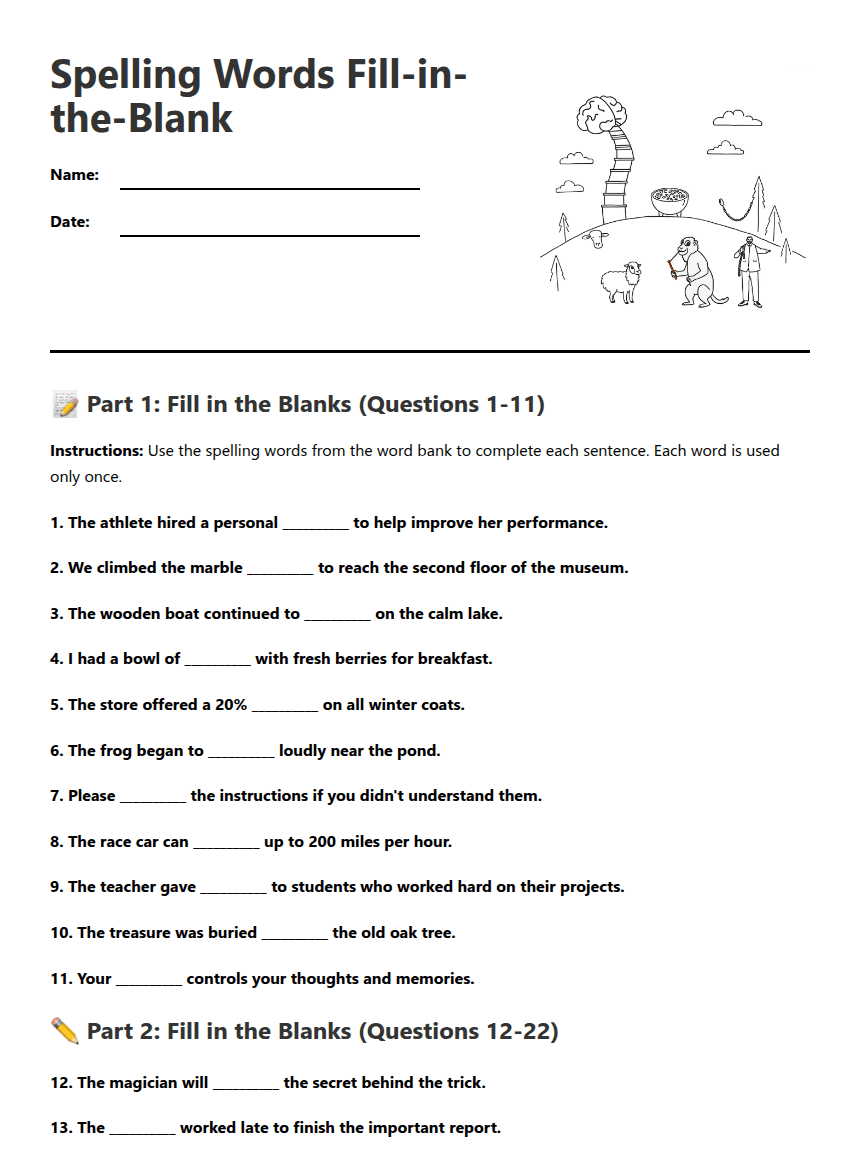
Worksheet · Grades 2–3
Spelling Words Fill-in-the-Blank
Context-based practice — spelling the word inside a sentence, which is closer to the real task than list-copying.
Open freeTeaching spelling — common questions
Are weekly spelling tests worth keeping?
A test isn't harmful — cramming for it is the problem. Keep a weekly check if you like, but organize lists by pattern rather than theme, add delayed review of earlier patterns, and treat carry-over into everyday writing as the real assessment.
How should I handle invented spelling?
In K–1, celebrate phonetically plausible attempts — they show the sound-mapping system working — while steadily teaching the conventional patterns. From grade 2, expect taught patterns and high-frequency words to be spelled correctly, and let invention cover only genuinely unknown territory.
Why do students spell words right on the test but wrong in writing?
Because list-cramming stores words short-term while writing pulls from long-term, automatic knowledge. The fix is pattern-based teaching, spaced retrieval over weeks, and a firm norm that taught words count in every subject's writing — not just spelling time.
Keep going
Create your own spelling lesson in seconds
Kuraplan's AI builds curriculum-aligned lessons, worksheets and slides - free to try.