Food Web Interaction Cards
A free science worksheet ready for your classroom. Open in Kuraplan to grab the print-ready PDF, customize it for your students, or generate a fresh version in seconds.
Food Web Interaction Cards
Organism and Energy Cards
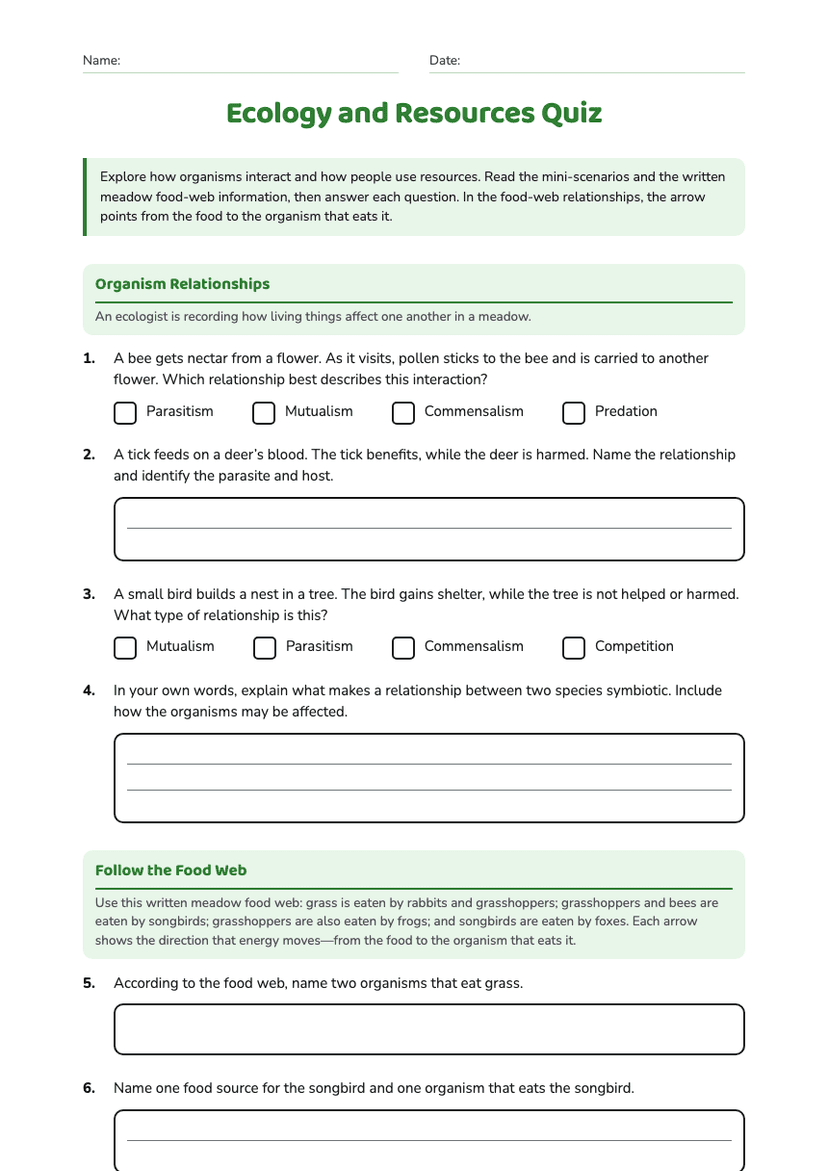
Cut apart the cards. Use them to classify producers, consumers, and decomposers. When building a food web, arrows show energy moving from the food source to the organism that eats it.
✂ CARD 1: SUN
Role: Energy source
Provides light energy for plants and algae.
✂ CARD 2: ALGAE
Role: Producer
Uses sunlight to make food. May be eaten by small animals.
✂ CARD 3: CATTAIL
Role: Producer and habitat provider
Makes food from sunlight and provides shelter near wetland water.
✂ CARD 4: GRASS
Role: Producer
Uses sunlight to make food. Seeds and leaves can feed consumers.
✂ CARD 5: INSECT
Role: Consumer and pollinator
May eat plants or nectar. Can be food for frogs, fish, ducks, and birds.
✂ CARD 6: FROG
Role: Consumer and predator
Eats many insects. May be eaten by snakes, fish, ducks, or herons.
✂ CARD 7: FISH
Role: Consumer
May eat algae, insects, or smaller water animals. Can be eaten by herons.
✂ CARD 8: DUCK
Role: Consumer
May eat algae, insects, seeds, and small water animals.
✂ CARD 9: MOUSE
Role: Consumer
Eats seeds and plant parts. May be eaten by snakes and herons.
✂ CARD 10: SNAKE
Role: Consumer and predator
May eat frogs, mice, or fish. Can be prey for a heron.
✂ CARD 11: HERON
Role: Consumer and predator
May eat fish, frogs, snakes, mice, and insects.
✂ CARD 12: DECOMPOSER / FUNGI
Role: Decomposer
Breaks down dead plants and animals and returns nutrients to the soil.
Relationship and Ecosystem-Change Cards
Place a relationship card between two organism cards. Then use an ecosystem-change card to predict what may happen to the food web.
✂ CARD 13: EATS
Connect a food source to the organism that eats it. Example: algae → fish.
✂ CARD 14: IS EATEN BY
Show the reverse wording of a food relationship. Example: insect → is eaten by → frog.
✂ CARD 15: COMPETES WITH
Two organisms compete when they need the same limited food, water, space, or shelter.
✂ CARD 16: PROVIDES SHELTER FOR
One organism or plant offers a safe place to hide, nest, rest, or find food.
✂ CARD 17: POLLINATES
An insect moves pollen between flowers, helping plants make seeds.
✂ CARD 18: DECOMPOSES
Fungi and other decomposers break down dead material and recycle nutrients.
✂ CARD 19: DROUGHT
There is very little rain for a long time. Predict effects on water, plants, insects, and animals.
✂ CARD 20: POLLUTION
Harmful substances enter the water or soil. Which organisms might be affected first?
✂ CARD 21: INVASIVE SPECIES
A non-native species spreads and changes available food, space, or shelter.
✂ CARD 22: HABITAT RESTORATION
People improve a habitat by planting native species, protecting water, or reducing disturbance.
✂ CARD 23: LOSS OF INSECTS
Fewer insects means less food for frogs, fish, ducks, and insect-eating birds.
✂ CARD 24: INCREASED RAINFALL
More rain may change water levels, soil conditions, plant growth, and shelter.
Teacher Guide: Lesson 2 of 10
Learning Intentions
Students classify organisms by observable traits and ecological roles, model energy flow, explain interdependence, and suggest a responsible action that supports local biodiversity.
Success Criteria
I can classify an organism as a producer, consumer, or decomposer and explain my evidence.
I can build a food web with arrows showing energy moving from a food source to the organism that eats it.
I can explain what may happen if one organism is removed or affected.
I can recommend one stewardship action and support it with an observation or reason.
Setup and Rules
Print on sturdy paper if possible and cut apart the 24 cards. Place students in groups of three or four. Provide string or yarn, pencils, and a local habitat photograph. Students may use a schoolyard, farm or pasture edge, wetland, or forest as their setting.
Rules: Handle cards respectfully. Discuss evidence before making a connection. Use arrows from food to eater. More than one relationship may be possible. Do not collect living organisms; use photographs, remembered observations, or classroom specimens.
Suggested Group Activity
1. Sort the organism cards into producers, consumers, decomposers, and energy source.
2. Build a food web with at least five organisms, including a producer and decomposer.
3. Add relationship cards and explain two connections.
4. Draw an ecosystem-change card. Identify which organisms may be affected first, what could happen next, and one practical stewardship action.
Discussion Prompts
What evidence supports your classification? Could this organism have more than one relationship? Where does the energy in this web begin? What might happen if one organism disappeared? What evidence would we need to test our prediction? How can people protect local biodiversity?
Plausible Food-Web Links and Examples
Sun → algae; sun → cattail; sun → grass; algae → fish; algae → duck; grass → insect; grass → mouse; cattail → insect; insect → frog; insect → fish; frog → snake; frog → heron; fish → heron; mouse → snake; snake → heron; dead plants and animals → fungi.
Accept other scientifically sensible links when students explain their reasoning. Remind students that arrows show energy flow, not simply “who points at whom.”
Differentiation Supports
EAL learners: Provide labeled pictures, gestures, a word bank, oral rehearsal, partner discussion, and sentence frames: “The ___ is a ___ because ___.” and “If ___ changed, ___ might ___.” Allow home-language discussion before sharing in English.
Younger or developing learners: Use fewer cards at first. Build one organism, one connection, and one explanation at a time. Accept drawing, speaking, dictating, or writing. Offer sensory alternatives and accessible observation locations.
Extension Challenge
Advanced learners model the removal of one species, compare two possible invasive-species effects, or compare biodiversity in two habitats by counting the number and variety of organisms. Require evidence and a chain of at least three predicted effects.
Respectful Local and Indigenous Connections
Use local First Nations and Métis knowledge only with respectful community guidance and permission. Invite land-based learning, local observations, and community expertise without treating one person or source as representing all communities.
About This Worksheet
Free in Kuraplan
Sign up free, grab the PDF, and customize it for your class.
Print-Ready
Formatted for standard paper. Clean layout, easy to read.
AI-Generated
Created with Kuraplan's AI, designed for real classroom use.
For Teachers & Parents
Use in classrooms, for homework, tutoring, or homeschool.
Need a custom version of this worksheet?
Kuraplan's AI generates custom worksheets in seconds — differentiated for every learner, aligned to your curriculum.
Generate Custom Worksheets — Free